
Executive summary
A position estimate can remain unchanged while contributing differently to a subsequent decision. Its assigned uncertainty determines that contribution. A study of image-based aerial localization examines this distinction: learned image features support position estimates, while additional calibration changes their weights. Quality assessment should therefore separate the estimate, its uncertainty and the consequences of weighting. The reported benefits concern a controlled update experiment and do not establish improved navigation in actual operation.
FQI takeaway
- Report position error separately from the consequences of uncertainty weighting.
- Include missing position outputs in the overall assessment.
- Do not describe calibration tested at represented locations as transfer to new locations.
The principle at a glance
A system often combines a previous estimate with a new observation. The uncertainty attached to the observation determines how much it contributes. An overconfident incorrect observation can worsen the combination even though its own position has not changed.
The source combines learned image matching with a digital surface model. It compares uncertainty models while keeping positions identical. This separates the effects of weighting from improvement of the localization method itself. That controlled comparison is the methodological contribution relevant to FQI.
Deep dive
Calibration uses 300 development queries at 24 locations. The main comparison uses another 728 eligible queries and a separate set of 142. All included locations are represented in calibration. Queries without required metric scale are excluded before localization and explicitly distinguished from later localization failures.
The method anchors assessment to a base solution and incorporates further uncertainty information. Position predictions, success states and random conditions remain identical across comparisons. Better uncertainty performance therefore cannot simply be attributed to different predicted positions.
Against a constant full-matrix baseline, the paper reports reductions of 7.70% and 5.46% in the prespecified update risk, with locations weighted equally. Failures contribute to this risk assessment. However, the update uses an artificial independent prior estimate. That condition belongs directly beside the reported figures.
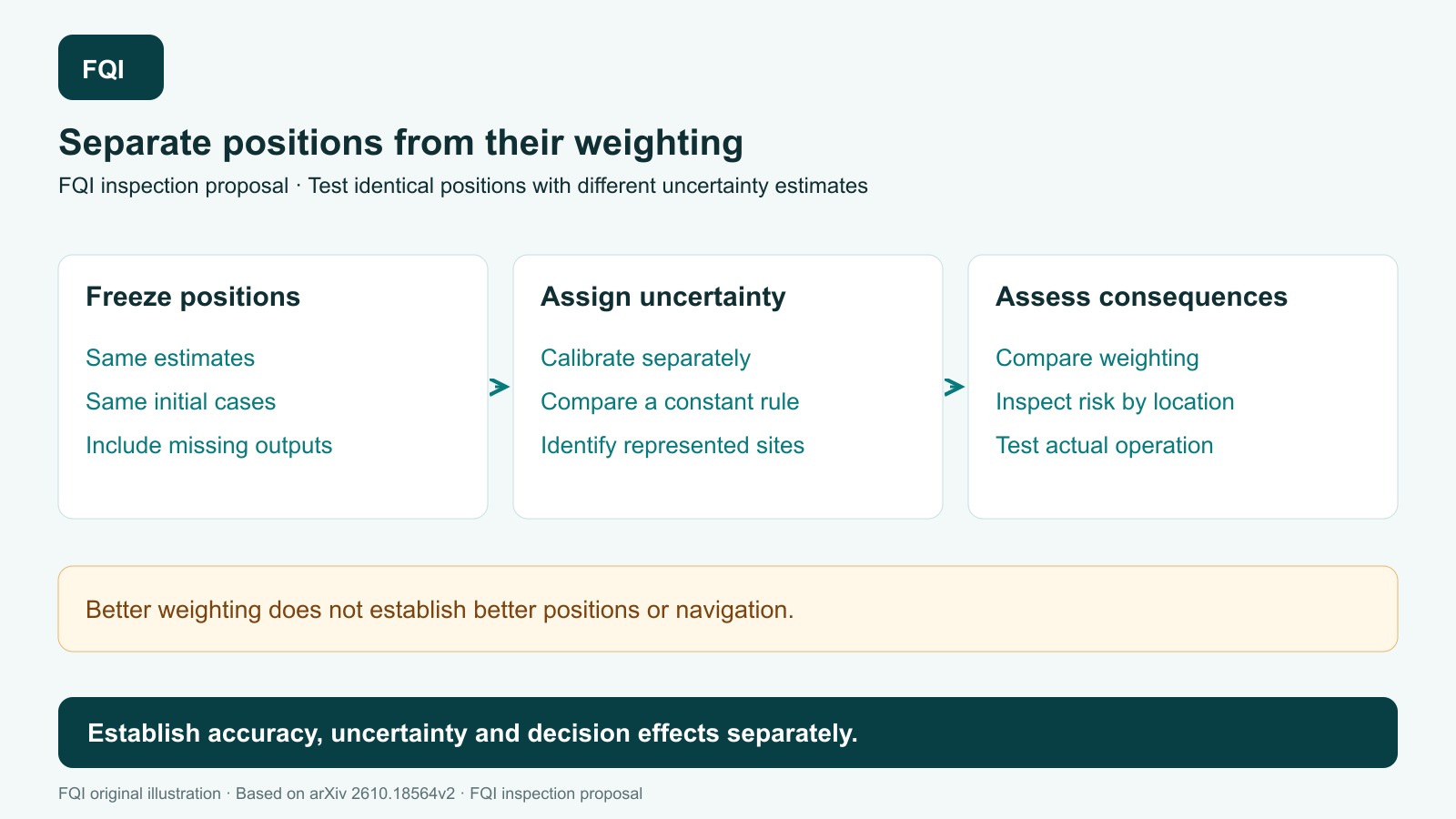
FQI derives a bounded operational assessment. First freeze the available estimates. Then assign different uncertainties learned from separate calibration data to those same estimates. Finally test whether the downstream combination actually becomes more reliable. Distributional uncertainty metrics and the consequences of weighting should be reported separately.
The report should count every intended observation: successful positions, failed localization attempts and cases excluded in advance, each with its reason. A metric restricted to successful outputs may differ from the complete operational population. Location-specific results are also needed so that large groups do not hide small problematic locations.
This protocol makes the acceptance object explicit. A change may improve uncertainty reporting without improving the original position. It may also change a downstream decision without establishing better physical accuracy. Keeping those outcomes distinct helps reviewers determine which benefit has actually been demonstrated and which still needs a separate experiment.
Limitations and risks
Images and maps share a reconstruction process in the tested conditions. Their errors can therefore be correlated. Reference accuracy is not fully quantified, and several configurations may agree on the same incorrect position.
The main assessment holds out queries rather than locations. Later analyses reuse previously examined data and are exploratory; the incremental value of some features remains unresolved. Independently produced maps, new locations and ordered flight sequences are needed before making navigation-transfer claims.
FQI conclusion
A more accurate estimate, a better uncertainty statement and a better downstream decision are three different outcomes. An acceptance protocol should connect them without treating them as interchangeable. The study motivates a controlled weighting comparison with unchanged observations. Whether that comparison improves a specific application must subsequently be tested under its actual data dependencies, failures and decision rule. The research figures provide a starting point for this assessment, not an acceptance threshold for another system.
Sources & transparency
Primary source: Observation Quality in DSM-Assisted Aerial Localization: A Benchmark and Base-Anchored Uncertainty Calibration; versioned full text reviewed. Preliminary research; methods, relevant results and limitations were assessed. No independent reproduction.
Artificial intelligence (AI)-assisted article. Operational examples and inspection proposals are FQI interpretations, not additional study results. Approved for publication by Johann Fischer on 2026-11-01.