
Executive summary
An assistant can improve a chart after a user comments on it. Whether its first attempt at the next chart is better is a separate question. A study of personalised agents compares tasks used during interaction with assignments held back from adaptation. The adapted agent and the original version face the same requirements within each comparison. For visualisation with context adaptation, the advantage was smaller on new assignments.
FQI takeaway
- Reserve new assignments that apply the same professional requirements to different material.
- Evaluate the original and adapted agent with the same user-specific criteria.
- Keep shared requirements and an individual user’s preferences distinguishable.
The principle at a glance
Thirty experts worked on 600 tasks in two domains, writing research abstracts and creating data visualisations. Each person completed 20 tasks in their assigned condition. One approach gives the agent information derived from earlier feedback as extra context. Another changes the model’s weights. A further group supplied comparison data without ongoing adaptation. The resulting criteria describe properties that a particular user expects from the output.
The starting draft is especially informative for a team considering this kind of assistant. Once a user has supplied several corrections, a good final chart reflects both the assistant and the person’s work. A new assignment without more feedback helps establish what the assistant carries forward to its next first draft.
Deep dive
The authors evaluate initial solutions on the 20 interaction tasks and the final adapted agents on 30 new tasks per domain. There is no further interaction on the held-out tasks. The unadapted agent also completes the assignments independently. Its output is evaluated with the same criteria used for the adapted version within each comparison.
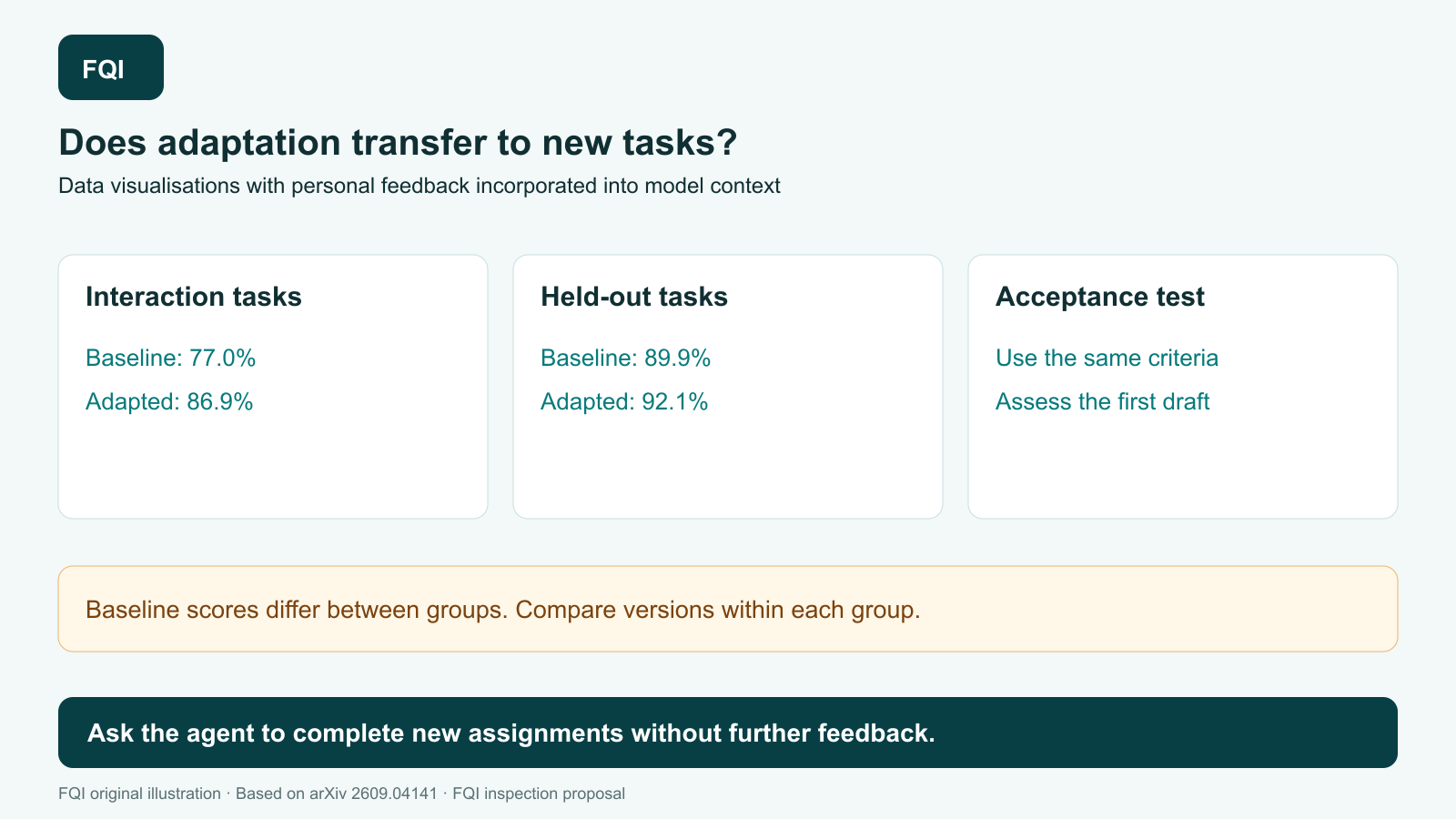
Table 1 gives an example for data visualisations with adaptation through context. On the interaction tasks the reported rubric score rises from 77.0 percent for the baseline to 86.9 percent for the adapted agent. On held-out tasks the corresponding scores are 89.9 and 92.1 percent. The two groups have different baselines. Comparing old and new tasks directly would mix the effect of adaptation with differences in the tasks and their evaluation criteria.
A workplace trial might start by identifying recurring chart requirements. One reviewer expects uncertainty intervals, another needs specific labels for a customer report. Record which requirements apply to each assignment and who specified them. Give both versions the same new data and assess their first outputs. A further test could check whether a preference learned from one person leaks into an assignment for someone else. That is an FQI proposal for local evaluation.
Limitations and risks
The results concern two creative domains. A language model helped construct the criteria for new tasks from general human requirements and earlier feedback. Each expert did not independently specify a complete scoring guide for every new assignment. Agreement with the rubric may therefore diverge from the intended user’s judgement.
For high-priority criteria, ask the relevant user to assess some new assignments independently in advance and record the grounds for each judgement. A later comparison can then distinguish a stable preference from a convenient rule that happened to fit earlier examples. Revisit that distinction when the purpose or audience of a report changes.
FQI conclusion
State the task domain, the relevant user or role and the improvement observed on new assignments. Saving the first independent outputs from both versions gives the person responsible for commissioning the work a concrete basis for deciding which future tasks should use the adaptation.
Sources & transparency
Author version reviewed 2609.04141v2. The workplace examples and proposed acceptance tests are FQI interpretations. Efficient Test-Time Adaptation through Human-Agent Interaction · Version history
Codex assisted with drafting and checked the claims against the cited original sources. Johann Fischer authorized publication on 2026-11-17.