
Executive summary
A language model can produce a program that runs, returns a feasible schedule and still solves the wrong planning problem. A study of mathematical optimisation separates training examples about mathematical derivations, solver operation and domain requirements. Combining the examples improved execution, while feasible but incorrect answers persisted. Quality teams can use this distinction to find out whether a training change improves the behaviour that actually matters for release.
FQI takeaway
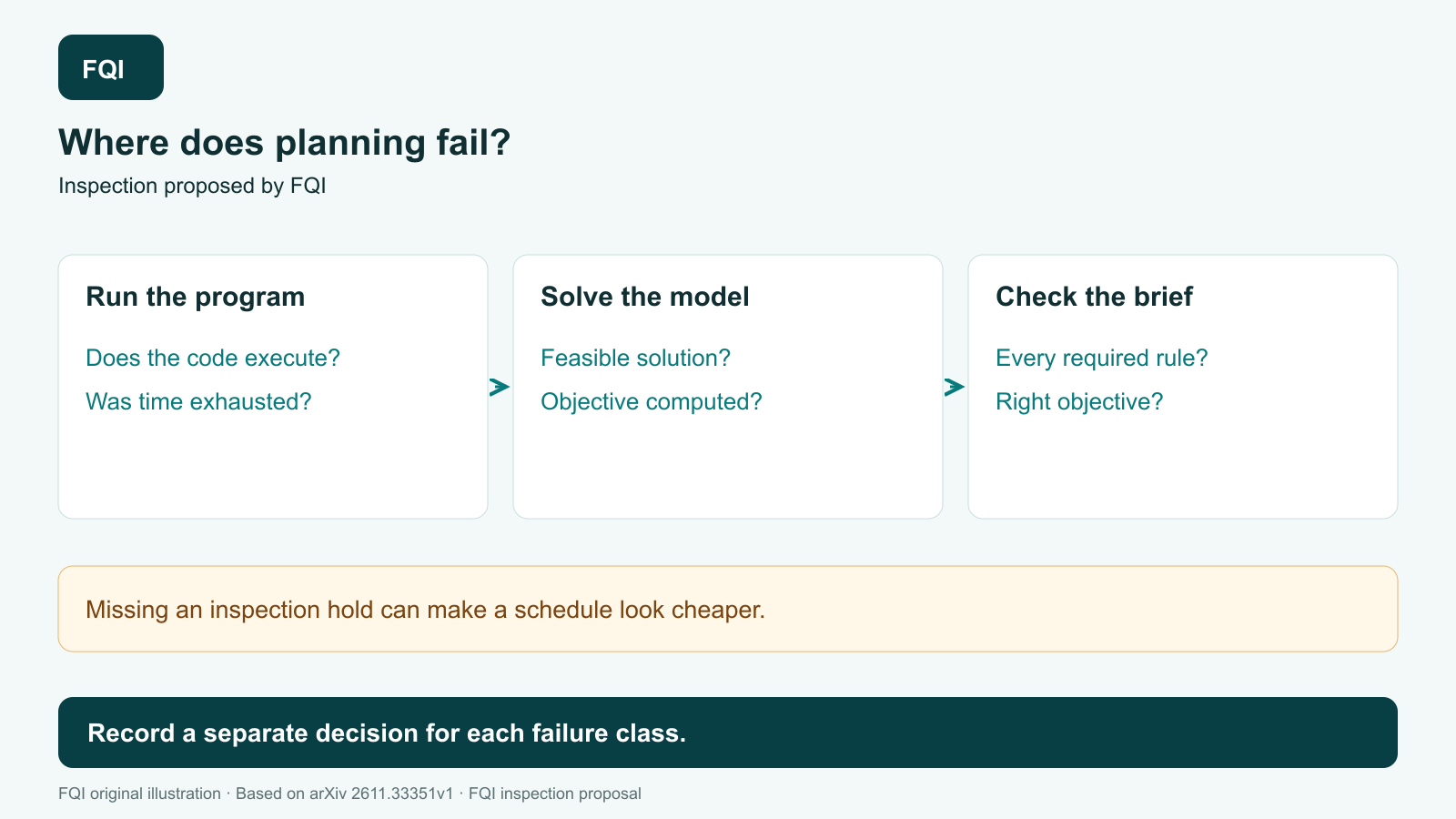
- Count execution failures, infeasible formulations and feasible but incorrect results separately.
- Trace required operating conditions to the model that was executed.
- Report the effect of a training change for each failure class and task family.
The principle at a glance
A solver searches for a solution within a mathematical description. A language model can write that description and generate code in the solver’s programming interface. The solver only receives the objectives and constraints that made it into the code. An omitted constraint can even make the computed schedule look better by allowing cheaper choices that the real operation forbids.
Deep dive
The researchers constructed approximately 32,000 mathematical derivations examples, 4,000 solver-use examples and 8,000 domain-knowledge examples. Language models generated tasks and code. Solver feedback helped filter examples, revise programs that would not run and develop tasks with additional constraints. The resulting collections placed different demands on the models.
The evaluation included fine-tuned Qwen3 variants and comparisons in which one category of training data was removed. Outputs were classified as non-executable, timed out, infeasible, feasible with an incorrect objective value, or correct. The researchers sampled multiple outputs per instance. Their full data combination performed best in the reported comparisons. Improvements in execution did not remove the dominant error of returning a feasible but wrong result. The associations between particular training components and particular errors varied by setting.
Consider a simplified FQI scheduling example. A measuring machine becomes available only after its calibration check. If the generated code omits this condition, it can assign a job too early and still return a valid cost according to its own rules. Reviewers can construct a case where including the calibration requirement changes which plan wins. They can then inspect the actual schedule and check the implemented constraint as well as the objective value.
This extends an earlier FQI comparison between the written model, implemented code and final report. Here the additional decision concerns training and evaluation. A reduction in exceptions provides evidence about code execution. To claim better planning, the team also needs results for exactly those cases where a missing or reversed requirement would change the decision.
Limitations and risks
The authors work in industrial research at Hitachi. Their results cover generated and established benchmark tasks. Solver-based filtering can miss a problem that remains solvable after an essential condition has disappeared. The reported error categories reveal a residual risk but do not diagnose the cause of every wrong answer. A local acceptance test needs independently established requirements and reference cases.
FQI conclusion
A planning team needs to know whether the software executed successfully, whether a solution exists within the generated formulation and whether the formulation captures the order it was given. The study supplies evidence that these questions can produce different answers after training. FQI would report a separate result for each one and keep examples of plausible, incorrect plans available for subsequent model revisions.
Sources & transparency
Understanding Failure Patterns in LLM-Based Mathematical Optimization Modeling · arXiv v1
Author preprint v1. FQI checked the cited sections of the original study. Workplace examples and inspection proposals are FQI interpretations. The experiments were not independently replicated.
Codex drafted the texts and checked them against the original study. Johann Fischer authorized publication on that basis on 26 November 2026.