
Executive summary
How closely does a controller tuned with artificial intelligence follow a specified furnace temperature profile? Yulin Xie and colleagues investigated this on an induction furnace for metal specimens. A learning procedure selected controller settings and received feedback from a physical heating trial. In one reported example, trial 18 already came close to the best profile observed in 100 trials. The result is meaningful for acceptance when the heating profile, error measure and observation window are identified together.
FQI takeaway
- Specify the target curve, measurement start and evaluation window before comparing settings.
- Inspect short temperature peaks alongside the accumulated error.
- Use separate tests for controller performance and the desired material property.
The principle at a glance
A controller adjusts furnace power in response to the difference between target and measured temperature. The PID controller used here combines responses to the current error, its history and its rate of change. A setting that works on a gentle ramp may produce an overshoot on a steeper one. Checking only the final temperature can conceal that excursion.
The controller still performs the moment-to-moment regulation. The learning procedure acts at a different level. Bayesian optimization uses previous trials to choose the next combination of controller parameters from a prepared list. Its feedback is the temperature measured at the specimen. A reviewer can therefore state both the decision made by the learning method and the measurement used to judge it.
Deep dive
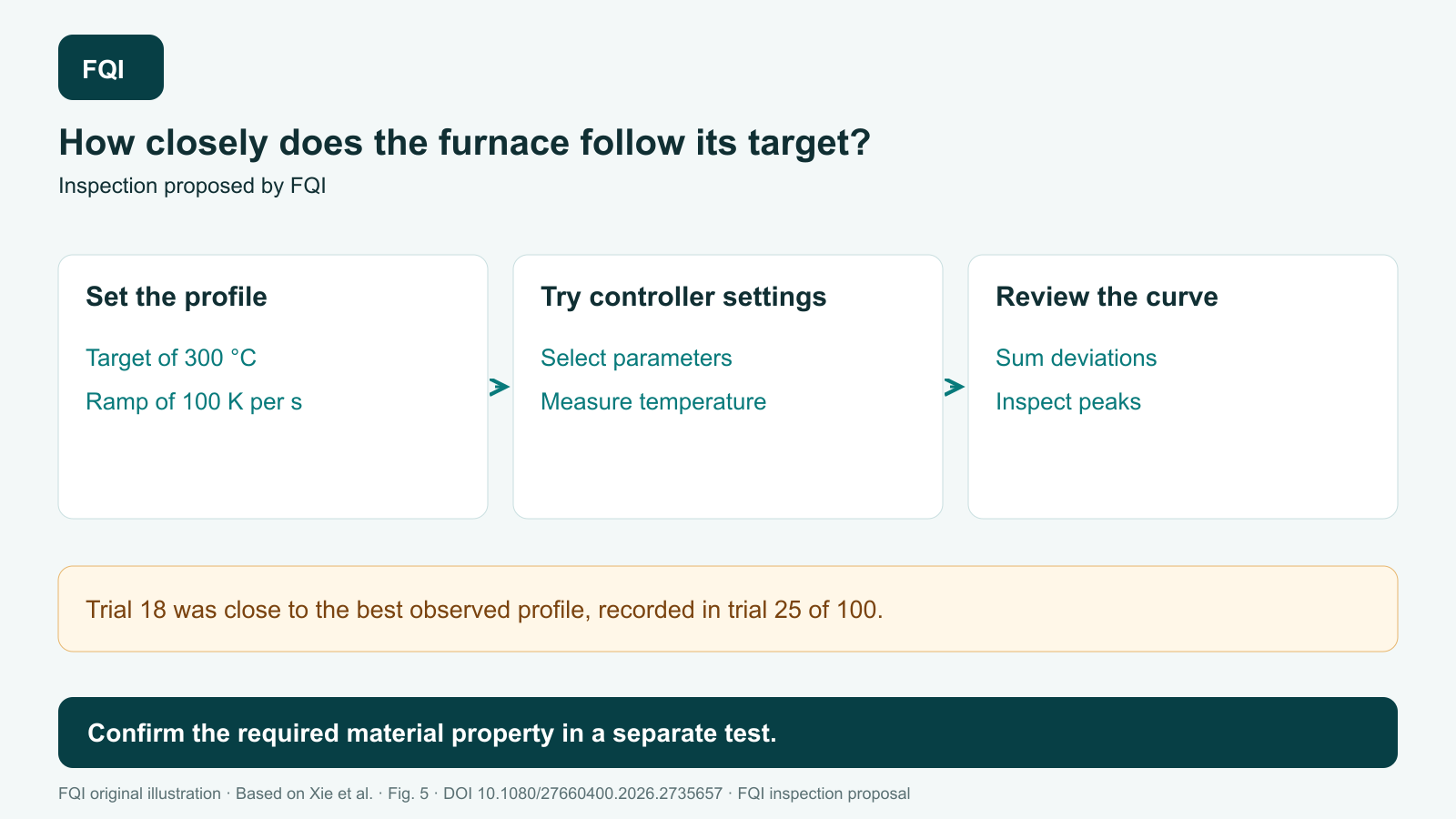
Figure 5 uses a target of 300 degrees Celsius and a heating rate of 100 kelvin per second. Time starts when the measured temperature reaches 155 degrees Celsius. From there, the researchers compare actual and target temperatures over a window lasting twice the remaining programmed time to target. They integrate the absolute error over that window. An overshoot and a later undershoot therefore both contribute to the result.
The initial profile overshoots appreciably. By trial 18, about an hour according to the authors, the measured curve follows the target much more closely. In 100 trials, the lowest observed error occurred at trial 25. The authors found little difference between the profiles at trials 18 and 25. For an acceptance decision, the curves allow a further question beyond their ranking. Was the additional improvement large enough to matter for this process?
FQI would define one acceptance requirement for accumulated deviation and, if brief overheating is critical, a second one for the maximum temperature excursion. The latter is a proposed application check. It was not a second optimization objective in the experiment. Repeating the heating test with fresh specimens could then show whether a chosen setting meets both requirements consistently.
Limitations and risks
Trial 18 does not establish a stopping rule for other materials, specimen shapes, targets or furnaces. The platform also automates X-ray and mechanical measurements. These capabilities do not demonstrate autonomous selection of a heat-treatment programme that achieves a desired material property. Controller tuning and property discovery require evidence across different parts of the process.
FQI conclusion
A team transferring the method to its own furnace should start by specifying the acceptable temperature history and deciding which part of it must be measured. A good result on that profile identifies a setting worth repeating. Consistent temperature control and a separate confirmation of the required material property would give the team a basis for the next process decision. The trial number alone would not.
Sources & transparency
Original paper · Xie et al. 2026 · PHYSBO at the University of Tokyo · Coverage of the study
Measurements are attributed to the linked original version. Application examples and acceptance criteria are FQI interpretations. This review did not independently replicate the experiment.
Codex drafted the texts and checked them against the original study. Johann Fischer authorized publication on that basis on 28 November 2026.