
Executive summary
An artificial intelligence (AI) agent can execute numerous inspection modules without using their results in its decisions. A recent preprint examines this gap between a named capability and an effective computation. For quality management, this creates a concrete acceptance question: which calculated value changes which execution step? FQI recommends tracing promised safeguards and analysis functions to their actual consumers. A successful overall run or a populated log does not establish that each function works. The study contributes an inspection method, not a representative defect rate for agent systems.
FQI takeaway
- Name the calculated value and its consumer for every promised AI function.
- Test whether changing a relevant module input affects the intended decision.
- Assess executed code, recorded values and effective control separately.
The principle at a glance
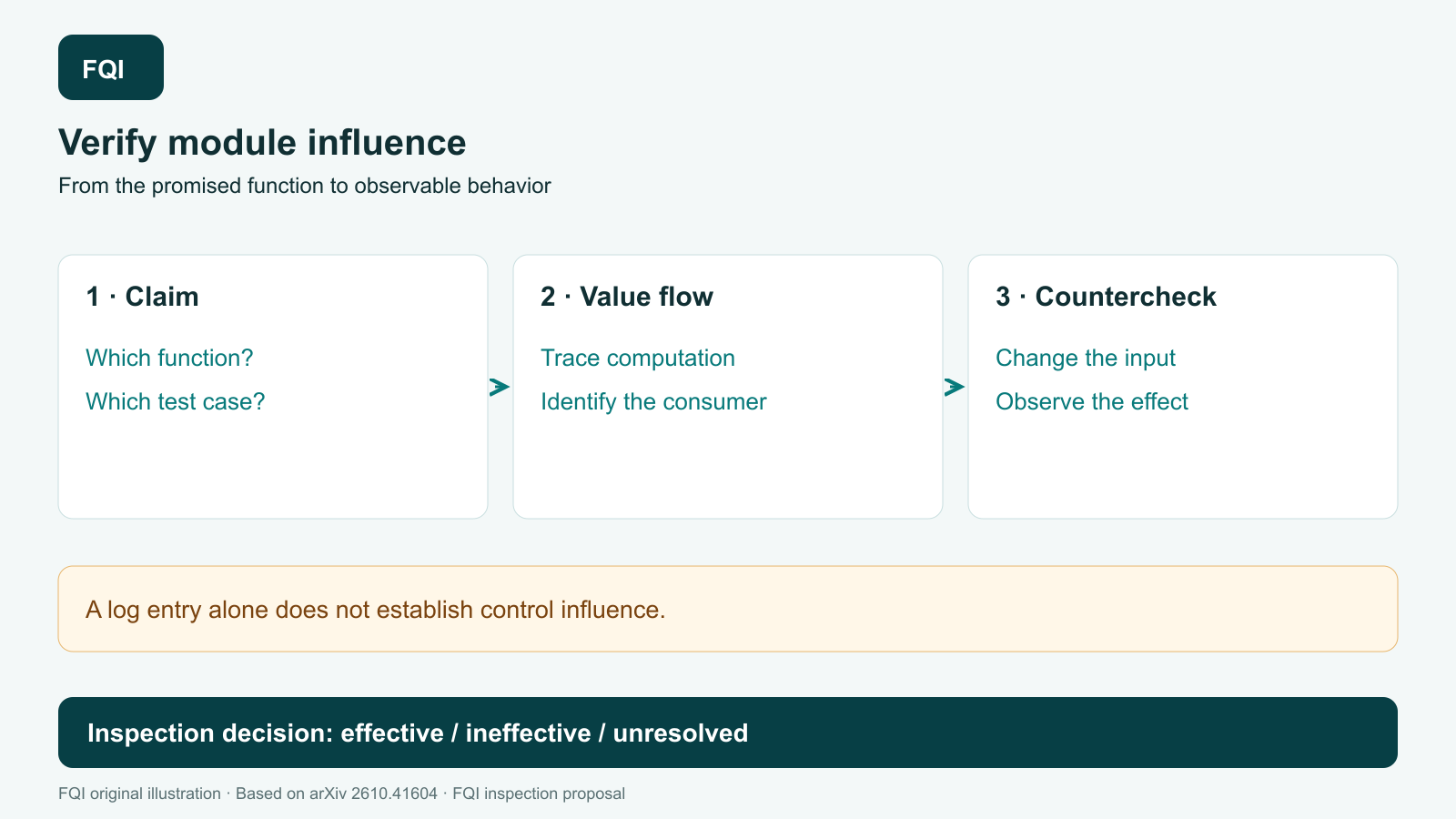
A module is a distinct software component. Its execution initially establishes only that a program path was reached. Whether its result is used is a separate question. An agent might calculate a risk value while its subsequent tool decision ignores that value. The result appears in the log but constrains no action.
The authors associate each claim with a computation, a technical classification, a route to an output and possible side effects. They combine code inspection with interventions intended to confirm or falsify specified expectations.
Deep dive
The investigation examines 25 named mechanisms in an agent system. Under the authors’ criterion, calculated values from 18 do not reach production output. The criterion is strict: decorative metadata do not count as effective control. Interventions and repair experiments test parts of the static findings. A second system provides a limited transfer check.
For FQI, the distinction between existence and effectiveness is especially useful. An operational extension is an acceptance table with four columns: promised function, input case, expected effect and observed consumer. An entry saying “risk analysis exists” would be incomplete. A statement such as “a blocked supplier status prevents automatic order release” becomes testable.
Consider a simplified example. An agent prepares an inspection report and must consider open deviations before sending it. The team creates one case without an open deviation and an otherwise identical case with one. The second case must produce the agreed restriction. Merely including the word “deviation” in the report is insufficient. The team then checks whether the restriction also applies to the actual sending path.
A countercheck needs a known expected state. Not every input change should alter the output; irrelevant changes should leave it unchanged. An effective test and a neutral control therefore belong together. Both should run against the same software revision so that an intervening modification cannot explain the difference.
Following repair, the same case is repeated. Acceptance documentation connects the original defect, the modified consumer and the new behavior. At least one case in which the module should still allow the action must remain. This prevents a repair from becoming a blanket shutdown of the capability.
Limitations and risks
AI-assisted agents produced the static judgments without a separate inter-rater agreement study. Inspecting a repository cannot completely rule out external invocation paths. Repairs cover selected tasks rather than an entire deployment. FQI has not reproduced the experiments. The operational transfer is therefore a proposal for acceptance design, not confirmation of any particular agent’s performance.
FQI conclusion
Evidence for an AI function must reach observable behavior. A module name or log entry cannot replace that connection. Quality teams can start with a short list of consequential promises and targeted counterchecks. Inputs, computations, consumers and effects should agree before a function is accepted as effective. This inspection complements assessment of answer correctness by showing whether the promised control architecture actually contributes to the result.
Sources & transparency
Methods, evaluation and limitations reviewed on 3 November 2026. Scientific preprint; no independent reproduction by FQI. Operational examples and inspection proposals are FQI interpretations, not additional experiments in the study. Artificial intelligence assisted preparation. Johann Fischer explicitly approved this article package for publication on 2026-11-04.