
Executive summary
An artificial intelligence (AI) learning method may win a comparison because a single data split happens to favour it. Research by Eve, Varoquaux and Moreau examines how repeated splits reduce evaluation variability. Benefits can continue beyond a few repetitions, but depend on the learning method and performance measure. Quality teams face a budget decision: allocate computation to additional splits, examine the information gained and avoid confusing more precise evaluation with new independent production data or final acceptance of a deployed model.
FQI takeaway
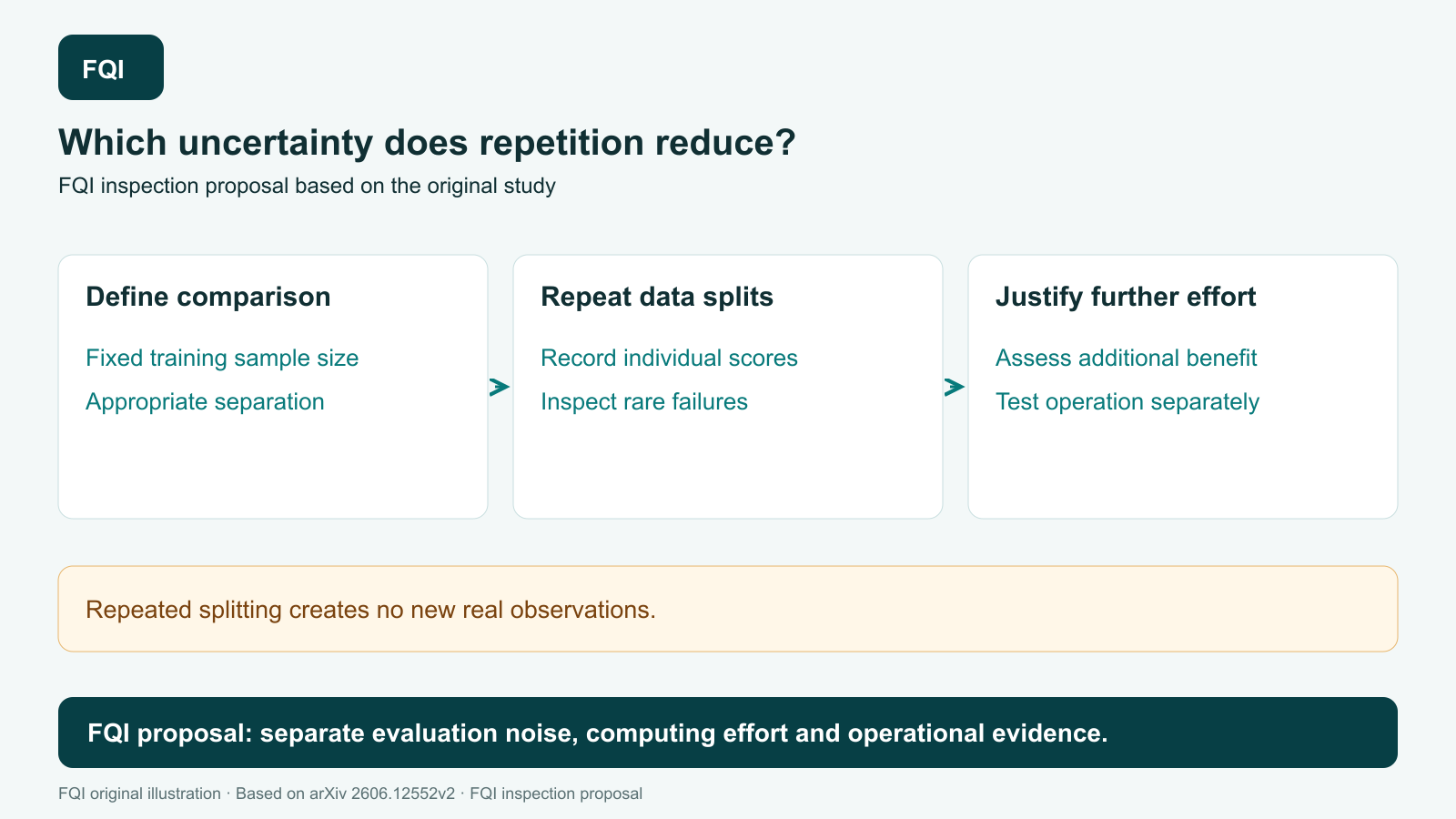
- Distinguish repeated model starts from repeated data splits.
- Compare learning methods at a fixed training size and expose outliers.
- Budget further repetitions by expected information gain; retain separate operational testing.
The principle at a glance
Cross-validation repeatedly divides existing data into training and evaluation portions. A model is trained for each split and assessed on its corresponding evaluation data. This paper particularly studies repeated random splits with a fixed training size. Repetition creates no new real cases; it helps measure performance using the available sample.
The object being assessed matters. A trained model is one concrete predictor. A learning algorithm produces different models depending on its training data and randomness. The study mainly estimates the expected performance of learning algorithms. Its conclusions do not directly release one delivered model for use.
Terms explained
- Cross-validation: repeated training and evaluation on separate portions of an existing dataset.
- Evaluation variability: fluctuation in a performance measure due to the finite evaluation sample.
- Redundancy: here, similarity between trained models’ losses on observations they jointly evaluate.
Deep dive
The authors separate training variability from noise caused by limited evaluation data. Their sample-gain measure concerns the second component. It expresses how much larger a single evaluation sample would need to be to achieve comparable evaluation precision. It neither multiplies observed products nor extends coverage to previously unseen defect types.
Large additional reference datasets help measure this gain experimentally. The practical recommendations for repeated splitting do not require those large reference datasets. Experiments cover synthetic regression, histopathological image classification and text reviews. The two real domains are not industrial process validation.
In the synthetic experiments, two methods reach a variance-based sample gain of roughly five after 200 splits, while others benefit more. This is not a recommendation to perform 200 repetitions universally. Instead, a small fixed number of splits need not give equal precision for different learning methods. Each extra training run also has a computational cost.
To inform that budget, the authors suggest examining similarity of per-observation losses after three to five splits, using observations evaluated by multiple trained models. High redundancy suggests limited further gains. Low redundancy makes further splitting interesting but does not guarantee a benefit. The proposed calculation requires a measure decomposable into individual observation contributions. It does not apply directly to area under a receiver operating characteristic curve or the coefficient of determination, R².
Mean performance and frequency of winning are different quantities. In a text experiment, one model wins many individual splits but occasionally suffers severe training failures. Another method can consequently have better long-run mean performance. Repeated splits reveal those failures more readily. Recovering a ranking more often still does not establish a statistically decisive difference in one small experiment.
FQI proposes fixing the training size, target measure and data boundaries before comparison. Retain individual results, investigate outliers and define how further computation will be justified. Time-dependent or batch-related data require splits that respect those relationships. Random mixing cannot replace a technically appropriate validation design.
Limitations and risks
Repeated splitting does not correct systematically wrong reference labels or laboratory-to-operation differences. Only two real domains were studied. Large gain estimates can be uncertain and should not become fixed multipliers for local data requirements. Model selection that reuses evaluation data also needs protection against information leakage.
FQI conclusion
The relevant question is which uncertainty a repetition changes. New splits and new training starts on an unchanged split address different components. A credible comparison records both, together with computational effort and unusual failures. The paper supports a targeted evaluation budget. It does not justify abandoning independent operational tests or claiming that a few real observations have become a larger real dataset. More stable comparison evidence remains distinct from deployment acceptance.
Sources & transparency
- Crossing the Validation Crisis: Cross-Validation Reduces Benchmarking Variance Surprisingly Well
- Crossing the Validation Crisis: Cross-Validation Reduces Benchmarking Variance Surprisingly Well
Codex assisted with drafting and checked the claims against the cited original study. Results were not independently reproduced. Operational recommendations and simplified examples are FQI interpretations.
Codex assisted with drafting and checked the claims against the cited original sources. Johann Fischer authorized publication on 2026-11-25 following review by Codex. Individual human reading is not claimed.