
Executive summary
Artificial intelligence (AI) agents may appear valuable when compared with manual work even though digitised evidence and deterministic checks produced the gains. This methods paper separates infrastructure improvements from the additional agent contribution. Its demonstration uses scripted policies, not actual language-model agents. FQI can nevertheless use its test design: an agent must add value beyond a frozen automated baseline, with false alarms, rework and invalid outputs included. The paper demonstrates a scoring protocol rather than operational savings or agent safety.
FQI takeaway
- Compare the agent with a functioning automated inspection baseline.
- Do not count repeated known findings as additional detection.
- Include review effort, false alarms and incomplete outputs in the assessment.
The principle at a glance
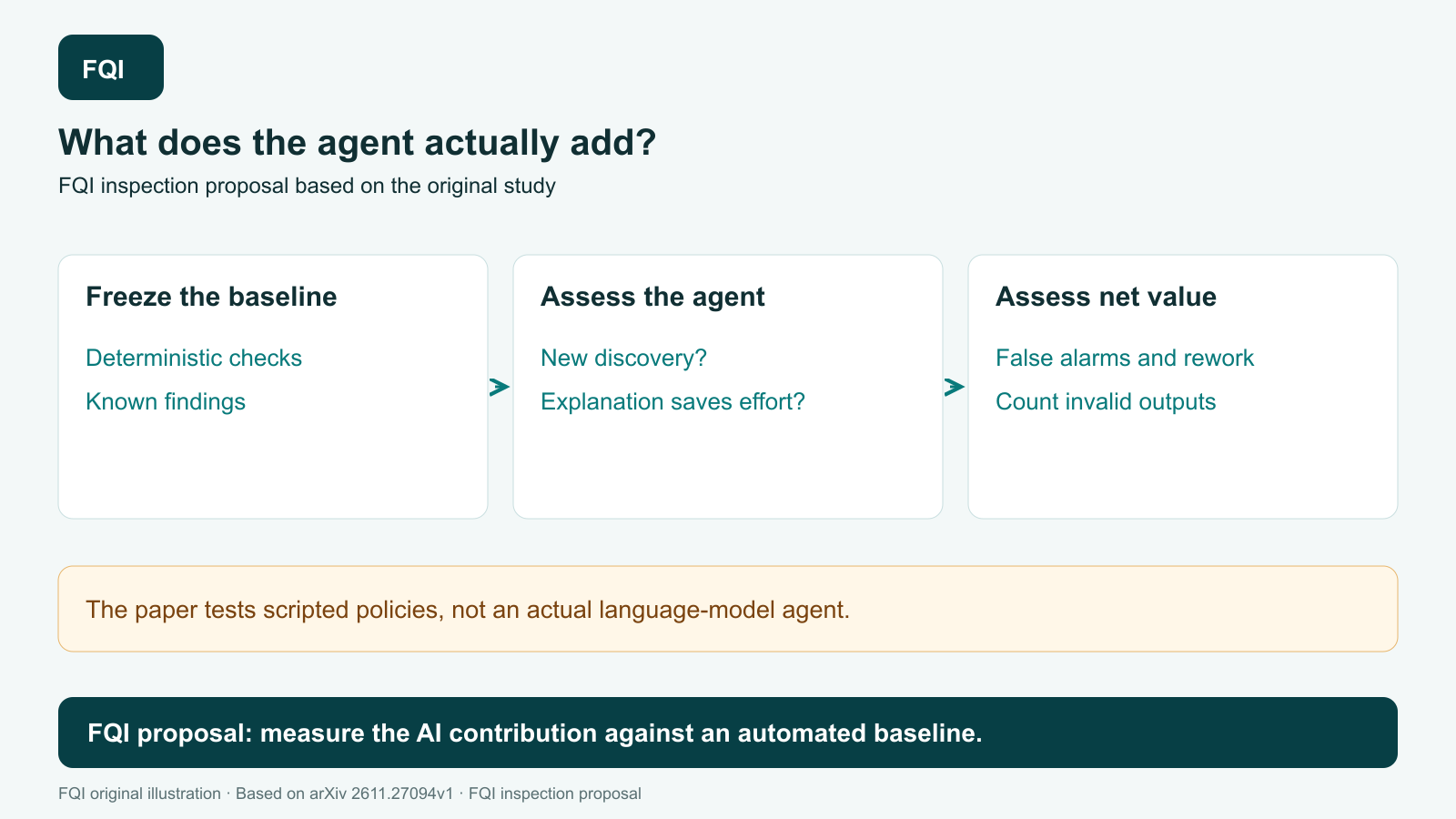
The paper distinguishes manual work, a controlled workflow with structured evidence and fixed tests, and a separately authorised agent task. The first comparison measures infrastructure gains. Only the second can estimate what the agent adds.
A fault already reported by a deterministic check remains a known fault when an agent explains it. Explanation may save time, but it is not a new discovery. Separating these channels makes the AI contribution testable.
Deep dive
The released demonstration contains six variants of one synthetic credit-scorecard case. Five scripted policies represent behaviours such as repeating existing findings or flagging harmless differences. Broad accuracy measures can treat flawed policies similarly, while the proposed attribution rules distinguish them.
This is a test of evaluation logic, not evidence that an actual agent works. The pack contains neither evaluated language-model outputs nor an implemented agent runtime. Proposed limits on tools, time and cost are contractual designs; their enforcement is not demonstrated.
The protocol can still inform an operational experiment. Before the trial, record the faults already exposed by the automated baseline. Freeze that baseline within the round. Give the agent the same inputs and test conditions, and evaluate its unedited proposal before a person repairs it. Any later correction belongs in the effort calculation. Missing or invalid outputs must remain in the main evaluation rather than disappearing from the denominator.
Harmless differences are needed as controls. An agent that challenges everything may detect genuine faults while creating unnecessary investigations. The test set should therefore include cases that require no escalation, and reviewers should assess whether proposed tests and questions were necessary.
FQI would also separate discovery from explanation. If an agent finds a fault that an approved deterministic check can subsequently detect, add that check to the baseline between rounds. Preserve discovery credit, but compare future performance against the stronger baseline. This avoids maintaining unnecessary work merely to preserve apparent agent value.
An operational pilot could use matched inspection groups and record time spent on checking, questions, corrections and final assessment. Its success criterion should be fixed beforehand and include both benefits and costs. These are applications of the protocol, not reported results from a bank or factory. An inconclusive comparison should remain inconclusive instead of being reported as evidence of savings.
Limitations and risks
All demonstration variants belong to one synthetic case family. Shared specification and implementation errors remain possible. Independent evaluation and the prospective pilot are proposed rather than completed. The demonstration cannot establish an actual agent’s safety rate or economic value. Moreover, apparently obedient behaviour would not prove that access restrictions are enforced. Permission boundaries need their own technical tests rather than confidence inferred from good answers.
FQI conclusion
FQI can adopt a stronger experimental design without claiming that this paper has demonstrated useful agents. The decisive question is what additional fault is found or what net work is saved after the deterministic baseline has done its job. This prevents infrastructure gains from being attributed to AI. It also makes genuine contributions clearer when independent assessment, complete cost accounting and unchanged comparison conditions support the result.
Sources & transparency
- Separating Automation Gains from Agent Contributions in AI-Assisted Model Validation
- Separating Automation Gains from Agent Contributions in AI-Assisted Model Validation
Codex assisted with drafting and checked the claims against the cited original study. Results were not independently reproduced. Operational recommendations and simplified examples are FQI interpretations.
Codex assisted with drafting and checked the claims against the cited original sources. Johann Fischer authorized publication on 2026-11-23 following review by Codex. Individual human reading is not claimed.