
Executive summary
A language model can adapt to the linguistic patterns of a document without subsequently retrieving its facts reliably. An original study separates these outcomes across several architectures and different methods of writing into model weights. Quality assessment therefore needs a clear question: which measured improvement supports which later benefit? Lower prediction loss, retrievable knowledge and preserved capabilities require separate tests. The findings concern the examined adaptation procedures, not a general limit on machine learning.
FQI takeaway
- Test text prediction, factual retrieval and general capability separately.
- Isolate context access from changes to model weights.
- Check every weight update for unwanted effects outside its target task.
The principle at a glance
Language models normally learn before deployment. The source additionally examines small changes to selected weights during processing. This adapts the model to recently read material without complete retraining.
Lower prediction loss means subsequent text elements become easier to predict. That may reflect vocabulary, format or style. Factual retrieval instead requires a specific piece of information to remain available when a relevant question is asked later. These abilities are related but not identical.
Deep dive
The study uses long books and legal-document streams, together with retrieval and downstream-task evaluations. It compares model families with different internal processing mechanisms. A fixed adaptation recipe changes selected weights and is assessed against frozen models and controls with context access.
Some architectures show substantial reductions in prediction loss. Hybrids already containing a continually adapted internal state show much smaller gains. This initially establishes adaptation to document statistics. The additional retrieval tests do not show a corresponding benefit from the updated weights in the examined setup.
Another experiment writes a statement through repeated text prediction. Format patterns are stored, but other response behavior deteriorates. A different method transfers a decision tendency into a small added parameter set and better preserves the tested capabilities. The procedures therefore differ not simply in the magnitude of change but in their learning objectives.
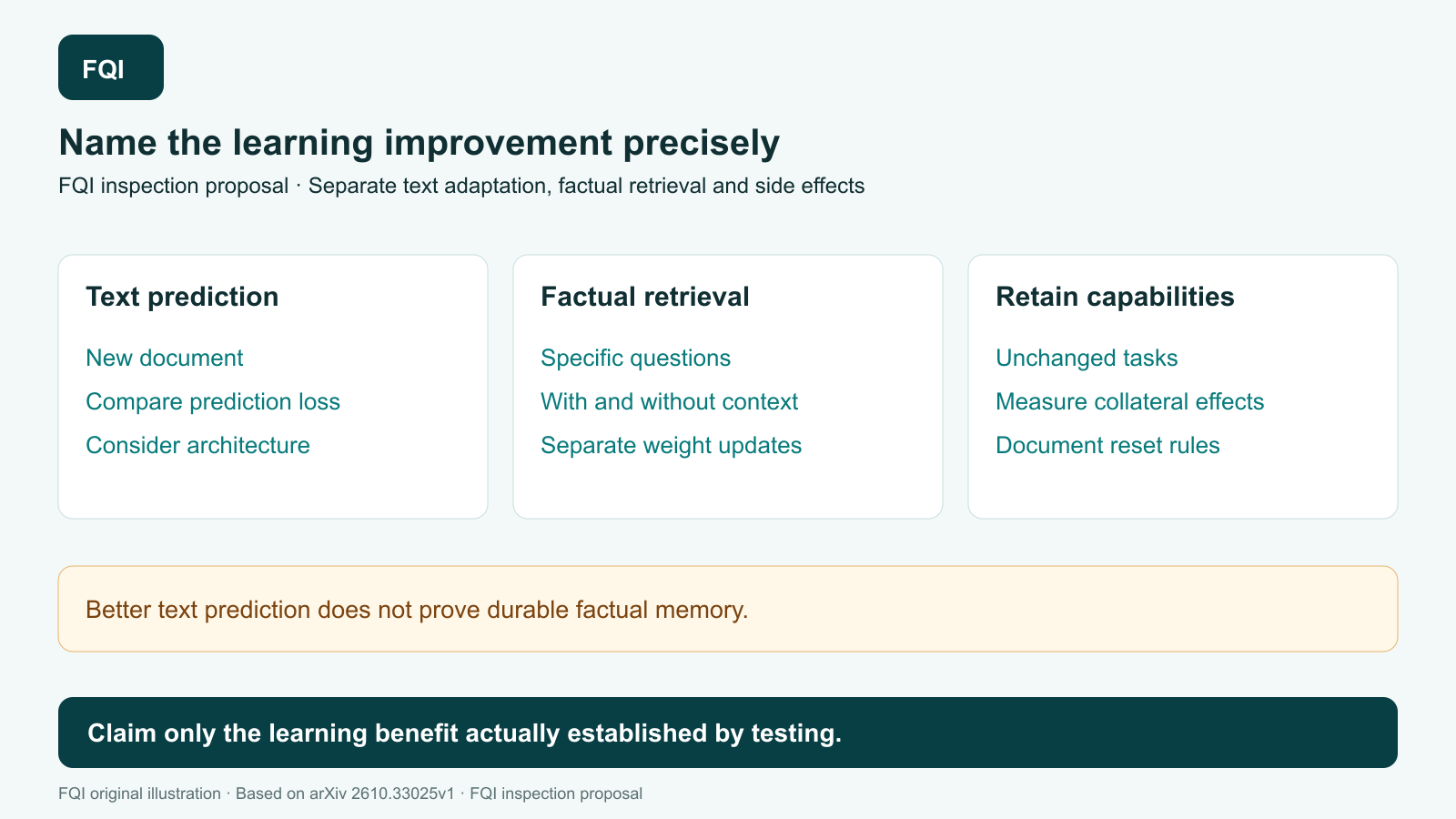
FQI proposes three separate evaluation sets. The first measures adaptation to new text. The second asks for specific facts while explicitly controlling whether the original document remains in context. The third retains unchanged tasks outside the adaptation objective to detect collateral damage.
Before testing, document the original weights, updated weights, available context and reset rule. Otherwise an apparent memory effect may simply reflect text still visible to the model. A favorable overall score can likewise hide degradation of particular answer formats or substantive capabilities.
Adoption should depend on the intended purpose. Temporary linguistic adaptation needs different evidence from durable knowledge acquisition. Reliable factual retrieval requires assessment of an appropriate storage and retrieval path. The study does not justify replacing that path solely with small weight updates.
For an operational trial, the update and its reversal should remain distinguishable. Preserve an unchanged comparison state and run the collateral tests after each permitted kind of update. This is an FQI assessment proposal: the paper does not establish that a particular enterprise application will retain its capabilities merely by following this procedure.
Limitations and risks
The study uses specific models, parameter subsets and a limited adaptation recipe. Negative retrieval results do not disprove other learning mechanisms designed and trained for memory. The authors distinguish their setup from methods whose fast-weight pathways are learned during training.
The more successful behavioral adaptation also requires assessment of its target judgments and side effects. Preserved performance on selected tasks does not rule out damage elsewhere. Runtime overhead and per-document resetting further constrain transfer to an application.
FQI conclusion
FQI recommends qualifying the word “learning” with the capability actually measured. Better text prediction is meaningful, but insufficient evidence of factual retrieval or reliable domain decisions. The practical assessment should expose context availability, weight changes and collateral effects separately. Only after the intended benefit and retained baseline capabilities are demonstrated can a team decide whether ongoing adaptation serves its particular process. The source offers a controlled comparison for that decision, not a universal architecture recommendation.
Sources & transparency
Primary source: Can Language Models Learn While They Think? Testing Gradient Adaptation Across Architectures; versioned full text reviewed. Preliminary research; methods, relevant results and limitations were assessed. No independent reproduction.
Artificial intelligence (AI)-assisted article. Operational examples and inspection proposals are FQI interpretations, not additional study results. Approved for publication by Johann Fischer on 2026-11-01.