
Executive summary
A language model can correctly predict the output of a small neural network from its weights. It might compute the output, or it might recognize a statistical pattern that often predicts the same answer. Researchers investigated whether rewiring the final layer could distinguish these explanations. None of the natural settings they tested met all their conditions. This illustrates why a technically successful control can still leave a scientific question unresolved.
FQI takeaway
- Specify the competing explanations and their predicted answers before running the experiment.
- Verify that the control changes the particular target needed to distinguish them.
- Identify the model that produced each answer and document its computational budget.
The principle at a glance
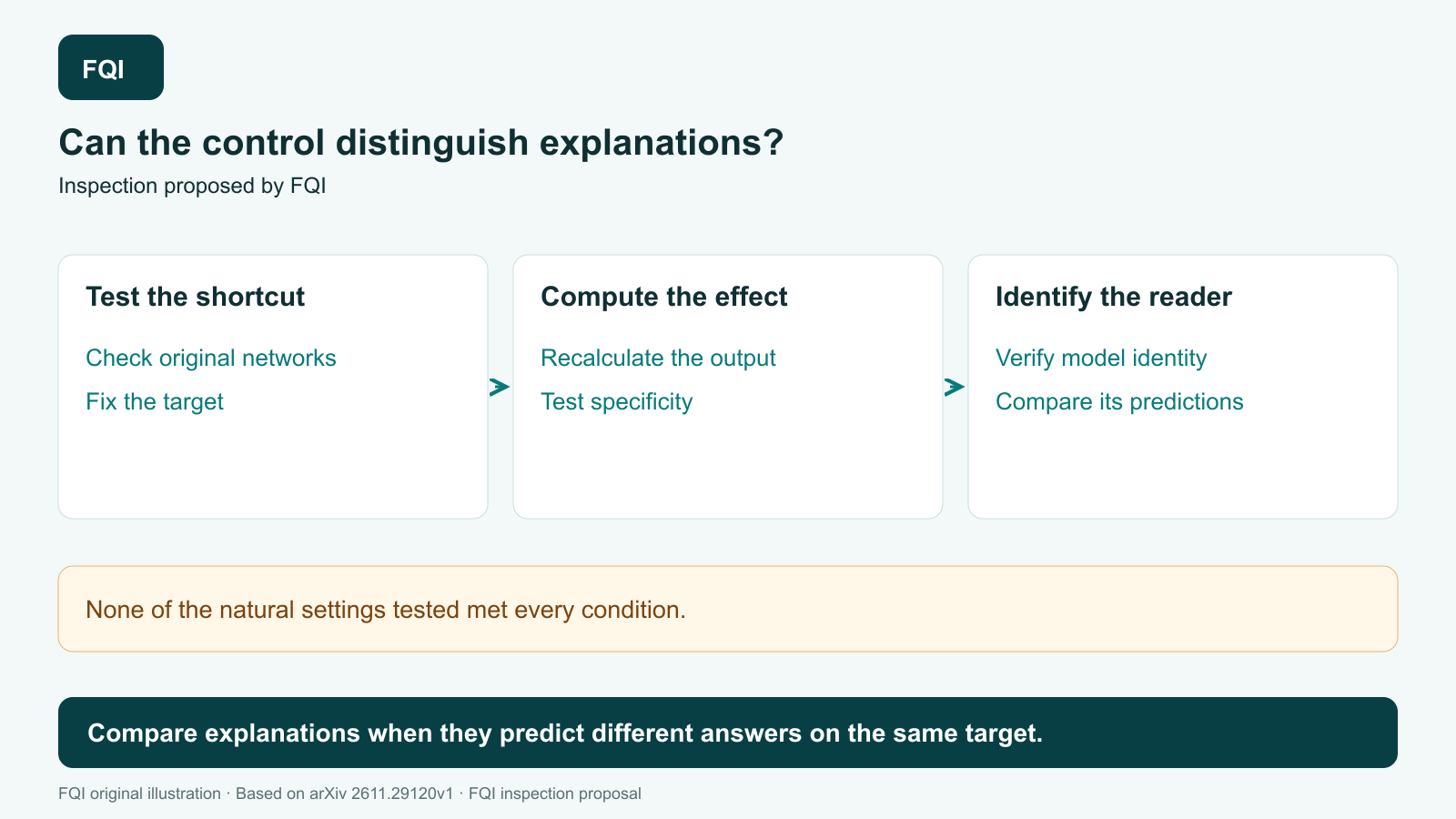
The control, called C2, permutes columns of the final linear readout. This changes which hidden features feed each output while preserving certain within-layer summaries, including the collection of entries and the singular values. The researchers can execute the changed network to determine its output. A reader relying only on the preserved summaries sees the same information as before. A reader following the new computation may need to give a different answer.
Deep dive
For the experiment to discriminate, a predictor restricted to those summaries must first be able to predict the target on original networks. Otherwise it offers little explanation for the original success. The chosen change must also have a measurable effect that depends on this specific rewiring. Finally, there needs to be evidence of which model actually answered the questions.
The specificity requirement became clearer during the experiments. Suppose almost any permutation damages overall accuracy. A reader that predicts a general drop could appear to understand a particular rewiring. Per-image outputs might discriminate better, but then the shortcut predictor must also work on per-image outputs. Success on overall accuracy cannot establish that condition for a different target.
In one experiment a model route gave correct answers throughout tests on 24 tiny networks, including rewired variants. The backend identity could not be attested, and the tested summary predictors failed to explain original success. The result shows that the route produced the expected outputs under that protocol. It does not distinguish the proposed internal strategies.
The trained image-network experiments exposed another trade-off. Weight statistics could help estimate accuracy in one setting, yet a change in overall accuracy was too generic. When individual image predictions became the target, the rewiring effect was specific but the tested shortcuts no longer predicted the original outputs. The necessary conditions must hold together.
A deliberately constructed population supplied a known shortcut. In a registered replication, two identified open-weight models generally followed the rewired function even though the shortcut was available. Tracking the new output remains evidence about observable behaviour. Other internal computations can produce the same output.
FQI would add a short eligibility study before an expensive comparison. Record what the shortcut predicts, compute the changed target independently and show at least one case where the explanations disagree. If that cannot be established, describe exactly which question remains open.
Limitations and risks
The samples are small and much of the work is exploratory. The specificity check was introduced after an observed result. The control preserves selected within-layer statistics while potentially changing cross-layer relationships. Some runs exhausted their output budget. That observation limits conclusions about the tested configuration. It cannot establish inability with a larger budget.
FQI conclusion
The useful decision comes before interpreting the score. Determine whether the two explanations were viable and whether the chosen intervention made them predict different outcomes. A perfect result on a test that lacks this property can establish correct answers for its cases. It leaves the proposed explanation of how the reader produced those answers open.
Sources & transparency
When Can a Rewiring Control Test LLM Weight Readers? C2 and an Eligibility Protocol · arXiv v1
Author preprint v1. FQI checked the cited sections of the original study. Workplace examples and inspection proposals are FQI interpretations. The experiments were not independently replicated.
Codex drafted the texts and checked them against the original study. Johann Fischer authorized publication on that basis on 27 November 2026.