
Executive summary
A web agent sometimes names a control that does not exist on the page. Researchers working with Qwen2.5-7B-Instruct investigated whether an intervention inside the language model could correct these selections. The intervention repaired many invalid selections but also damaged some valid ones. Even the way the available actions were written down affected the result. An acceptance test therefore needs both groups of actions and the formats actually used in the service.
FQI takeaway
- Count repaired and newly broken selections within their respective starting groups.
- Repeat the comparison when the action list or response format changes.
- Check whether the selected control actually advances the user’s task.
The principle at a glance
Imagine an order form with a Save button and a Cancel button. The agent proposes Next. The interface can check that no such button exists. After an intervention, the agent might choose Cancel instead. It now names a real control, yet the order may still fail. This simplified example separates the failure studied in the paper from the business outcome. A test that checks only whether a named control exists will treat both Save and Cancel as equally valid.
Deep dive
The researchers used tasks from Online-Mind2Web. They examined internal model states to see whether they contained information about an invalid selection before the action was written. A linear classifier reading the final input unit achieved an area under the receiver operating characteristic curve of 0.80. This measures how well a score ranks cases across thresholds. The number of valid actions a monitoring system would interrupt depends on the threshold chosen for operation.
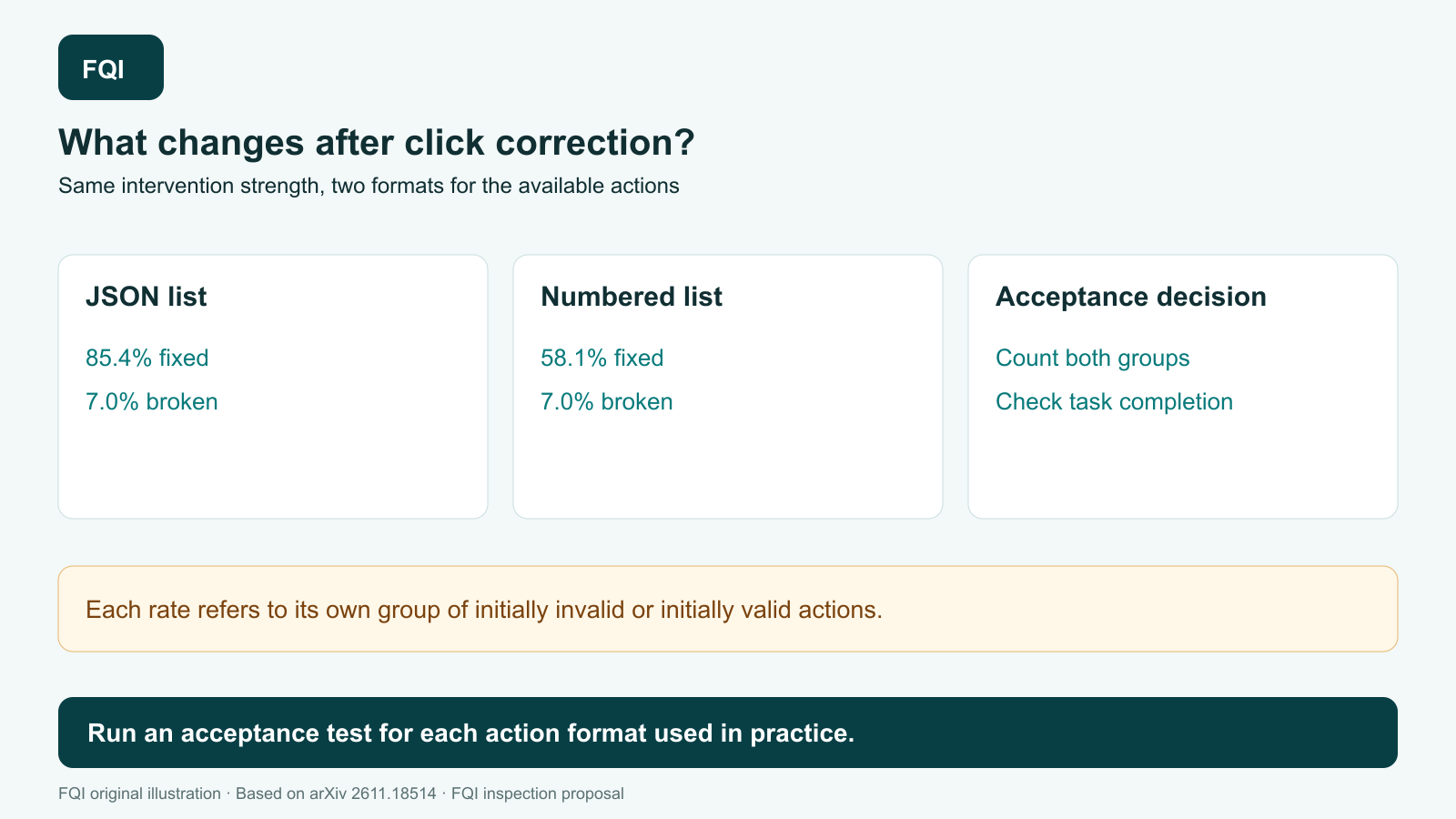
In a separate experiment the authors shifted a model state along a direction identified from the data. At the highest strength compared in Table 6, the intervention corrected 85.4 percent of initially invalid actions in the original format. It also made 7.0 percent of initially valid actions invalid. The two figures have different denominators. A team estimating how many actions it would gain or lose needs to know the frequency of each starting group in its own workload.
The researchers also changed the representation of the action list and the required response. A numbered list replaced the original JSON format while the available elements remained the same. The fix rate dropped to 58.1 percent at the same intervention strength. The break rate was again 7.0 percent. A formatting change that looks minor to a person can therefore affect the value of an intervention that was tested on the original interface.
Limitations and risks
This study examines one model and one kind of selection error. A predictive signal inside the model offers limited evidence about how it arrived at an individual decision. The reported rates describe the tasks examined. Routine actions at another site may be easier, while rare actions with serious consequences may prove harder.
For a local acceptance test, include forms with several similarly named controls. Have a process expert record the intended action and the expected outcome before comparing versions. A reviewer can then distinguish a repaired selection from a technically valid click that takes the order in the wrong direction.
FQI conclusion
Report repaired selections, lost valid selections and successful tasks for each supported representation. Keeping those counts separate gives the process owner the evidence to decide where the intervention helps, where it creates avoidable rework and which screens still require another check before the agent acts.
Sources & transparency
Author version reviewed 2611.18514v1. The workplace examples and proposed acceptance tests are FQI interpretations. Can Mechanistic Interpretability Help Explain LLM Agent Failures? A Case Study on Web Element Hallucination · Version history
Codex assisted with drafting and checked the claims against the cited original sources. Johann Fischer authorized publication on 2026-11-17.