
Executive summary
Generating several possible answers introduces a second quality question. Which one should the system select? A study of four benchmarks removes candidates that violate required properties and then ranks the survivors. The authors also test a separate model that chooses weights for the ranking. The simpler alternatives performed comparably in the reported comparisons. A team considering this design can measure how often the additional model actually changes a decision for the better.
FQI takeaway
- Enforce measurable requirements before calculating a weighted ranking.
- Compare task-specific weights with equal weights and the strongest individual check.
- Specify what happens when every candidate fails a mandatory check.
The principle at a glance
A hard check rejects a candidate for violating a non-negotiable property. A soft check contributes evidence about its relative quality. A model-generated opinion can help assess an aspect that is difficult to compute directly. Its score may also share the generator’s blind spots. The distinction matters because a weighted score can offset a weakness on one dimension with a strength on another. An essential condition needs an explicit treatment that matches its consequences.
Deep dive
The researchers evaluated two kinds of programming tasks, simulated robot plans and answers grounded in retrieved documents. They tested fourteen generator conditions across those benchmarks. The selection procedure stayed the same while the checks changed with the task. A program can be checked for syntactic validity, for example, and a document identifier can be checked against the documents supplied with a question.
A separate model sees the task before seeing the candidate outputs. It chooses optional factors and their weights. Candidates that pass the mandatory checks are scored on the selected factors. These include measured values and model judgments, mapped onto common scales. The mapping is a design choice. It has not been calibrated to express the probability that a candidate is safe or correct.
The component comparisons address where the benefit comes from. Task-specific weighting did not clearly outperform equal weights, a simple combination fitted to data, or configuration by the generating model. On one benchmark the strongest grounded factor alone made better selections. Among candidates left after filtering, several soft scores were close enough that changing their weights seldom altered the winner.
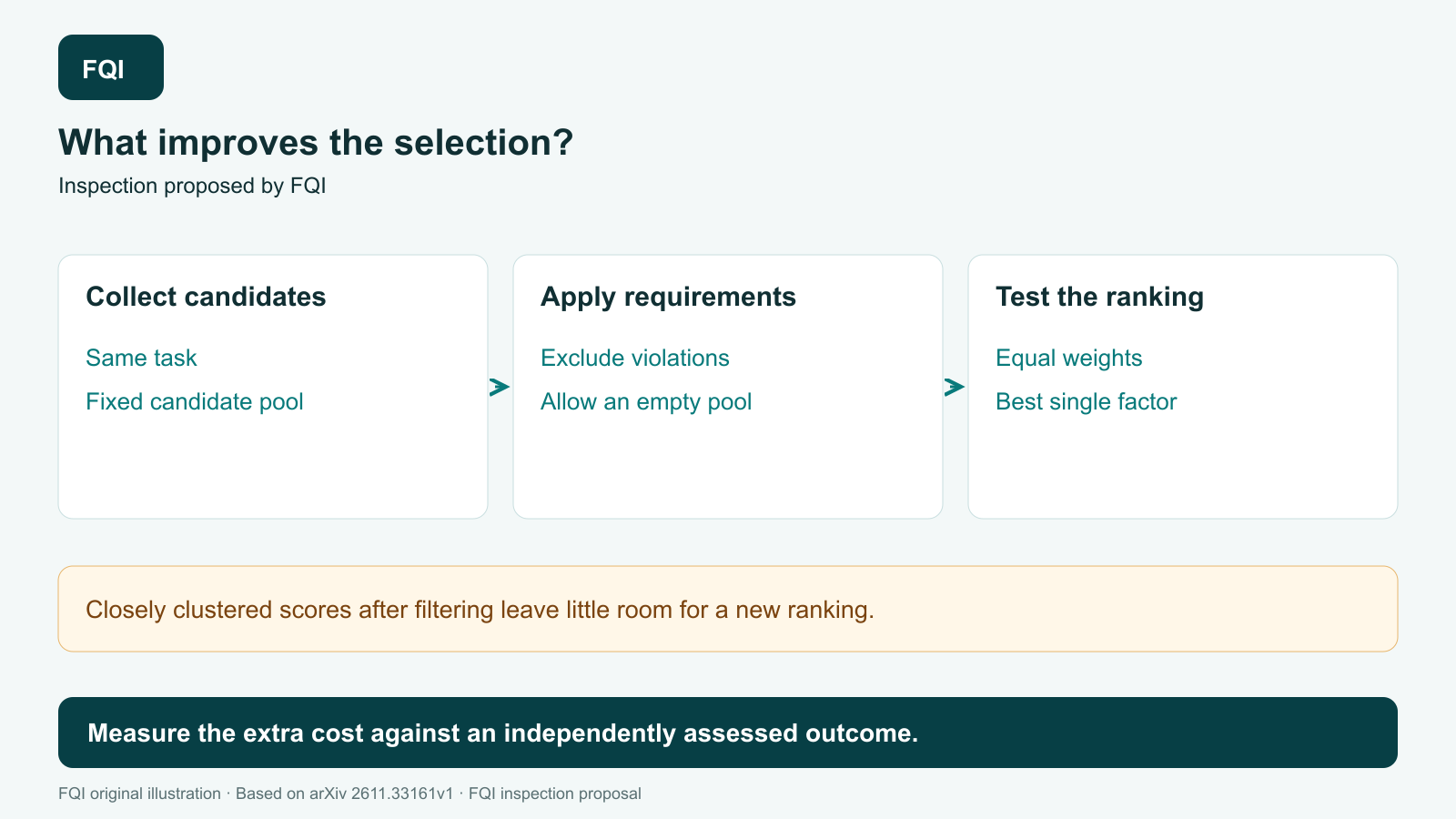
FQI proposes freezing a set of candidates for each local task. Run the existing selection rule, a simple comparison and the proposed weighted selector on the same sets. Have an independent assessment determine the actual outcome for each selected answer. Count tasks where the additional model changed the selection, how often that change helped, and the added time required. Keeping the generator fixed prevents changes in candidate quality from being attributed to the selector.
A separate record should cover tasks for which every candidate failed a requirement. In that situation the procedure abstains and the caller decides what to do next. Even when a candidate survives, it may fail a property outside the scope of all available checks.
Limitations and risks
Open-ended tasks may have few properties that can be verified directly. The remaining selection then depends heavily on model judgments. In one robot condition there was little effective candidate diversity. Similar answers leave little room for any selector to improve performance. Additional configuration also costs time. The findings are conditional on these pools, the chosen checks and their scales.
FQI conclusion
A decision to add another model should rest on measured improvement in selected outcomes. Mandatory checks, independent outcome assessment and simple comparison rules give reviewers a way to identify that contribution. If different weights return the same answer on almost every task, a team can use the evidence to decide whether the extra delay is justified in its own application.
Sources & transparency
Constraint-Aware Test-Time Scoring for LLM and VLM Candidate Selection · arXiv v1
Author preprint v1. FQI checked the cited sections of the original study. Workplace examples and inspection proposals are FQI interpretations. The experiments were not independently replicated.
Codex drafted the texts and checked them against the original study. Johann Fischer authorized publication on that basis on 27 November 2026.