
Executive summary
What can a customer check when an artificial intelligence provider keeps its model weights private? In FlashProve-Next, Liang Song describes evidence for a single request. The proof links the visible answer to a previously committed model configuration and a compatible computation trace. An acceptance decision depends on the scope of that statement. The existence of a compatible trace, the identity of a particular machine and the factual accuracy of an answer are three separate questions.
FQI takeaway
- Identify the request, response and model configuration covered by the proof.
- Record proof generation time separately from verification time.
- Tie every assurance to a particular model, verification profile and set of assumptions.
The principle at a glance
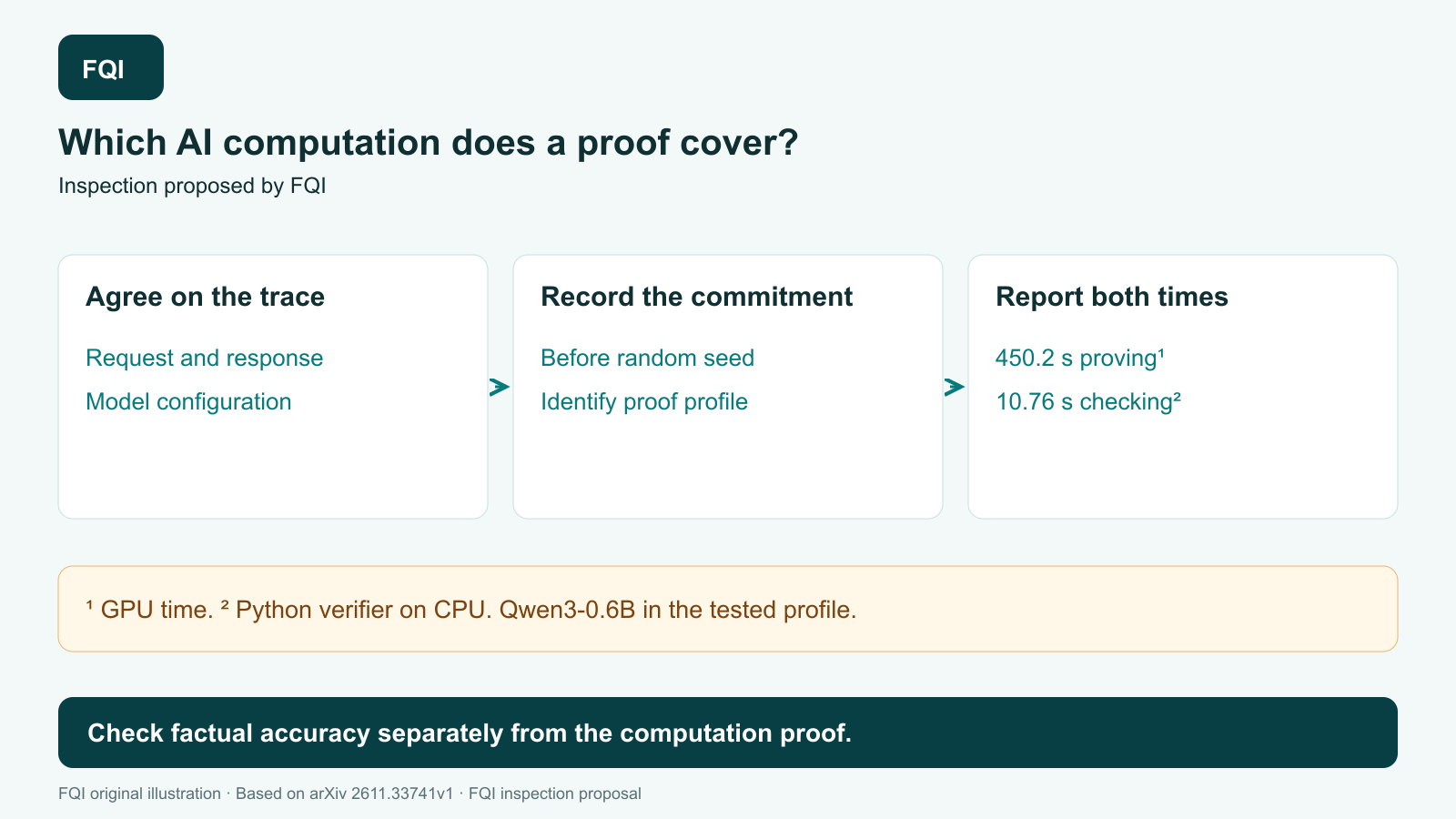
A purchasing team contracts for access to a named language model. A well-written answer reveals little about the configuration that could have produced it. In the proposed system, the provider commits to a configuration and supplies evidence about a trace consistent with the request and response. The profile specifies the numerical tolerances allowed during the computation. A contract needs to identify those tolerances if the customer is to interpret a successful check.
The check concerns possession of a trace. A customer who needs to know which hardware processed the original request has a different requirement. Likewise, a perfectly compliant computation can produce a factually incorrect answer. The team needs its own test for the intended application.
Deep dive
The paper distinguishes a publicly verifiable mode from a mode that takes an external random value. In the second mode, the customer or auditor must retain a request-bound commitment before the unpredictable external value becomes available. This makes the order of events part of the acceptance evidence. A reviewer needs to know who held the reference, when it was received and whether it can be retrieved for a subsequent dispute.
For one Qwen3-0.6B profile, the author reports 450.2 seconds of graphics-processor proving time and a total of 569.8 seconds. The corresponding Python verification took 10.76 seconds on a central processor. Elsewhere the paper reports milliseconds for a Rust verifier checking a particular proof relation. A customer estimating the delay for a complete request must identify the path it will actually use before combining numbers from different measurements.
FQI would trace a sample request from the agreed model reference through receipt of the commitment to the customer’s final check. Recording the profile, the proof and the verifier result in that order also clarifies where each cost falls. The party producing the evidence and the party using it at acceptance can face very different waiting times.
Limitations and risks
The author identifies open work on connecting the implemented circuit builder to the abstract proof system. A complete argument for confidentiality in the folded implementation also remains open. Experimentally examined rounding behaviour and machine-checked mathematical properties carry different kinds of evidence. The prototype provides no independent measurement of answer accuracy. Its performance figures describe the reported experiments and have not been independently reproduced in this review.
FQI conclusion
Procurement can ask for evidence on individual requests while retaining a separate set of application questions with known answers. The acceptance case should exercise the same model configuration and verifier path that the contract calls for in service. If a part of that path rests on an open assumption, recording where it enters the judgment gives the customer a meaningful basis for deciding whether the assurance is sufficient.
Sources & transparency
Original paper · FlashProve-Next v1 · arXiv record
Measurements are attributed to the linked original version. Application examples and acceptance criteria are FQI interpretations. This review did not independently replicate the experiment.
Codex drafted the texts and checked them against the original study. Johann Fischer authorized publication on that basis on 28 November 2026.