
Executive summary
Artificial intelligence (AI) agents can produce hardware descriptions, tests and review reports that share the same blind spot. A study from Lucid Motors and EYL examines this problem in a cryptographic accelerator. Independently selected code mutations exposed insensitive tests. Reviews focused on individual modules found known faults reliably, yet missed many newly planted key-custody faults. Acceptance therefore needs separate evidence for functional correctness, test sensitivity and protection of secrets. Passing generated tests alone does not establish those properties.
FQI takeaway
- Challenge tests with faults that their authoring agent did not select.
- Treat correct calculations and protection of secret data as separate requirements.
- Limit every countertest result to its tested fault class and scope.
The principle at a glance
Mutation testing deliberately changes an implementation. If a test detects the change, the mutation is counted as killed. A surviving mutation can indicate an insensitive test, but it can also leave behaviour unchanged. Survivors must therefore be classified before anyone treats them as actual product defects.
The study concerns register-transfer level descriptions, or RTL: instructions describing how a digital circuit moves and processes data. Language-model agents ported an existing cryptographic design to another programmable chip. AI generated the technical artefacts; the resulting hardware was not itself an AI classifier.
Terms explained
- Mutation testing: deliberately changing an implementation to measure the sensitivity of its tests.
- Negative control: a known faulty case that a check must detect.
- Formal verification: mathematical checking of a stated property under explicit assumptions.
Deep dive
The hardware passed all 85 standardised cases applicable through its interface, selected from 285 cases, plus 484 signature tests with known answers. This is neither complete security coverage nor device certification. The US National Institute of Standards and Technology (NIST) defines the key-encapsulation procedure in FIPS 203; that standard does not validate this particular implementation.
A tool then introduced single-bit mutations into the synthesised circuit description. Across three modules, existing tests killed 303 of 399 usable mutations, approximately 76 percent. Of 96 survivors, 19 were proven behaviourally equivalent, 22 non-equivalent and 55 unresolved. Timeouts counted as kills. Unequal mutation counts across modules also affect the aggregate percentage.
An agent used the survivors to add tests with specification-derived expectations. On a fresh set of 50 mutations per module, the decapsulation kill rate rose from 48 to 74 percent. Those tests passed on the unchanged original implementation. The finding therefore identifies a closed test gap rather than a demonstrated original product fault. The test author knew the fresh set’s random seed, so complete independence was not established.
Module-focused language-model reviews found known flaws in all 54 sessions. For newly planted key-custody flaws, however, they succeeded in only three of 20 sessions. Formal checks flagged every planted custody flaw, although one property was added for the replay. This evidence covers specified properties, not total security.
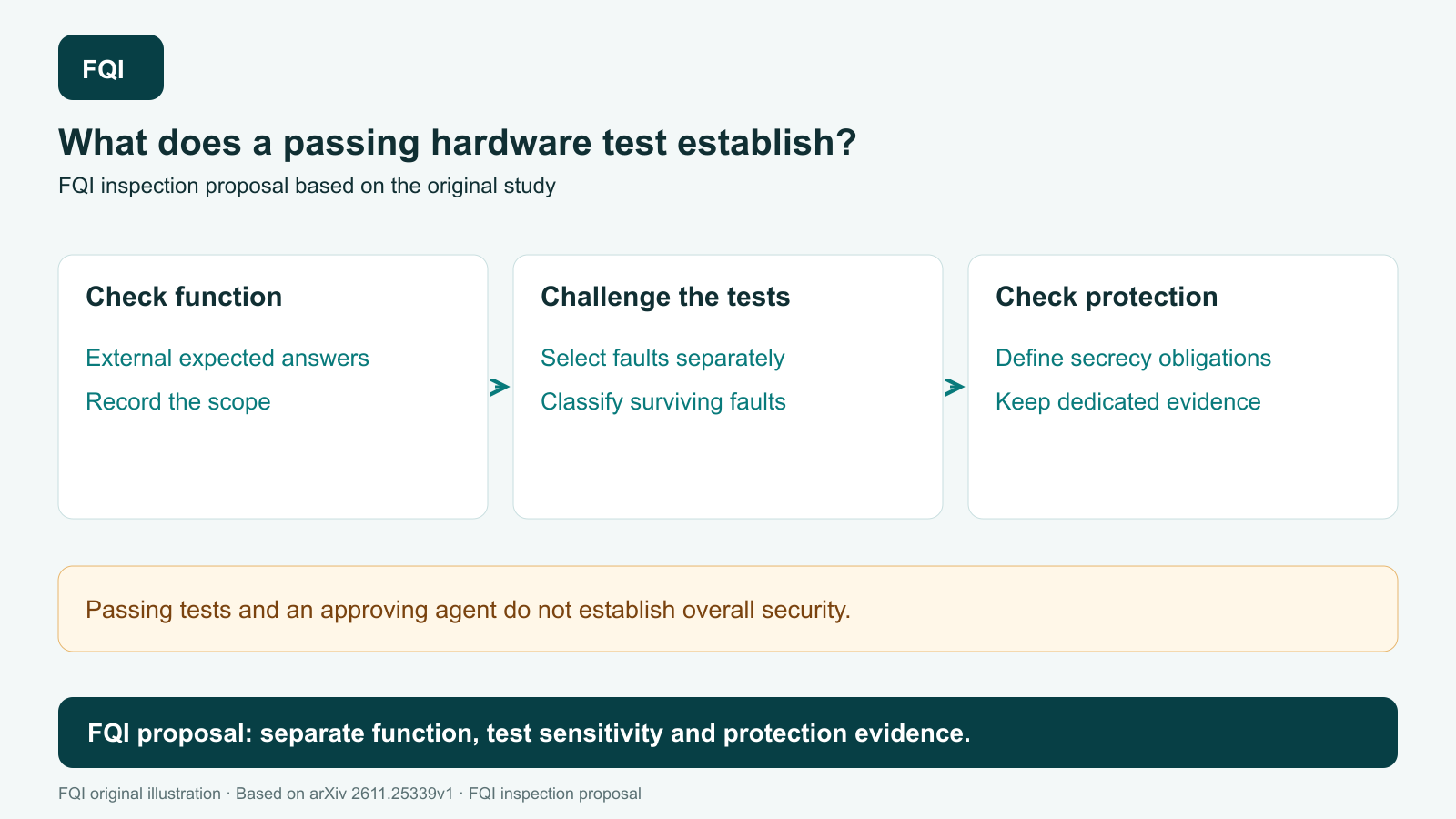
FQI proposes three complementary acceptance records. Compare functionality with an external reference; challenge test sensitivity with separately generated faults; and provide dedicated evidence for critical protection requirements. Record the code version, scope, excluded fault classes and unresolved mutations alongside each result. This is an operational interpretation, not a measured industrial outcome of the paper.
Limitations and risks
The study covers one design family, one experienced operator and limited hardware runs. It has no non-AI baseline and supports no general productivity claim. Single-bit mutations cannot represent all missing mechanisms. Reviewers and parts of the evaluation use the same model family. Results have not been independently reproduced here.
FQI conclusion
A test becomes more informative when its sensitivity is demonstrated. AI-generated hardware should not pass acceptance merely because generated tests succeed and another agent agrees. Functional references, independent fault selection and explicitly stated protection properties answer different questions. Applying this separation to technical inspection software is a useful FQI proposal, but still needs validation in that setting. A high mutation score is supporting evidence within a boundary, not a universal release certificate.
Sources & transparency
- From FIPS to FPGA with LLM Agents: Measuring What Tests and Reviews Miss in Post-Quantum Cryptographic Hardware
- NIST FIPS 203
- Scout discovery reference; not primary evidence
Codex assisted with drafting and checked the claims against the cited original study. Results were not independently reproduced. Operational recommendations and simplified examples are FQI interpretations.
Codex assisted with drafting and checked the claims against the cited original sources. Johann Fischer authorized publication on 2026-11-25 following review by Codex. Individual human reading is not claimed.