
Executive summary
Several language models can rate the same text on a quality scale. An average gives every judge the same influence, even if one barely distinguishes strong from weak answers. AGORA estimates these differences from overlapping ratings. The authors compare the resulting rankings with human judgments. A quality team can use the same comparison to decide whether learned weighting improves on a simple mean for its own material.
FQI takeaway
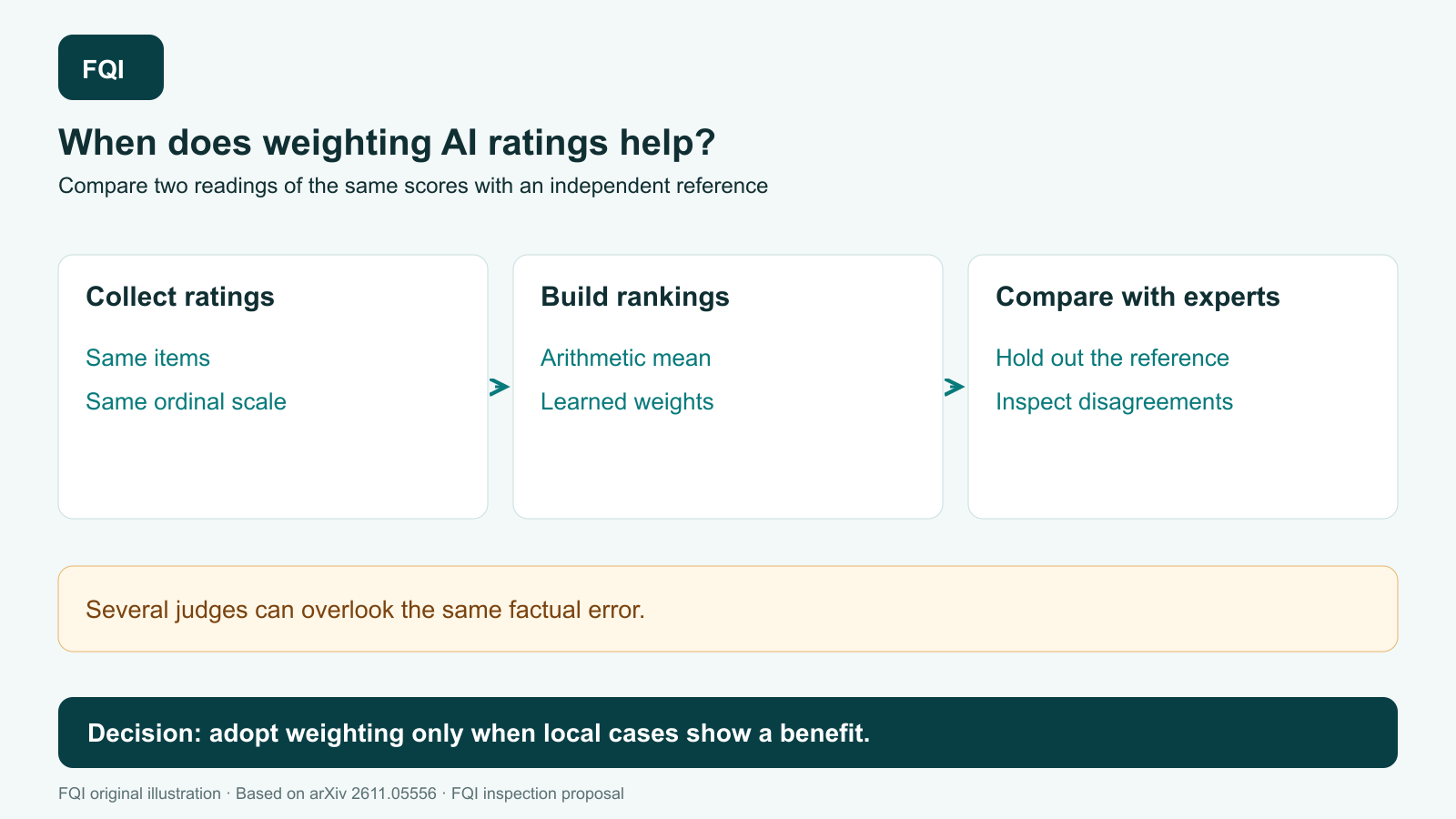
- Give each judge the same items and the same ordered rating scale.
- Compare weighted scores and the simple mean against a held-out expert reference.
- Investigate shared errors before treating several model votes as corroboration.
The principle at a glance
Two judges may differ in severity while agreeing about which cases are better. A third may use the full scale yet respond weakly to real quality differences. AGORA uses a statistical model from test theory. It estimates a quality value that cannot be directly observed for each item. For each judge it estimates sensitivity to differences and the thresholds at which ratings move from one category to the next.
Deep dive
The researchers use three datasets covering summaries, dialogue and machine translation. Learning the weights requires no human grades. Agreement with human reference ratings subsequently serves as an external measure. This separates the cost of checking validity from the number of labeled examples a procedure needs to estimate its parameters.
A competing method needs enough observations for a detailed table of rating errors for each judge. Small samples can leave many cells sparsely populated. AGORA represents sensitivity and thresholds with fewer parameters. At 50 items it outperformed the Dawid–Skene comparison in 98 to 100 percent of the random panels of five judges in the reported comparisons. The outcome measures ranking quality against the reference. It does not say that 98 percent of individual grades were correct.
FQI proposes a trial with responses to customer complaints that experts have already assessed. Begin with separate dimensions such as accuracy and clarity. For the same responses, compute the average and the weighted ranking, then inspect cases that change position substantially. Ask which changes the experts endorse. Replacing a judge with a different model version calls for checking the weights again.
The paper also examines how unevenly individual judges agree with the other members. Weighting helped more often when those differences were larger. A team can use this observation to select cases for investigation. Two models with a shared preference for long answers can appear to confirm each other even on a question where brevity is desirable.
Limitations and risks
The study considers absolute ordered ratings. Choosing the better of two answers requires a different formulation. Several judges can also miss the same factual error. Agreement within the panel cannot reveal that blind spot. Rare errors with serious consequences therefore deserve deliberately chosen examples and a well-documented expert reference.
FQI conclusion
Adopt weighting when it demonstrably improves the ordering of important local cases. A modest set of well-supported reference judgments may serve this decision better than a large collection of unchecked model scores. Include the cases on which the panel still disagrees with experts after weighting. Those groups help determine where an automated ranking can prioritize review and where a specialist still needs to examine every individual answer.
Sources & transparency
The methods and results are reported in the authors’ paper. The proposed workplace test and illustrative examples are FQI interpretations.
Artificial intelligence assisted preparation. Johann Fischer approved this article package for publication on 2026-11-07.