
Executive summary
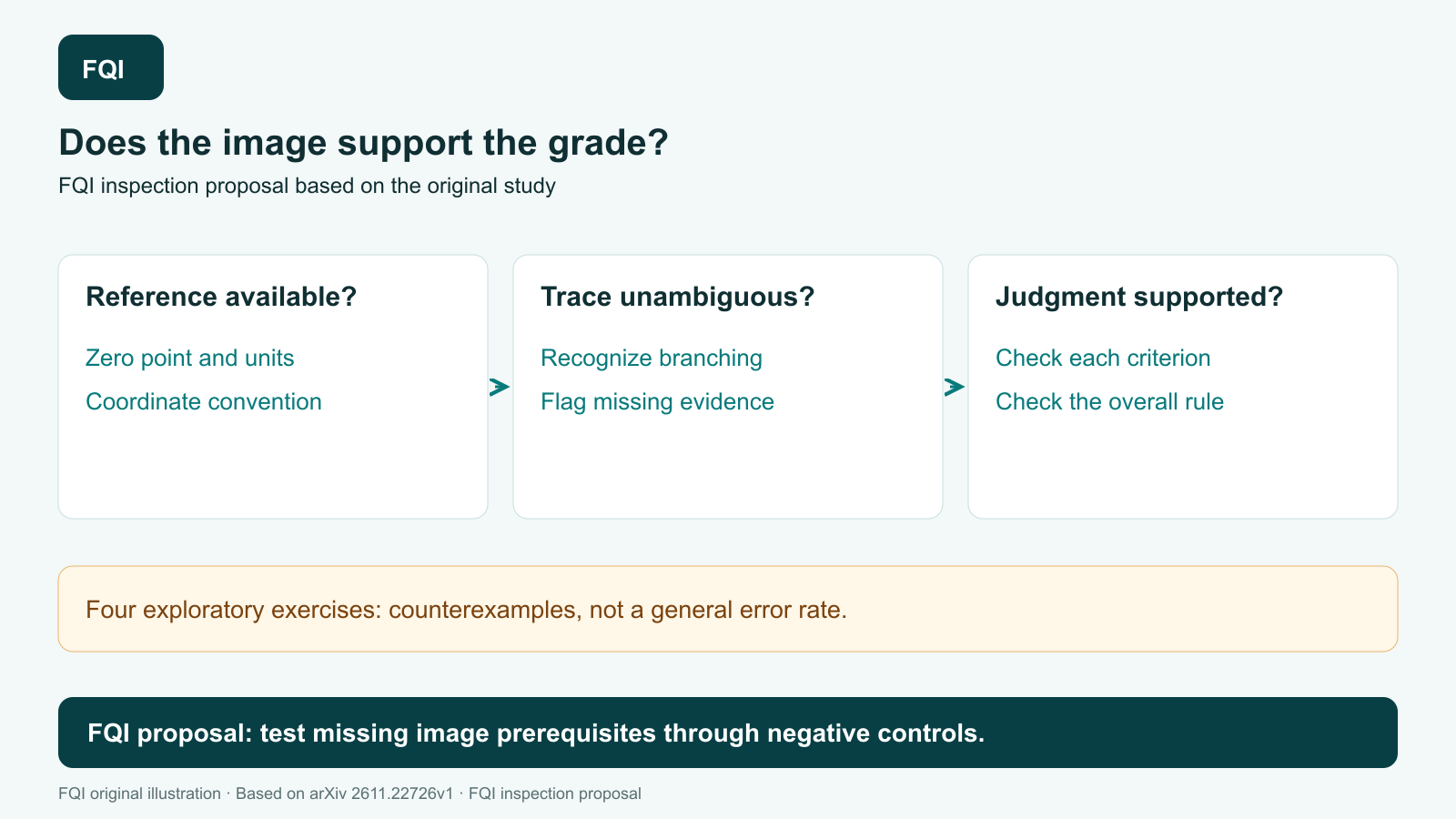
Artificial intelligence (AI) can recognize graph features while awarding credit that the image does not support. An exploratory study involving four kinematics exercises includes a full-credit judgment for a heavily distorted graph with an unclear zero reference. The quality-management implication is specific: required reference lines, scales and unambiguous traces must be present before a technical judgment is accepted. The paper provides counterexamples and inspection ideas, not a general error rate for automated graph grading.
FQI takeaway
- Define the required zero reference and scale as separate inspection conditions.
- Test missing evidence with deliberately constructed negative-control images.
- Report criterion-level correctness separately from the total awarded score.
The principle at a glance
The AI grades synthetic responses to motion exercises. In a velocity–time graph, a horizontal line first establishes constant velocity. It establishes rest only when that line can clearly be placed at zero. Shape alone is insufficient if the reference is missing.
A position–time graph requires a different interpretation. A horizontal interval represents constant position over time. An isolated turning point does not establish a sustained stop. The study examines whether model judgments respect these distinctions using the evidence actually present in the image.
Deep dive
The authors generate distorted images and progressive transformations toward reference graphs. The two directions use different model and instruction configurations. Their results should therefore not be treated as one uniform controlled comparison. The analysis focuses on documented judgments and their corresponding images.
One problematic example receives ten out of ten points. Its image contains disconnected fragments and branching traces, and zero velocity is unclear. Nevertheless, the grader justifies full credit by asserting a stopping interval on the zero line. The technical claim exceeds the visible evidence.
Other examples show correct distinctions. A position graph with a narrow maximum but no horizontal interval loses the stopping points. Its total score can still reach the selected threshold because forward and backward motion receive additive credit. This separates two questions: whether an individual criterion was graded correctly and whether the overall scoring rule supports the intended decision.
Some rules also apply numerical thresholds to slope or curvature. Without a coordinate convention for unnumbered graphs, such thresholds are not unambiguously applicable. A qualitatively rising curve may be visible even when the claimed numerical comparison cannot be checked.
FQI recommends paired images with similar traces but deliberately different reference information. One image contains a clear zero line and scale; the other does not. Define the expected response beforehand: the grader must recognize the missing prerequisite and must not infer a certain numerical result from it.
A simplified operational example is AI inspection of an exported measurement chart. Exporting may crop an axis label while leaving the curve visible. The unit or reference line is then absent. A robust inspection process should treat this as a distinct case. The study did not test that industrial application; it illustrates the transfer here.
Criterion-level evidence should remain attached to the judgment. A total score can conceal whether the model correctly recognized one feature but invented another. The inspection record therefore needs the original image, the applicable criterion and the evidence used to award each component of the score.
Limitations and risks
Four exercises and selected outputs cannot establish a representative error frequency. Increasing image distortion was not shown to produce a reliably monotonic decline in scores. The cases demonstrate that a failure can occur, not how often it will occur in an intended deployment.
An auxiliary surrogate model does not explain the original grader’s internal decisions. Likewise, a saved explanation is not direct evidence of how the model reached its judgment. What can be checked is the relationship between image, criterion and award.
FQI conclusion
The inspection opportunity concerns the prerequisites of a claim. Before AI evaluates a curve, the necessary reference must be visible. FQI recommends including missing scales, ambiguous zero lines and branching traces as explicit negative controls. These checks complement correct standard images and help prevent plausible explanations from concealing insufficient evidence. Representative operational testing is still needed before acceptance.
Sources & transparency
- Stress Testing a Multimodal Large Language Model Grading Assistant on Kinematics Graph Reading
- Stress Testing a Multimodal Large Language Model Grading Assistant on Kinematics Graph Reading
Codex assisted with drafting and checked the claims against the cited original study. Results were not independently reproduced. Operational recommendations and simplified examples are FQI interpretations.
On 2026-11-21, Johann Fischer authorized editorial approval following source and quality review by Codex. Approval relies on that review; individual human reading is not claimed.