
Executive summary
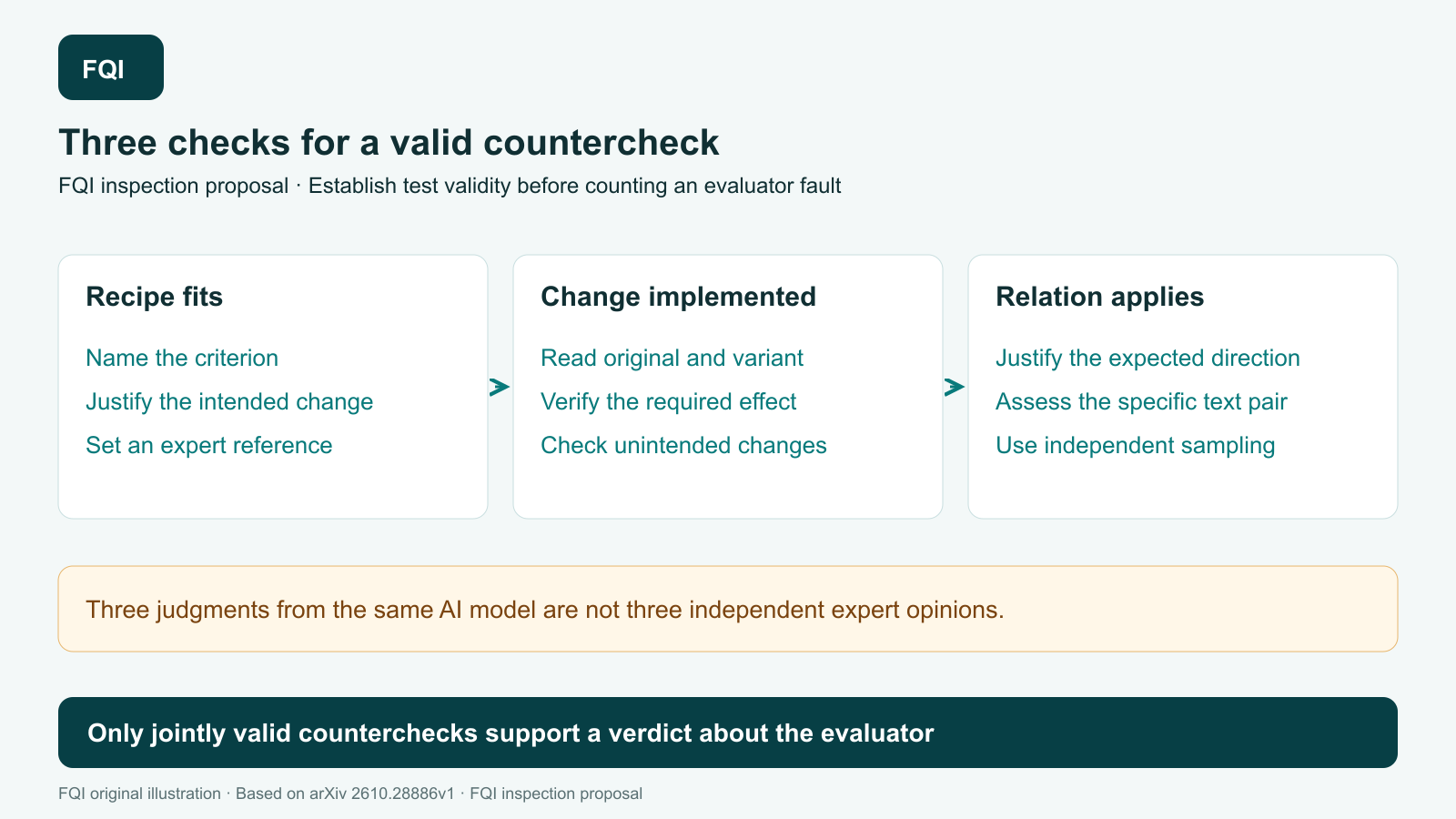
An automatically generated countercheck can itself be faulty. Deliberately worsening a text and observing an unchanged assessment by artificial intelligence (AI) does not yet demonstrate an evaluator defect. SANE checks three prerequisites: whether the recipe fits the criterion, whether the change was actually implemented, and whether the expected score relationship applies to the specific case. This separation helps quality teams reject unsuitable tests before interpreting their results as evidence that an AI evaluator is weak or dependable.
FQI takeaway
- Specify which change should have which defensible effect for each evaluation criterion.
- Check the test recipe, generated text and expected score direction separately.
- Supplement AI-based validity decisions with expert-checked reference cases and an independent sample review.
The principle at a glance
A simplified FQI example: an AI system evaluates whether a summary remains faithful to its source. A test generator is instructed to falsify a number, which should reduce the score. If the number accidentally remains unchanged, the countercheck has failed. If only style changes, a lower score may not be justified for this criterion.
Such relationship tests do not require an exact target value. They require a justified relation between the original and variant, such as a lower assessment. That relation must make sense for the criterion and apply to the text pair actually generated.
Deep dive
SANE generates criterion-specific test recipes for AI evaluation of summaries. The examined criteria include faithfulness, fluency, coherence, professionalism and toxicity. The work separates the intended test property from the actual text transformation.
The first validation stage checks whether the recipe fits the required property. The second checks whether the generated variant implements it. The third assesses whether the expected relationship between scores holds for that individual case. Only their joint success justifies counting a conflicting score as a possible evaluator failure.
The reported comparison produces 133 scorer–recipe candidates. Of these, 108 are considered aligned and 77 validated; 31 detect evaluator faults. The comparison method produces 35 candidates, including 21 validated tests and ten that detect faults.
These are different inventories. A larger number of valid tests does not imply a higher validity proportion: relative to all candidates, the proportions are about 57.9 and 60 percent respectively.
For FQI, that distinction is essential. A generator can produce more useful counterchecks while still requiring a similar review effort per candidate. Before adoption, a team should establish whether additional failure types are found, which expert checks remain necessary and how many generated cases must be discarded.
The study’s validity procedure uses repeated judgments from another AI model. Three calls to the same model are not three independent expert opinions. The included human investigation covers a narrower faithfulness assessment; it does not validate every generated case across all criteria.
As independent methodological guidance, the voluntary AI Risk Management Framework from the National Institute of Standards and Technology (NIST) supports regular assessment of evaluation metrics and independent review. It validates neither SANE nor its performance figures. FQI proposes a small reference collection of known valid and invalid transformations.
Experts determine the expected relation beforehand. The automatic validity checker is then assessed on how often it handles those cases correctly.
Limitations and risks
The authors disclose affiliations with Cisco and Anduril. The work therefore includes commercial involvement. The supplementary NIST source supports the evaluation principle; this draft does not rely on an independent reproduction of the experimental results.
A recipe judged valid by a majority of sampled instances does not make every generated instance valid. The generator, validity checker and evaluated model may also share failure modes. Results concern the tested summaries and criteria. Relations must be justified again for technical inspection reports or other specialist domains.
FQI conclusion
For FQI, assessing an AI evaluator should begin by validating the countercheck used against it. This extra stage turns unusual scores into traceable defect reports: the criterion is known, the change is established and the expected response is justified. An operational pilot should document that chain and begin with a few relations experts can inspect directly.
Its value lies in better-supported conclusions and more specific improvement actions. The quantity of automatically generated variants is not a sufficient success measure.
Sources & transparency
Primary source: SANE, original full text v1, Sections 3–7. Normative guidance: NIST AI RMF 1.0, MEASURE 1.2, 1.3 and 2.13, a voluntary framework. No independent reproduction; the example and pilot proposal are FQI interpretations. AI-assisted article, approved for publication by Johann Fischer on 2026-10-23.