
Executive summary
A robot can correctly identify a delicate obstacle yet move past it inappropriately. OSMA-Bench examines this gap between semantic understanding and executed movement in artificial intelligence (AI) navigation. Collision avoidance and correct image description are separate findings. Quality assessment must also determine whether clearance and speed suit the situation. FQI derives a paired testing principle that compares different obstacles under similar route geometry. Simulation findings do not replace physical safety acceptance.
FQI takeaway
- Vary obstacle type while keeping route geometry as similar as possible.
- Record hazard judgment, selected parameters and executed movement separately.
- Require additional caution where the application risk assessment justifies it.
The principle at a glance
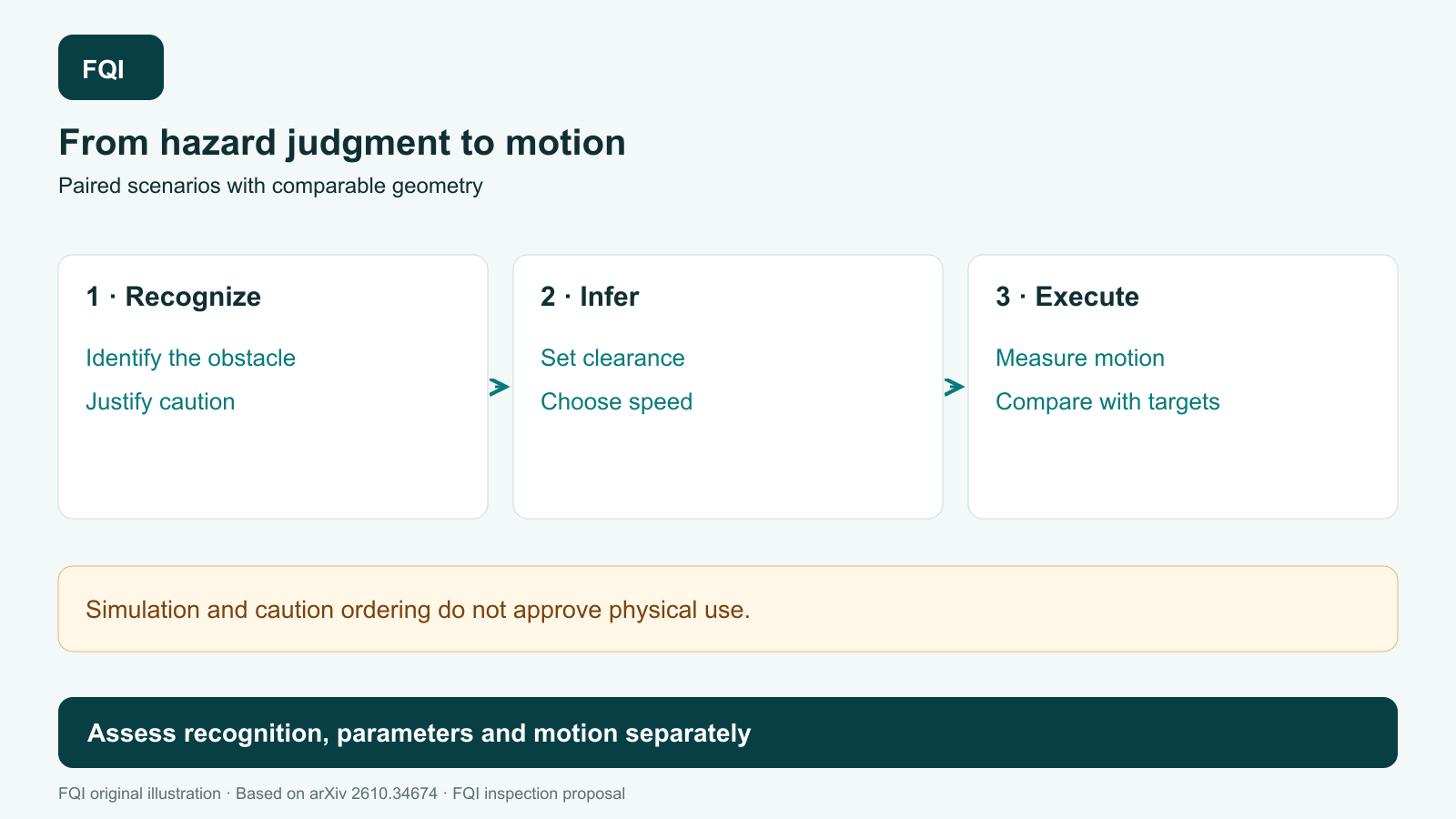
The investigated models process images and language to produce navigation instructions or actions. The inspection problem lies in translating meaning into movement. A correct statement about an obstacle is only an intermediate result.
OSMA-Bench uses spatially matched scenarios and compares motion features against a specified caution ordering. Its Semantic Sensitivity Index measures this ordering, including clearance and proximity-dependent movement. It is a diagnostic measure rather than a complete safety certificate.
Deep dive
The design combines obstacle identities, routes and kitchen layouts in 625 scenarios. Evaluated models do not consistently adapt their movement to the expected caution. For particular language-model-based controllers, a separate stage for inferring movement parameters improves the connection. This identifies a specific interface where an apparently understood hazard can be lost during execution.
For a local experiment, FQI recommends a manageable paired series. A simplified example is a transport robot passing a robust container and a delicate inspection setup. The responsible team specifies application-appropriate clearances and speeds. The simulation provides no automatically transferable numerical limits.
Record three levels side by side: the recognized situation, the derived target parameters and measured movement. A correct first level followed by unchanged parameters indicates a different problem from correct parameters followed by incorrect execution. This distinction helps direct corrective work to the right interface.
Paired cases must account for available space. A larger obstacle changes passage geometry and can itself force different clearance. Document size, position, path width and measurement definition together. Do not automatically attribute an apparent obstacle-type effect to semantics when geometry also changed.
Include a case without elevated caution requirements. A system that moves very slowly everywhere might improve an apparent ordering while undermining the process purpose. Acceptance should jointly show goal completion, contact avoidance, appropriate caution and unnecessary restriction. Changes to the model, parameter selection or movement controller require repeating the same series.
For each comparison, preserve the scenario definition and resulting trajectory. That record allows a later reviewer to distinguish a parameter recommendation from the motion actually produced and to identify conditions that the initial test did not cover.
Limitations and risks
The study covers simulated household navigation and a limited model selection. Its caution ordering is benchmark-specific, not universal. Only selected movement features are measured; approach direction and behavioral legibility are not fully represented. Obstacle size can partly explain differences. Consequently, the results establish neither a particular safe speed nor approval for physical robots.
FQI conclusion
FQI values the continuous evidence path from recognized hazard to movement. A correct judgment should lead through documented parameters to appropriate observed behavior. The next step is controlled case pairing with predefined responses. It complements conventional success and collision metrics and helps diagnose situations in which an AI system describes a scene correctly but does not adapt its action accordingly.
Sources & transparency
Methods, evaluation and limitations reviewed on 3 November 2026. Scientific preprint; no independent reproduction by FQI. Operational examples and inspection proposals are FQI interpretations, not additional experiments in the study. Artificial intelligence assisted preparation. Johann Fischer explicitly approved this article package for publication on 2026-11-04.