
Executive summary
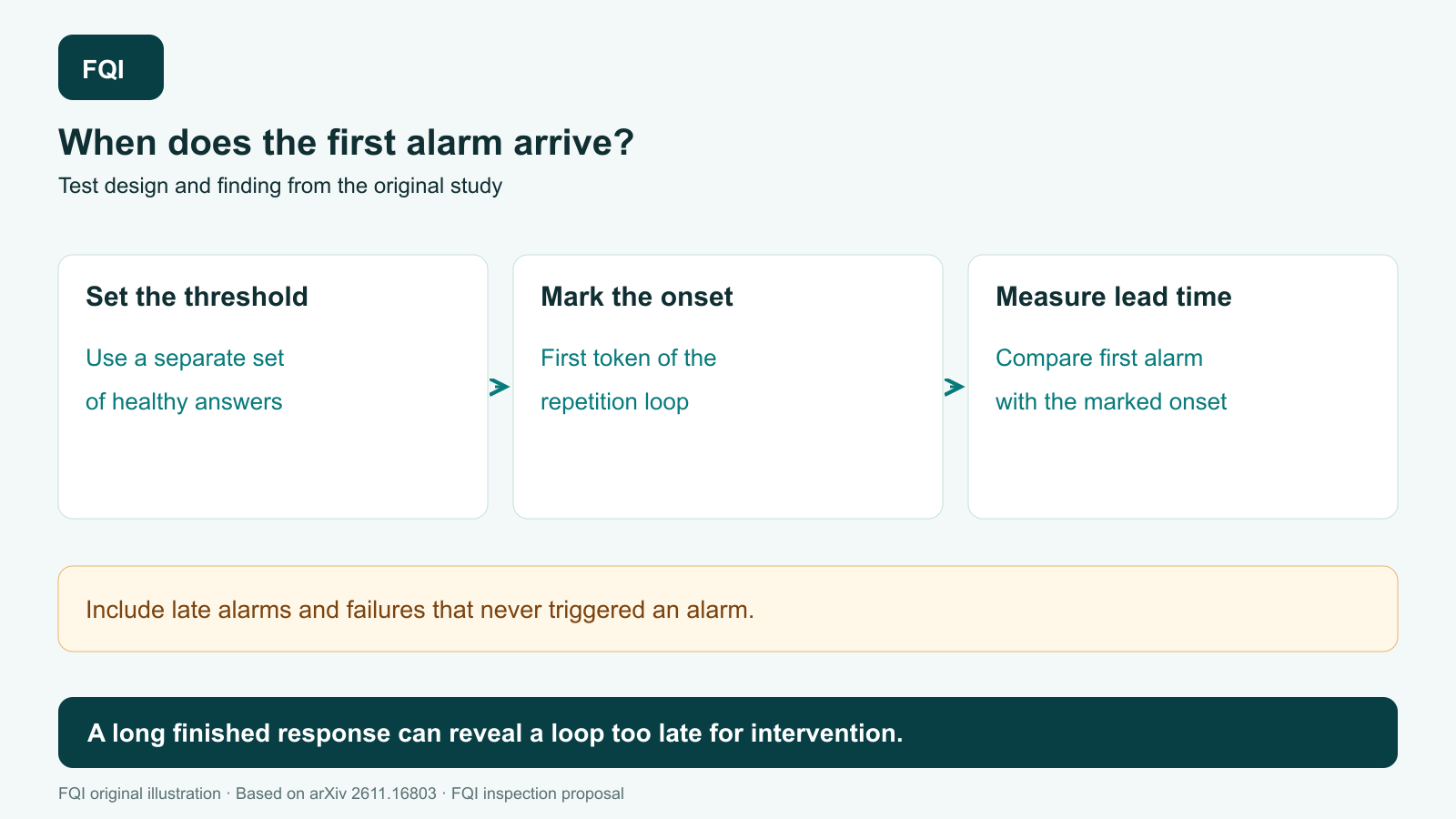
A language model can keep writing until a repeated phrase exhausts its output allowance. In a study of such loops, a rule based only on final response length could almost perfectly distinguish failed outputs from healthy ones. By then it was too late to prevent the loop. The study evaluates monitors at a fixed false-alarm budget and compares the first alarm with the marked onset of repetition.
FQI takeaway
- Mark the output step at which the failure begins before assessing the monitor.
- Set the threshold using separate validation data with healthy responses.
- Count late and missing alarms as well as warnings that arrive in time.
The principle at a glance
Language models generate short units called tokens (technical text-processing units). A monitor may inspect each step as the answer grows. A completed answer reveals information that was unavailable while the first words were being written. In particular, a loop may run all the way to the length limit. Classifying such an answer afterwards tests a different capability from issuing a warning while a change of course is still possible.
Deep dive
Prewarn separates three tasks. A system can classify a completed response, detect a failure already underway or warn before its onset. The researchers first choose a threshold on validation data. For repetition, the false-alarm budget is the share of healthy responses that trigger at least one alarm. The comparison in Table 1 uses a 5% budget for calibration. The observed rate on new cases can differ.
Across three open language models, the authors compare learned monitors that read internal states with simple rules that use the response length or emitted tokens. On two models, learned monitors warned before onset on most responses that eventually degenerated. Monitors with similar scores for classifying finished answers differed in their warning behavior. An alarm far ahead of onset may indicate general susceptibility. That is different from locating the point at which a focused intervention would help.
A quality team could replay recorded outputs one step at a time. It would keep the first alarm for every answer and include healthy answers, late alarms and failures without an alarm. The gap between first warning and marked onset gives a lead in tokens. For an operational decision, the team would also measure how long the chosen response takes. A lead of a few tokens may be enough for an automatic pause but too short for a person to intervene.
The practical decision also depends on the cost of an unnecessary pause. Set that cost beside the cost of allowing a loop to continue when selecting an operating threshold.
Limitations and risks
The observed failure was repetitive degeneration. A factual error might develop over several sentences and have no equally clear onset. These results do not supply a threshold for that task. Some model interfaces also hide internal states. A test report should identify the model version and the information available to the monitor.
FQI conclusion
Before enabling automatic interruption, inspect false alarms, missed failures and usable lead together. Comparing a long healthy answer with a shorter answer that begins looping can reveal whether a monitor recognizes the developing failure or simply reacts to length.
Sources & transparency
The study is an author preprint. The proposed operational checks are FQI interpretations. Detection Is Not Early Warning: Evaluating Token-Level Alarms on Language Model Failures · Version history
- Approval status: First-use explanations and the glossary were added systematically on 16 November 2026. This version awaits renewed human review and is not approved for publication.
Codex assisted with drafting and checked the claims against the cited original sources. Johann Fischer authorized publication on 2026-11-16.