
Executive summary
A convincing explanation does not establish that its proposed correction would have helped. ReplayRCA assesses artificial intelligence (AI) diagnoses through a controlled intervention in a recorded agent run. Its comparison condition is particularly useful for quality management: the corrected step is compared with replaying the original action. This separates spontaneous recovery from additional repair effect. FQI recommends the principle for reproducible test environments, explicitly excluding experiments on live processes with irreversible consequences.
FQI takeaway
- Compare the correction and unchanged replay from the same initial state.
- Evaluate retrospective diagnosis separately from intervention during execution.
- Include unnecessary interventions in already successful runs.
The principle at a glance
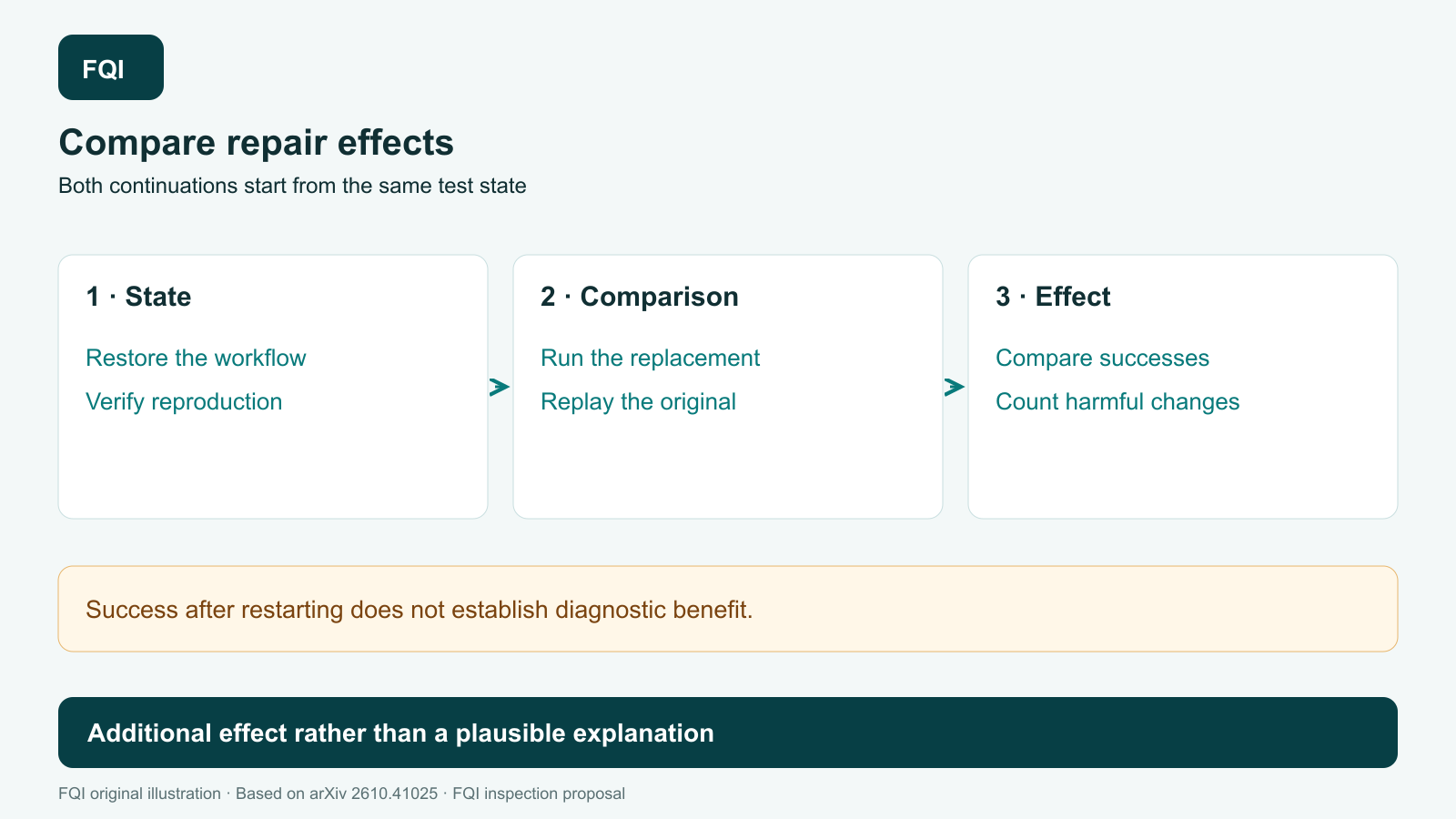
Here an agent is a language model performing multiple steps through tools. The investigation restores the state before a selected step. Another model may replace exactly one action. The original agent then continues. In the control condition, its original action is executed again.
The difference between success rates describes the intervention’s added benefit. Agreement with a human failure description is thereby supplemented with an observable effect test.
Deep dive
ReplayRCA uses a deterministic, procedurally generated administrative environment. Before intervention, replay must reproduce stored observations exactly. The study separates retrospective diagnosis from live oversight. In the latter, the supervising model does not yet know the final outcome. Successful runs supplement failure cases, and interventions incur a specified cost.
FQI proposes transferring this idea to an acceptance experiment for complaint handling. This is an independent interpretation, not an industrial process evaluated in the paper. Start with a completed test case containing an incorrect assignment. Freeze the task, data and software revision. A diagnosis must name a particular step and permitted replacement action. A general recommendation to “check more carefully” is insufficient.
Run the replacement and the original action several times from the same state. Assess success against predefined conditions: correct case number, correct assignment and complete documentation. A better-written final message does not count as repair if the incorrect assignment remains.
The team should add a successful neighboring case. A diagnosis system that always recommends intervention might improve many failures while damaging good runs. Record unnecessary interventions, effort and newly introduced errors. The process determines how these costs are weighted; the paper’s weighting is not a universal quality criterion.
For live oversight, expose only the information available at the intervention point. Knowledge of the eventual outcome would make the task easier. Report retrospective and live results separately. This prevents good after-the-event analysis from being mistaken for evidence of reliable early warning.
The test record should preserve the selected action, observed continuation and outcome rule. If replay itself no longer reproduces the original state, stop the comparison and investigate that discrepancy before attributing any improvement to the diagnosis.
Limitations and risks
The investigation concerns a synthetic deterministic environment and selected stable failures. Operational systems may contain changing data, external services or nonrepeatable actions. Models and computing budgets also affect comparisons. Small rank differences do not establish a general ordering. FQI has not reproduced the code or model runs. A local experiment requires an isolated environment, a verified restoration path and independent success conditions.
FQI conclusion
The central quality question is what a diagnosis improves beyond restarting. A paired comparison makes that question measurable and requires concrete corrections. FQI recommends beginning with a small, fully reproducible case set before comparing diagnosis tools. Retrospective root-cause analysis, timely intervention and false-warning costs remain separate evaluation dimensions with different evidence requirements.
Sources & transparency
Methods, evaluation and limitations reviewed on 3 November 2026. Scientific preprint; no independent reproduction by FQI. Operational examples and inspection proposals are FQI interpretations, not additional experiments in the study. Artificial intelligence assisted preparation. Johann Fischer explicitly approved this article package for publication on 2026-11-04.