
Executive summary
A detector for unreliable AI (artificial intelligence) answers may work well in its original domain and lose value elsewhere. AdaST investigates how several detectors can be combined using a limited number of labeled target examples. It uses internal language-model states and adapts detector weights to the target domain. The quality-management implication is that transferred reliability signals require local assessment. Good ranking of answers also does not by itself establish a suitable operational decision threshold.
FQI takeaway
- Compare source detectors with a target-only alternative under the same labeling budget.
- Keep variants of the same question together when splitting data.
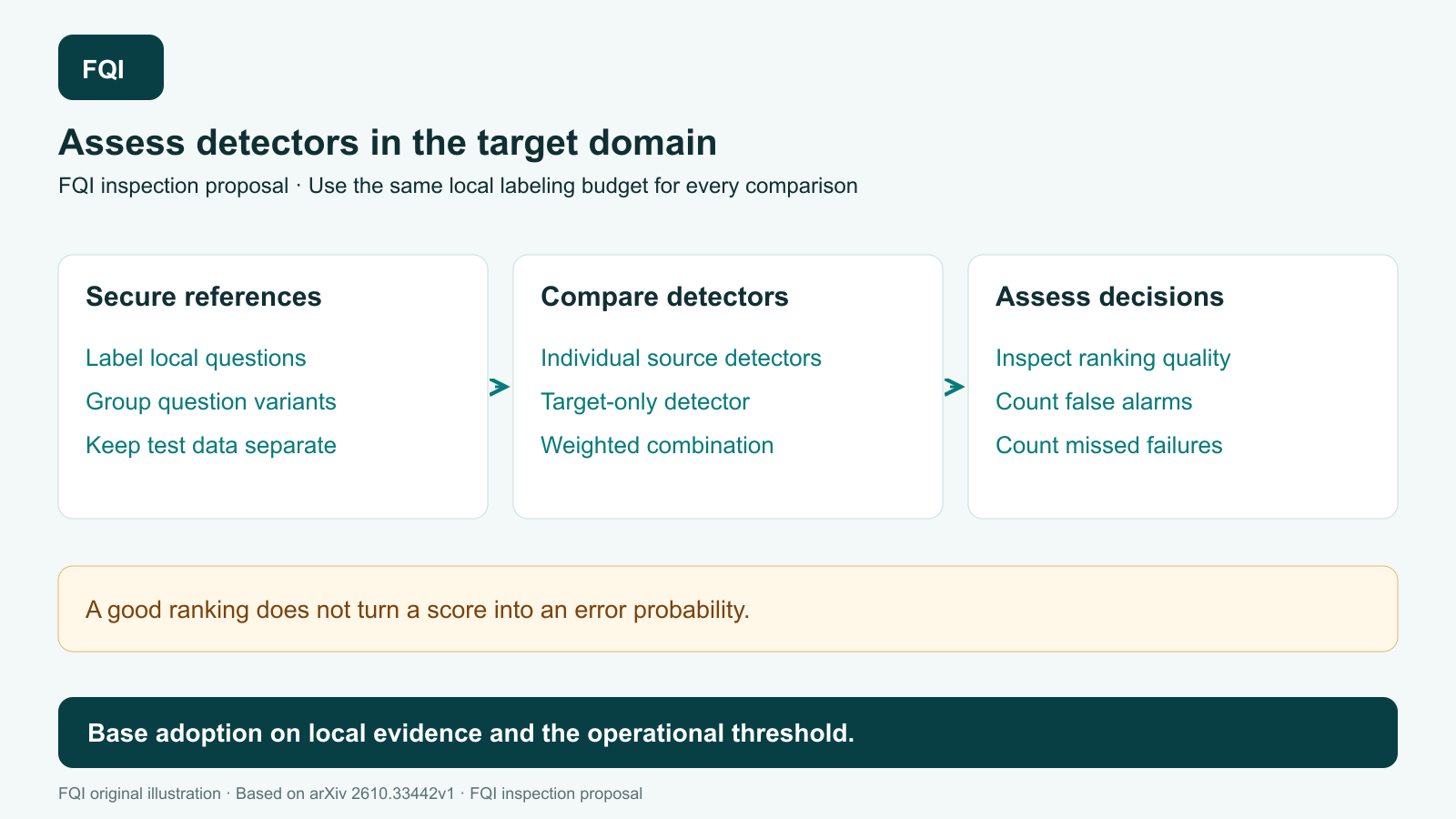
- Measure ranking quality separately from error types at the intended threshold.
The principle at a glance
A reliability detector assesses an answer without replacing the substantive answer itself. Here it uses internal model representations: numerical states formed during processing.
AdaST generates semantically equivalent versions of questions and uses contrasts between responses labeled reliable and unreliable. It constructs domain-specific detectors and combines them with a target-domain detector. The combination weights are learned from reference judgments available in the target domain.
Deep dive
The study considers two tasks: detecting unreliable factual answers and evaluating the correctness of next steps in mathematical step-by-step inference. Six question-answering datasets serve in turn as source and target domains for the first task. Seven mathematical subjects are used for the second.
For factual questions, two paraphrases and multiple responses are generated per original question. The target-label budget counts original questions, not every derived response independently. All variants of a question remain together in data splitting. This prevents closely related examples from entering both fitting and apparently independent evaluation.
Weights are estimated using three-fold cross-fitting. Predictions used for weighting each subset come from a model fitted without that subset. Performance is compared at different target-label budgets rather than treating all supervision levels as equivalent.
The paper reports particular benefits from transfer when target examples are scarce. As more target labels become available, the target detector receives greater weight. It also shows that strong ranking discrimination does not automatically produce balanced classification of both response classes.
FQI proposes a controlled comparison with the same local data budget. Report the target-only detector, individual source detectors and their combination separately. Then measure false alarms and missed unreliable answers at the intended operating threshold. The consequences of these error types should be specified before comparing alternatives.
Reference-label construction also belongs in the report. The study uses similarity assessment against reference answers and another model to judge mathematical steps. In an operational application, contested cases should receive substantive expert review. A transferred detector can only be meaningfully assessed relative to the procedure defining its target classes.
The comparison should be repeated when the intended domain changes. A useful combination in one collection is not automatically the right allocation for another. Keeping question-level grouping, label budgets and threshold choices visible makes the comparison reproducible and prevents a nominal transfer benefit from being explained by extra supervision or related examples leaking across subsets.
Limitations and risks
The method requires access to internal model states and cannot be applied unchanged through every closed interface. Specific open models and bounded tasks are evaluated; safe transfer to arbitrary enterprise data is not established.
Automatically generated labels can be wrong. Selecting clearly positive and negative mathematical steps may underrepresent difficult boundary cases. A high ranking score also does not establish that a reported risk value is a calibrated probability.
FQI conclusion
The practical question is whether an existing detector genuinely helps in the new domain at the same assessment cost. Answering it requires local references, clean data separation and a fair target-only comparison. FQI recommends adopting the combination only when it improves the relevant error profile under intended operating conditions. More source detectors or a higher aggregate score alone do not justify an acceptance rule. The decision remains tied to local evidence and an explicit threshold.
Sources & transparency
Primary source: Adaptive Transfer of Representational Signatures for LLM Reliability Detection; versioned full text reviewed. Preliminary research; methods, relevant results and limitations were assessed. No independent reproduction.
AI-assisted article. Operational examples and inspection proposals are FQI interpretations, not additional study results. Approved for publication by Johann Fischer on 2026-11-01.