
Executive summary
Two simulated vehicles can trace nearly identical paths while reacting quite differently to each other. Researchers trained an artificial intelligence (AI) model to generate the behaviour of human-driven vehicles at urban intersections. They compared generated encounters with recorded traffic using five measures of relative motion and timing. The results suggest a separate acceptance question for a simulator. Does it reproduce the interaction that the downstream test is meant to exercise?
FQI takeaway
- Measure relative motion and timing alongside geometric path error.
- Distinguish encounters with restricted visibility and different response patterns.
- Test the generator on conditions beyond the intersection used for training.
The principle at a glance
A vehicle can follow the recorded route and still start slowing down at the wrong moment. Its final position may then look plausible even though another vehicle encountered a very different situation. The study uses a learned generator to represent what a driver could see and how the driver might respond. Multiple learned components capture different driving styles. A refinement step adjusts the generated motion towards observed interaction patterns.
Deep dive
The researchers used two intersections from the INTERACTION dataset. One served as the main evaluation site, while data from the other supported a transfer experiment. The five interaction features included estimated time to collision and radial relative speed at the beginning and end of a speed adjustment, plus the duration of the adjustment. Their distributions describe variation across encounters.
The team compared these distributions using Jensen–Shannon divergence, a measure that decreases as two distributions become more similar. Across all interacting encounters at the main intersection, divergence fell by 39.9% to 87.1%, depending on the feature, relative to the SMART configuration used for comparison. Average and final position errors were quite similar between the methods. The percentage reductions refer to the distribution distance for five selected features.
The authors also removed individual components. Including the field of view reduced divergence on four of the five features in the partially obscured subset. The initial relative speed was the exception. Experiments on driving styles and residual learning examined further contributions. Training at one intersection and adjusting the model on the other provided a limited test of transfer.
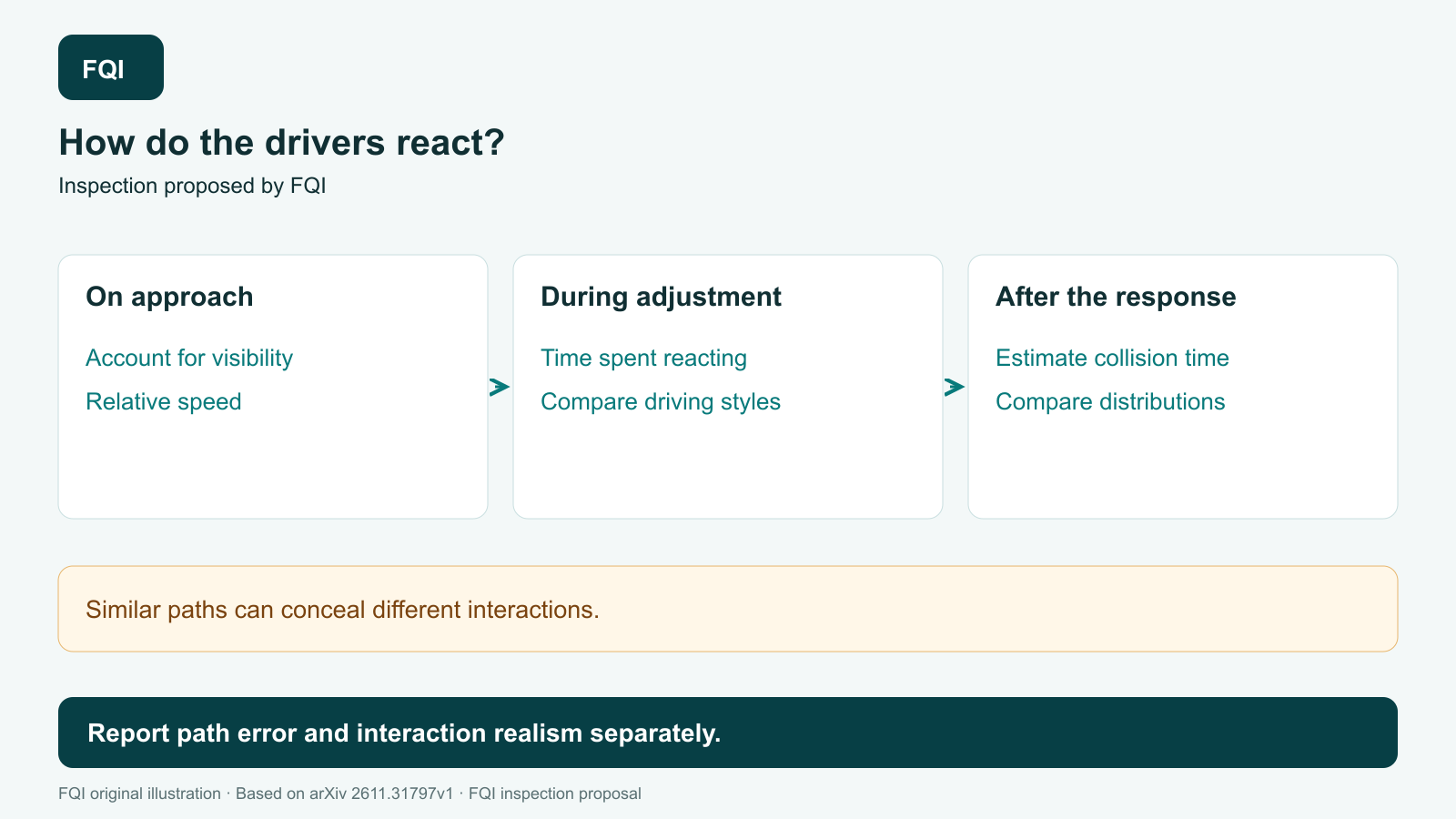
For a local acceptance plan, FQI would start with the interaction a test is supposed to represent. Reviewers could group encounters by visibility and compare the onset, duration and end of the response. They would retain position errors alongside these measures. This makes it possible to investigate a replay that follows the expected path but produces an unusual encounter at the point where the tested system must act.
Limitations and risks
The generator learned using the same types of features that appear in the distribution comparison. The reported agreement is therefore only one piece of validity evidence. Two intersections cannot represent every road layout or traffic population. Coupling the generator to an interactive driving world model with generated video was proposed as future work. The study did not measure a reduction in accidents.
FQI conclusion
A simulator used as an inspection tool needs evidence for the property that drives the inspection decision. These results show how path accuracy and interaction realism can give different impressions of the same generated encounter. FQI would record both results, identify the types of encounter covered and repeat the comparison when the generator, target site or intended test changes.
Sources & transparency
A Generative AI Agent to Emulate Interactive Human-driven Vehicles for Automated Driving Testing in Urban Areas · arXiv v1
Author preprint v1. FQI checked the cited sections of the original study. Workplace examples and inspection proposals are FQI interpretations. The experiments were not independently replicated.
Codex drafted the texts and checked them against the original study. Johann Fischer authorized publication on that basis on 26 November 2026.