
Executive summary
A language model can identify a relevant event in a report and still connect it to the wrong cause. A study of 300 aviation accident narratives separates concept extraction, verbatim quotations, output structure and directed relationships. The best observed input strategy depends on which of these properties is measured. Teams using extracted information to populate an incident database therefore need a reference for each property and a way to withhold uncertain links.
FQI takeaway
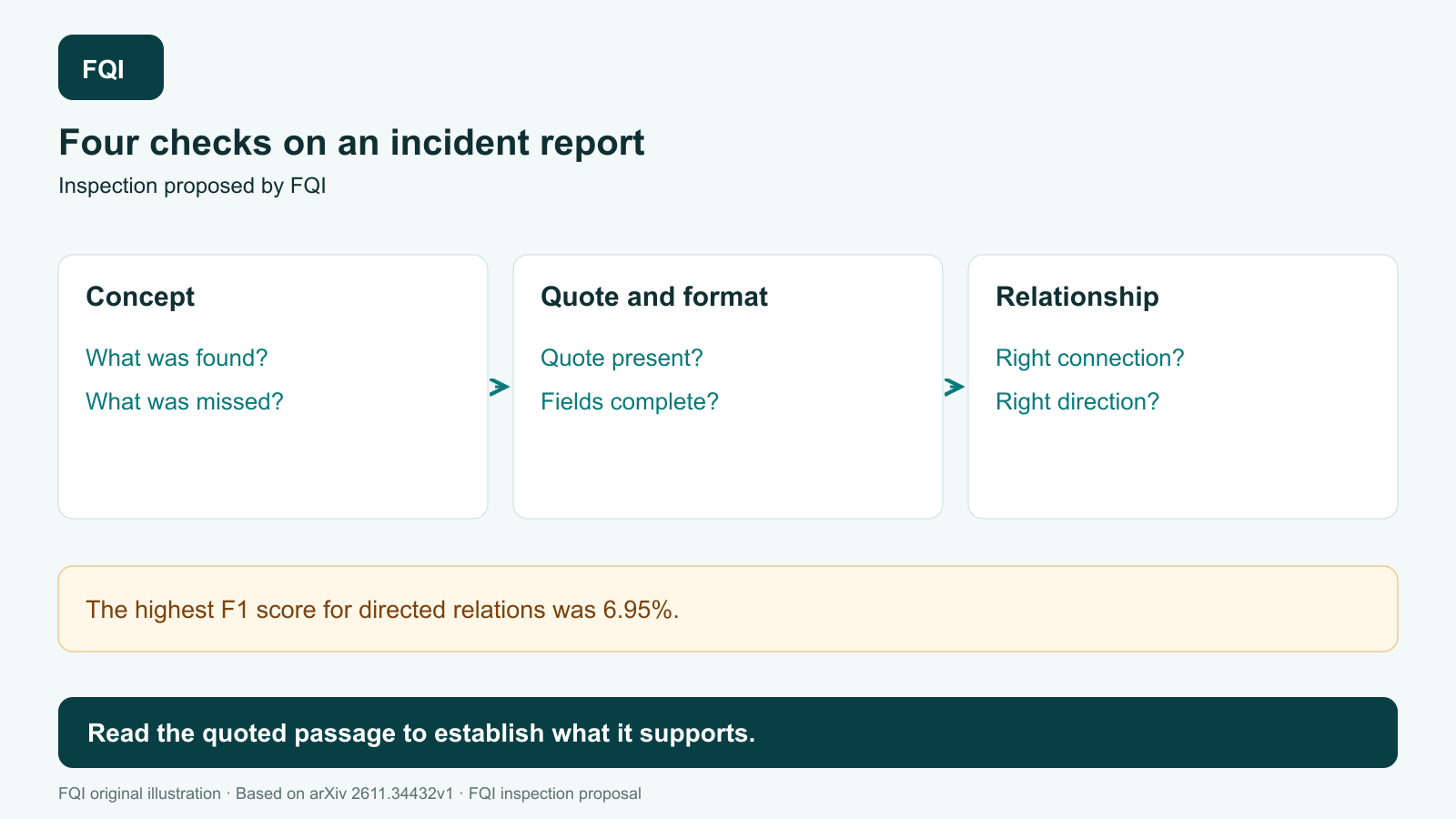
- Score the extracted concept, supporting passage, required fields and direction of each relationship separately.
- Read a quoted passage in context to check that it supports the attached claim.
- Keep failed generations and truncated outputs visible in the evaluation.
The principle at a glance
The researchers asked a compact language model, SmolLM2-1.7B-Instruct, to extract concepts such as events and technical factors. A directed relationship expresses which concept is linked to which other concept and in what role. It is possible to identify both concepts correctly while reversing their relationship. The team compared four input conditions, ranging from no demonstration to fixed or automatically retrieved examples. Retrieval here selects demonstrations of the task.
Deep dive
The agreed reference comprised 3,763 concepts and 467 directed relations in 300 US National Transportation Safety Board narratives from 2000 to 2020. Three reviewers reconciled the annotations. Only 232 cases had usable, unambiguous individual submissions for the original agreement analysis. The final consensus therefore answers a different question from independent agreement before discussion.
Examples improved concept extraction. The micro-F1 score combines precision, the proportion of proposed concepts that match the reference, and recall, the proportion of reference concepts recovered. It rose from 3.72% without examples to 32.27% with retrieved demonstrations. The paired comparison did not establish a clear aggregate advantage over a fixed set of several demonstrations.
Retrieval improved the rate of verbatim evidence spans by 5.42 percentage points over fixed demonstrations. At the same time, the proportion of generation attempts that met all structural requirements declined by 9.33 points. These measurements have different denominators. They describe two consequences of changing the input strategy, rather than two parts of one overall accuracy score.
The highest relation F1 was 6.95%. Across the four conditions, 40.8% of proposed relations had structural defects. A database built from apparently plausible concept lists could thus contain unreliable connections. A correct quotation presents another challenge. Exact text matching establishes that the words occur in the report. The passage may still refer to a different event.
For an internal acceptance exercise, FQI would prepare independently checked concepts, supporting passages and directional relationships for the same reports. The test can then identify whether a failure arose in extraction, quotation, formatting or linking. Automated checks can flag a missing field. A reviewer can decide whether a valid field contains the right assertion. Recording performance by category and report length makes sparse or difficult cases easier to see.
Limitations and risks
The main experiment covers one model, one reporting authority and one historical period. An exploratory comparison on 35 nonrandomly selected reports cannot establish general performance. The intervals are conditional on the reconciled annotations. Exact matching can reject legitimate paraphrases, and it cannot assess whether a quote justifies an inference. The study did not measure a prospective reduction in analyst workload.
FQI conclusion
An acceptance record should show which extracted elements a reviewer may reuse and which require another judgment. The numerical trade-off in this study illustrates why one headline score can obscure an operational problem. An incident database may tolerate a missing optional field yet require explicit confirmation before recording that one event caused another. The test should reflect those different consequences.
Sources & transparency
Evaluating Aviation Safety Knowledge Extraction with SmolLM2: From Zero-Shot to Retrieval-Grounded Prompting · arXiv v1
Author preprint v1. FQI checked the cited sections of the original study. Workplace examples and inspection proposals are FQI interpretations. The experiments were not independently replicated.
Codex drafted the texts and checked them against the original study. Johann Fischer authorized publication on that basis on 27 November 2026.