
Executive summary
An artificial intelligence (AI) model can get the total temperature change right while assigning the wrong share to individual emissions. That matters when someone plans to change just one of them. Christopher Womack and colleagues tested an emulator, a model trained to reproduce the output of a slower climate simulation. In their simple climate model, one deliberately varied training scenario helped the emulator separate the effects of different emissions better than six conventional scenarios. For quality planning this suggests a question worth asking before commissioning another expensive run. Which inputs will the model have to assess individually, even though they usually change together in the available records?
FQI takeaway
- For each proposed intervention, check whether the input in question varied independently of the others in the training records.
- Assess gradual changes and abrupt transitions separately if both fall within the intended operating range.
- Reserve an independent comparison when evaluation tasks have already influenced the design of the training data.
The principle at a glance
In several conventional climate scenarios, carbon dioxide and methane emissions follow similar paths. The model sees plenty of examples of their joint movement. A good fit to the resulting temperatures can therefore coexist with an inaccurate estimate of each substance’s contribution. If one substance is reduced while the other keeps rising, their relative contributions become important to the prediction.
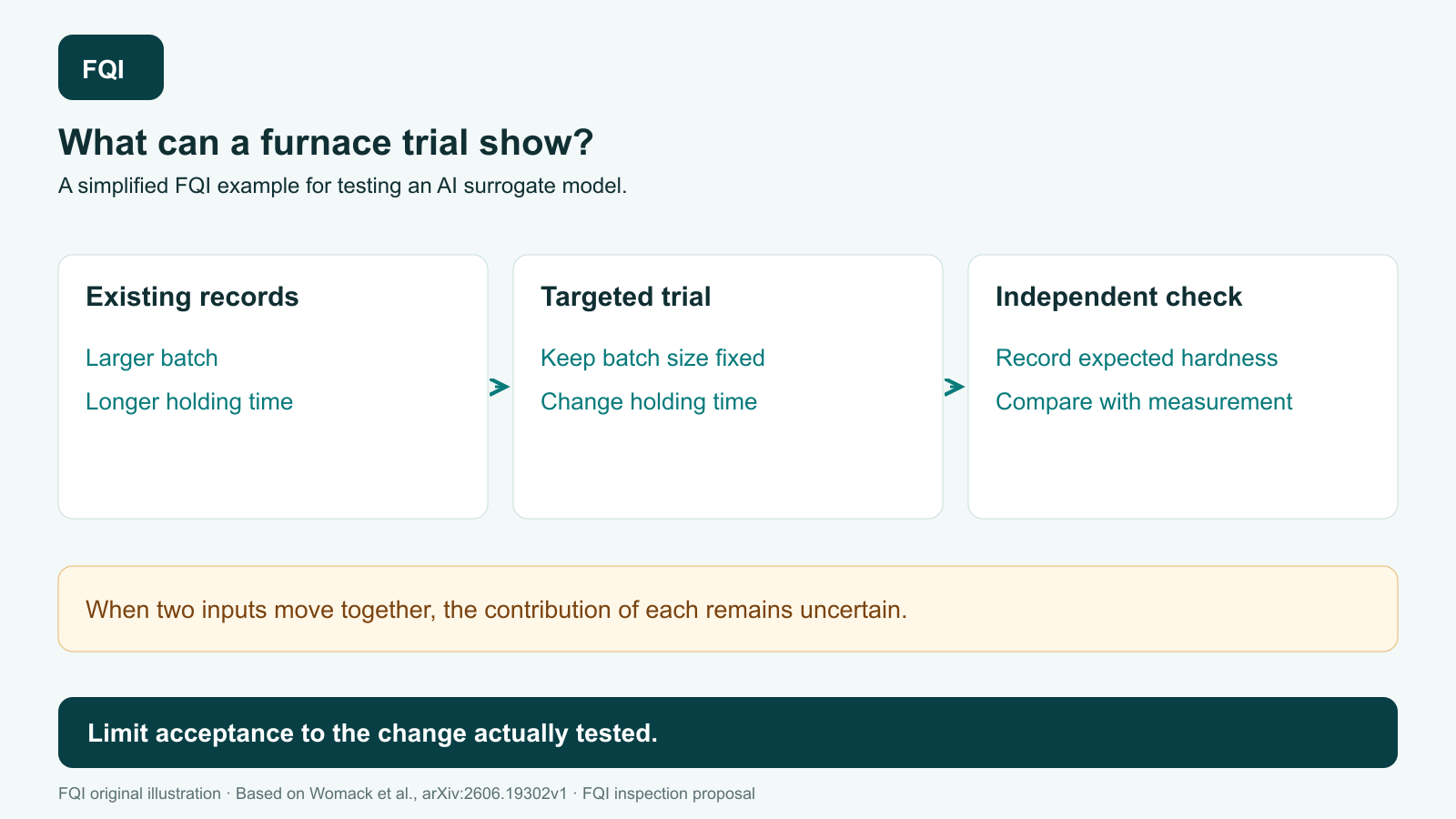
Consider a simplified manufacturing example. In past furnace runs, larger batches usually spent longer in the furnace. A model might predict final hardness accurately across these runs. Yet the records tell the team little about what will happen if it increases holding time while keeping the batch size fixed. A trial at constant batch size could help answer that question. The furnace is an illustration developed by FQI. The researchers studied climate simulations.
Deep dive
The team used a simple physical climate model to calculate how changes to a training trajectory affected prediction error. It adjusted the trajectory repeatedly. Some of the resulting curves changed rapidly. They were designed to expose the emulator to distinguishable responses. Their value as training inputs did not depend on whether they resembled likely future emissions policies.
Sulfur illustrates the consequence. The emulator trained on conventional joint trajectories overestimated the cooling contribution of sulfur. That error mattered in a scenario in which the sulfur intervention changed the balance among emissions. The pace of change mattered as well. Optimizing for gradual changes offered little benefit, and sometimes reduced performance, when carbon dioxide increased abruptly. A single average error across those cases would obscure a boundary that matters to the user.
The researchers also reported which evaluation scenarios influenced the optimization. For a further comparison, they transferred the training trajectories designed with the simpler model to a climate model of intermediate complexity. They evaluated temperature responses averaged by latitude band there. This transfer experiment was restricted to carbon dioxide alone. For industrial acceptance testing the distinction is practical. Once a team uses evaluation results to choose its next training run, an additional comparison that did not influence that choice can provide a more independent check.
Limitations and risks
The reference values came from physical simulations. The study did not measure accuracy at a production plant or establish that one trial will generally suffice. Machine condition, measurement resolution and permitted operating ranges constrain the changes a plant can safely make and interpret. If two inputs cannot be tested separately, the acceptance record should specify the combinations that were actually examined.
FQI conclusion
Start with the decision the model is expected to support. If the team wants to change holding time, the acceptance test should cover that change at a comparable batch size. With evidence only for joint changes, the team can assess performance for that combination. The unresolved decision about a single input then gives the next trial a specific purpose.
Sources & transparency
Methods and results are drawn from the authors’ June 17, 2026 version, especially Table 1 and the single- and multiple-forcing experiments. MIT’s November 12 report identifies the journal article of the same title. The furnace example and the acceptance procedure are FQI interpretations. Womack et al., arXiv v1 · MIT News
Codex assisted with drafting and checked the claims against the cited original work. Johann Fischer authorized publication on 2026-11-12.