
Executive summary
Artificial intelligence (AI) can reject obviously foreign text while retaining plausible false details as memories. A small study examines this difference when an agent regularly rewrites its text memory. Heavy detail corruption reduced final recall, whereas conspicuous random text did not show the same consistent effect. The quality-management implication is specific: test believable incorrect details as well as obvious disruption. The findings concern a restricted experimental setup and do not establish a general theory of human dreaming.
FQI takeaway
- Test plausible false details separately from obviously unrelated text.
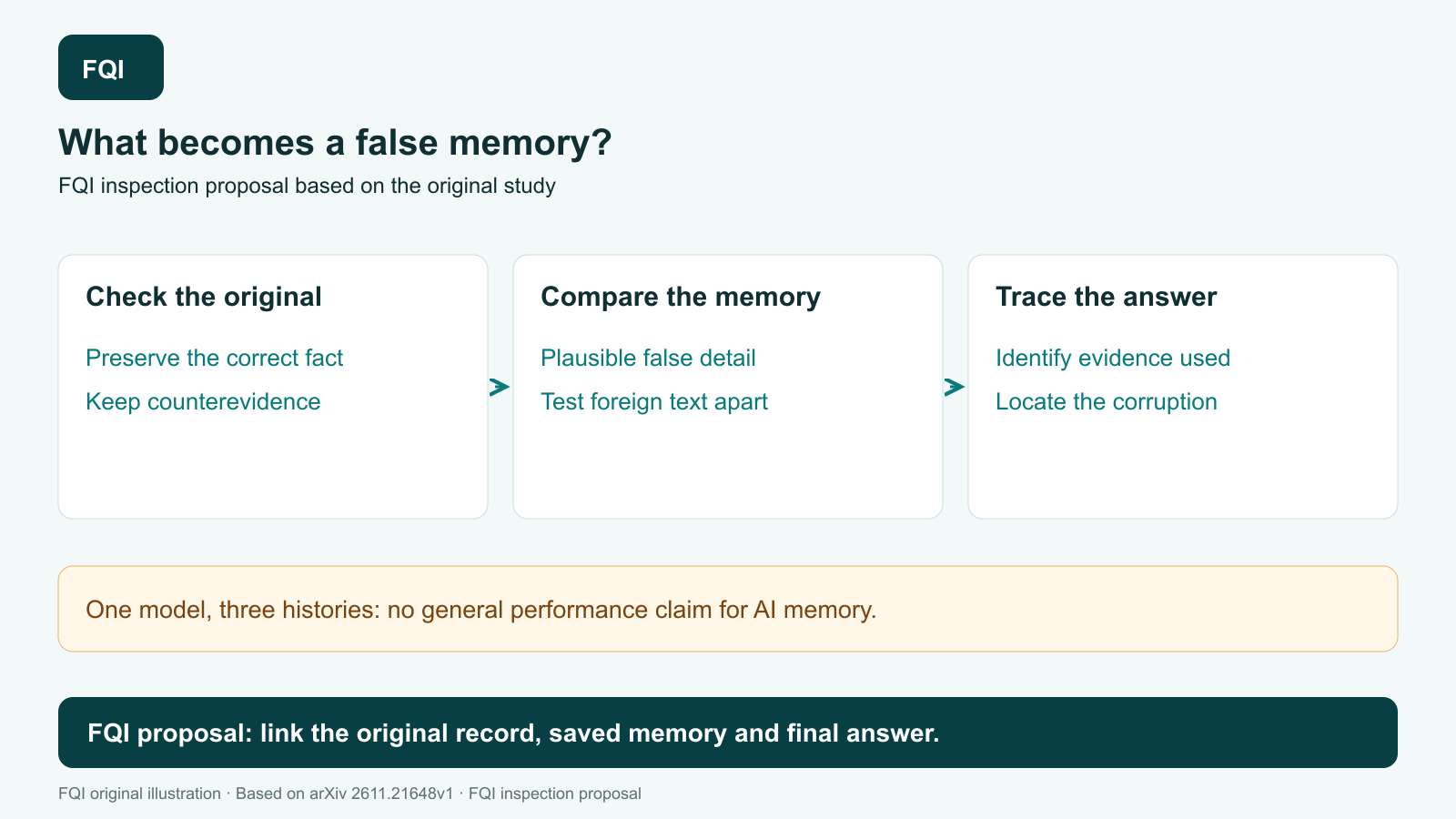
- Inspect the original conversation, rewritten memory and subsequent answer together.
- Preserve correct counterevidence and check whether it actually corrects false information.
The principle at a glance
The agent uses a language model whose model weights remain fixed. After each simulated day, it rewrites conversation material into a text memory for later use. This changes stored information; it does not retrain the underlying model.
The study corrupts selected conversation turns before the rewrite. One condition introduces plausible wrong details. Another uses conspicuous text from a novel. The comparison tests whether the system can resist credible misinformation as well as recognize obvious noise.
Deep dive
Eric Zou studies Claude Opus 5.5 over ten simulated days using LongMemEval material. Ten conditions are combined with three conversation histories, giving 30 runs. Depending on the condition, five, ten, twenty or forty percent of turns are corrupted. A growing memory limit constrains what the agent retains.
Final recall uses 84 answerable questions per history. Without the regular rewrite, mean recall is 14 percent; with a clean rewrite, it is 76 percent. At forty percent detail corruption, the reported value is 60 percent. These figures describe the particular experiment and should not be presented as general performance levels for agent memory.
Conflicting evidence is especially revealing. Plausible wrong details were stored as facts even when another turn contained the correct information. For 67 affected questions, the paper reports forty percent correct answers under heavy detail corruption, compared with 75 percent under clean rewriting. Obviously unrelated material was more readily recognized and excluded from memory.
FQI derives a three-stage inspection path. First, mark the known correct fact in the original conversation. Next, inspect what the rewrite stores. Finally, determine which information supports the subsequent answer. This separates information loss, corruption and incorrect use of otherwise available evidence.
A simplified FQI example concerns a complaint history in which one delivery date is replaced with a believable wrong date. The correct confirmation remains elsewhere. The test asks for both the date and its supporting record. This is a proposed inspection idea, not an industrial experiment reported by the paper.
A practical assessment should retain the original and modified turns rather than just the final score. Otherwise, a wrong answer might be attributed to forgetting when the system actually retained and preferred an incorrect detail. Such traceability helps identify the stage that needs improvement without claiming that the study already validated a production control.
Limitations and risks
Only one model and three histories were studied. Variation is substantial, so smaller differences cannot be separated confidently. The additional transfer test, based on twelve facts per history, is also small. Modified tasks, mixed histories and a different judge prevent direct comparison with published LongMemEval scores.
A second model judge supplemented automated grading. Agreement between judges still does not establish an independent truth reference. The underlying model also remained unchanged: the experiment concerns stored text rather than training on corrupted data. It does not resolve the biological hypothesis that motivated the work.
FQI conclusion
The distinct inspection question concerns believable errors introduced during information condensation. Successfully rejecting foreign text says little about whether a plausible wrong detail will become a trusted memory. FQI recommends separate corruption classes and a visible evidence chain through to the answer. Operational acceptance would additionally require more models, realistic conversation types and enough independent cases. This small study motivates the question, not a universal acceptance threshold.
Sources & transparency
- Can an LLM dream? Testing the overfitted brain hypothesis on an agent with text memory
- Can an LLM dream? Testing the overfitted brain hypothesis on an agent with text memory
Codex assisted with drafting and checked the claims against the cited original study. Results were not independently reproduced. Operational recommendations and simplified examples are FQI interpretations.
On 2026-11-21, Johann Fischer authorized editorial approval following source and quality review by Codex. Approval relies on that review; individual human reading is not claimed.