
Executive summary
A diagnosis produced by artificial intelligence (AI) can appear convincing even when its input signal is damaged or the current situation lies outside the tested range. COMET investigates three complementary checks for acoustic compressed-air leak detection: signal integrity, physical consistency and the model’s familiarity with observed features. Their combination reduces some unreliable outputs while leaving important residual failures. The transferable quality value is differentiated diagnosis: it can indicate whether the measurement chain, physical interpretation or model operating range needs investigation first.
FQI takeaway
- Establish whether the input signal is technically usable before relying on an AI diagnosis.
- Treat physical plausibility and similarity to tested operating cases as distinct evidence sources.
- Report remaining falsely trusted outputs and lost coverage alongside detected failures.
The principle at a glance
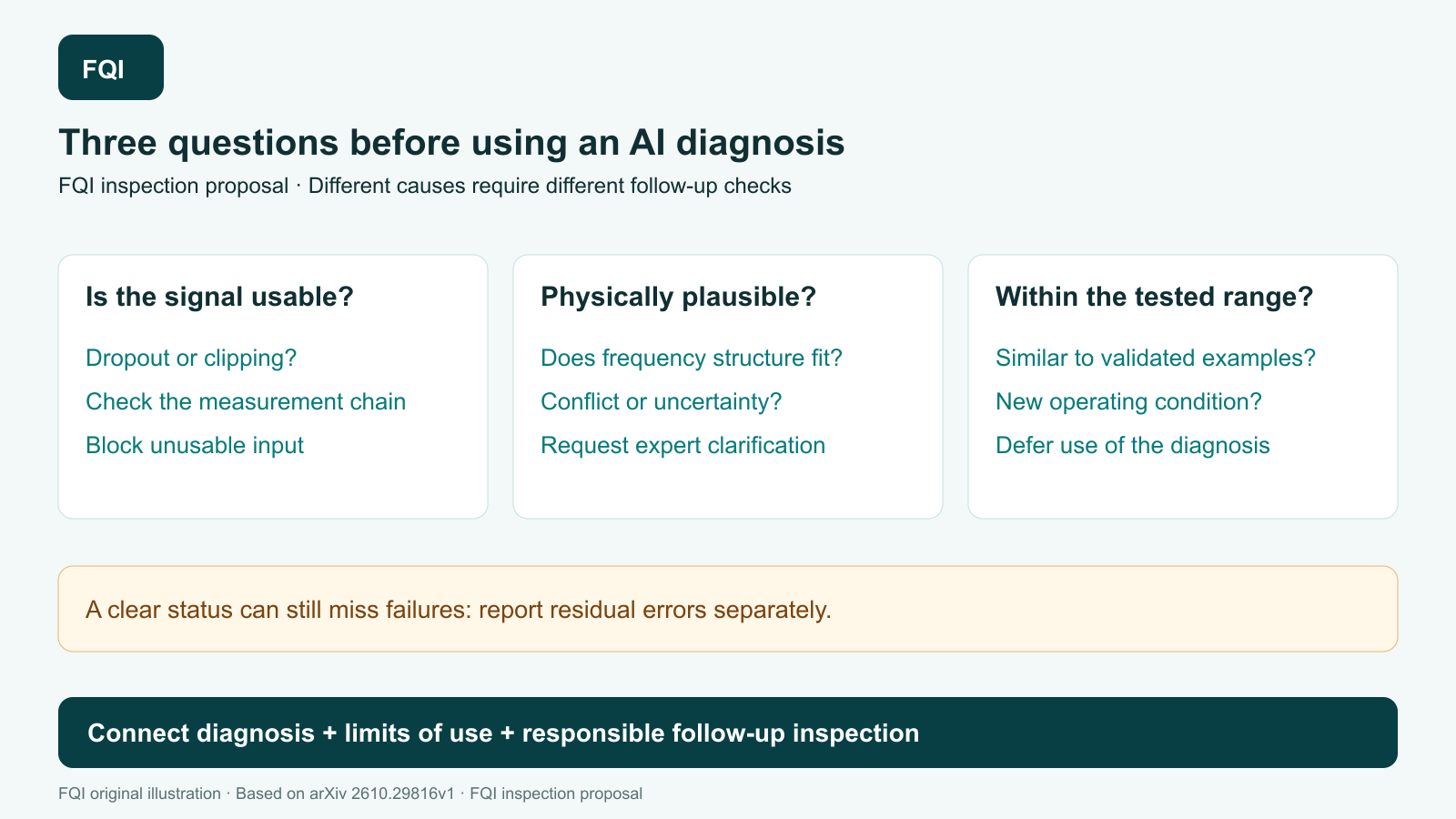
A simplified FQI example: a microphone records a sound classified by AI as a leak. One check detects signal clipping. Another finds a frequency pattern more consistent with an unfamiliar machine. A third identifies an operating situation poorly represented by previous examples.
These findings call for different follow-up actions. A damaged signal suggests checking the measurement chain. An unfamiliar situation needs further expert assessment. A coloured status display only communicates the decision; its criteria and residual failures still require evidence.
Deep dive
The work combines a neural leak detector with three monitoring layers. The first checks technical anomalies such as missing signals, constant values and clipping. The second compares frequency structure with a physically motivated reference. The third assesses whether features produced by the AI model are close to known examples.
The coordination logic distinguishes unusable measurements, conflicting or insufficient physical evidence and inadequate model coverage. Certain findings prevent the model’s output from being forwarded as trusted. The resulting diagnosis also indicates why further inspection is needed.
The researchers fix the model and thresholds using nominal recordings. Two recording sessions support training and a third supports calibration. That third session is therefore not an independent final test of normal operation. Later assessments include hydraulic background noise, a new leak configuration and deliberately corrupted signals.
For shifted background without a leak, the proportion of falsely trusted outputs in the examined collection falls from 37.5 percent without monitoring to zero with COMET. For a new leak configuration, 8.3 percent of all files still receive falsely trusted outputs. Among the 174 missed leaks specifically, 48 remain classified as trusted clear. These figures have different denominators and must not be equated.
Signal checks are not uniformly effective either. Constructed dropouts and certain constant or shifted signals are detected reliably. Clipping detection is considerably weaker.
The study also reports nominal false alarms largely linked to a particular microphone rule. Each additional monitor therefore needs its own counterchecks.
For an operational pilot, FQI recommends a decision table for each failure family. It should identify the expected responding control, which diagnosis remains usable and who resolves the open question. Assessment separately counts detected problems, missed problems, false alarms and deferred cases. A simple comparison method should also establish whether the more complex combination provides a needed additional benefit.
This comparison matters in the original study too. For the new leak configuration, a simpler proximity-to-known-examples check achieves almost the same residual error proportion. The extra layers therefore do not add equal value in every subtask; their benefit also concerns other disturbances and more differentiated diagnostic information.
Limitations and risks
The study uses a bounded acoustic compressed-air dataset. It does not validate safety for gas leaks or other plants. Remaining failures explicitly show that a clear status is not a general assurance of harmlessness.
There is no user study demonstrating better human decisions. Physical references and technical rules can themselves be incorrect. Their validity ranges must be reassessed when microphones, environments or leak types change.
The work was conducted within SUBPRO-Zero, which the paper states is financed by industry partners and NTNU. As independent methodological guidance, the voluntary AI Risk Management Framework from the National Institute of Standards and Technology (NIST) calls for monitoring behaviour, assessing measurement methods and documenting generalisation limits. It does not confirm any COMET performance figure.
FQI conclusion
For FQI, the contribution is a traceable allocation of unresolved questions. An AI output is considered together with signal condition, physical plausibility and the tested operating range. This can support more targeted follow-up checks.
Before operational use, however, teams should test known failures and acceptable normal cases for each layer. The decisive assessment combines wrong outputs still marked usable with sound cases unnecessarily deferred. Only that joint view supports a bounded decision about where the system may be used.
Sources & transparency
Primary source: COMET, original full text v1, especially Sections 2–6 and residual-failure analyses. Normative guidance: NIST AI RMF 1.0, MEASURE 2.4, 2.5 and 2.13. NTNU research manuscript with disclosed industry funding; no independent reproduction by FQI.
The microphone example and decision table are FQI interpretations. AI-assisted article, approved for publication by Johann Fischer on 2026-10-23.