
Executive summary
Artificial intelligence (AI) supports the tasks described here.
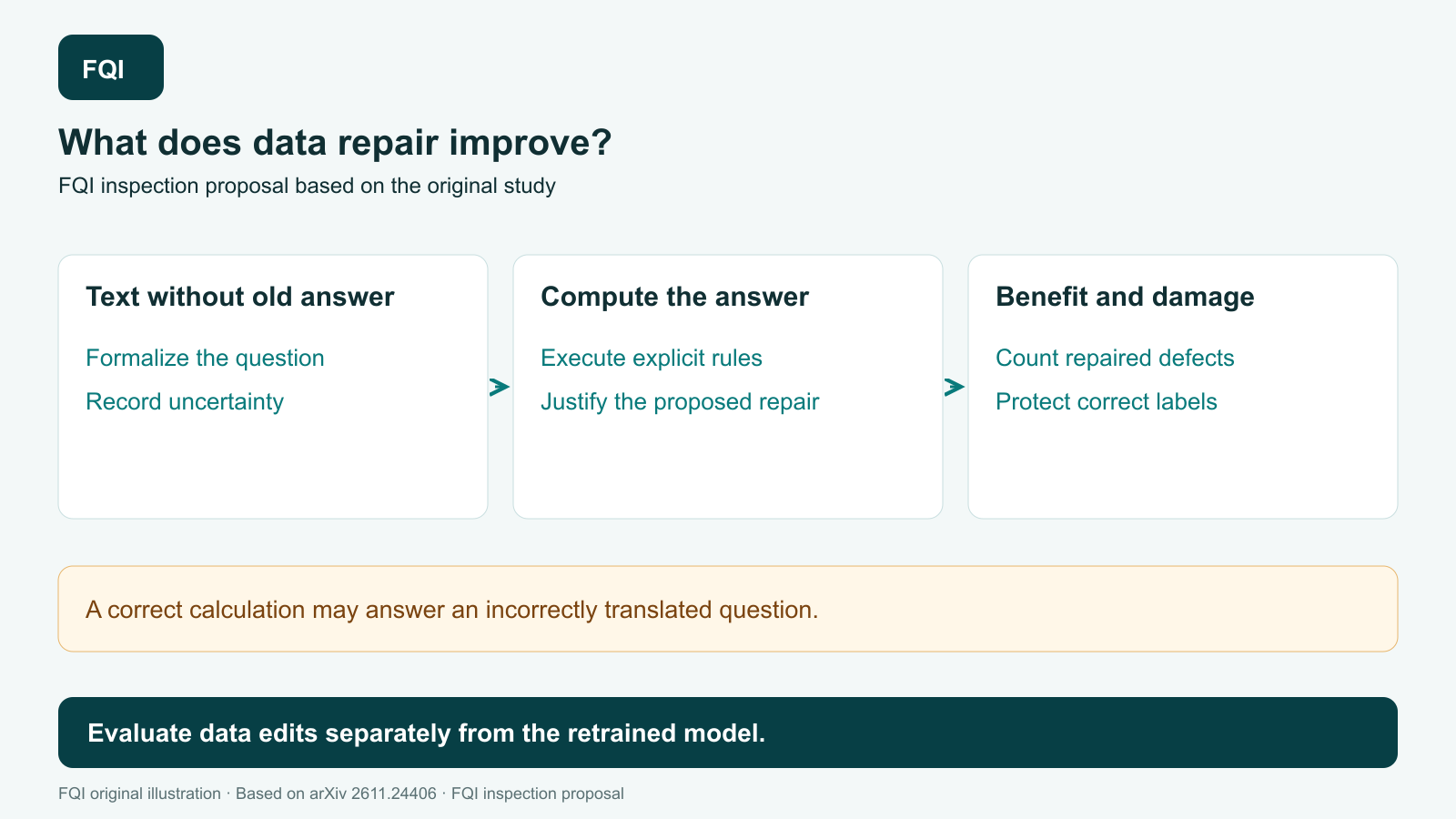
Automated data cleaning can remove errors while damaging correct training examples. CaDO studies this risk in causal inference datasets for language models. AI translates questions into formal queries, while an executable causal engine checks the resulting answers. Its important quality contribution is a separate accounting of detected defects, successful repairs and newly introduced errors. For FQI, a cleaning process therefore needs evidence that it protects correct data as well as evidence that its corrections work.
FQI takeaway
- Hide the existing answer from the component formalizing the question.
- Count damaged correct examples alongside repaired defects.
- Evaluate the repaired dataset separately from the model trained on it.
The principle at a glance
A causal question may ask how an intervention changes an outcome. CaDO gives the question text to a language model without its existing label or rationale. The model translates it into a formal causal representation and query. A computational engine returns an answer, derivation and verification status.
Separating these roles reduces the chance that an existing wrong answer steers its own review. It does not eliminate uncertainty. If the language model translates the text incorrectly, a logically correct calculation can still answer the wrong question.
Deep dive
The authors use three datasets with controlled injected defects. These include wrong answers, altered premises, reversed questions and faulty rationales. They also alter the distribution of question types and labels. The evaluation therefore covers individual examples and structural weaknesses of the collection.
The cleaning methods cannot see the injected defects. The evaluation retains the clean reference, allowing it to determine which edits actually help. Across 18 dataset and downstream model combinations, the authors report improvements over the strongest of five cleaning baselines in 16 settings. This describes the tested arrangement, not universal superiority for every kind of data cleaning.
The damage accounting is particularly useful. At least 95 percent of flagged examples were defective in the experiments. On CLadder, CaDO changed substantially fewer correct labels into wrong ones than the compared language-model judge. Such a comparison requires retaining the known set of correct examples. Showing only successful corrections can hide collateral damage.
As an FQI transfer, establish a protected control set containing both known correct entries and deliberately introduced defects. Archive the original text, formal translation, engine result, verification status and proposed edit for every repair. Cases without a determinate answer should go to expert review. Then evaluate the model trained on repaired data using unchanged test examples.
Generated examples receive an additional round-trip check: the generated wording is translated back into a formal representation, and the answer must remain consistent. This checks whether the representation preserves its intended answer. It does not establish that the generated collection adequately represents future operational use.
The downstream model test answers another question again. Cleaner labels can be useful without guaranteeing improvement on every new task. Conversely, an improved average score does not justify every individual edit. Keeping both levels of evidence prevents a broad model result from concealing specific harmful repairs.
Limitations and risks
The strongest evidence comes from controlled defects in formally expressible tasks. Naturally occurring errors may differ. The method needs suitable executable semantics, which free-form shift reports or ambiguous complaints often lack. High precision among flagged errors does not reveal how many other errors were missed. Extending the approach to naturally occurring defects remains further work. FQI did not independently reproduce the experiments.
FQI conclusion
Data cleaning changes learning and evaluation material. Its approval should therefore use a benefit-and-damage account: what was correctly repaired, what remained wrong and what was newly damaged? CaDO provides a concrete design with a hidden reference and separate downstream evaluation. Operational decisions remain tied to the data type. Without a reliable translation and appropriate formal rules, an automated repair should remain a reviewable recommendation rather than an automatically accepted replacement.
Sources & transparency
Source 1. Author manuscript accessed on 20 November 2026; methods, experimental setup, results and limitations reviewed. Findings and FQI proposals are distinguished above. AI-assisted editorial draft, checked by Codex; no independent replication.
Codex assisted with drafting and checked the claims against the cited original sources. Johann Fischer authorized publication on 2026-11-20.