
Executive summary
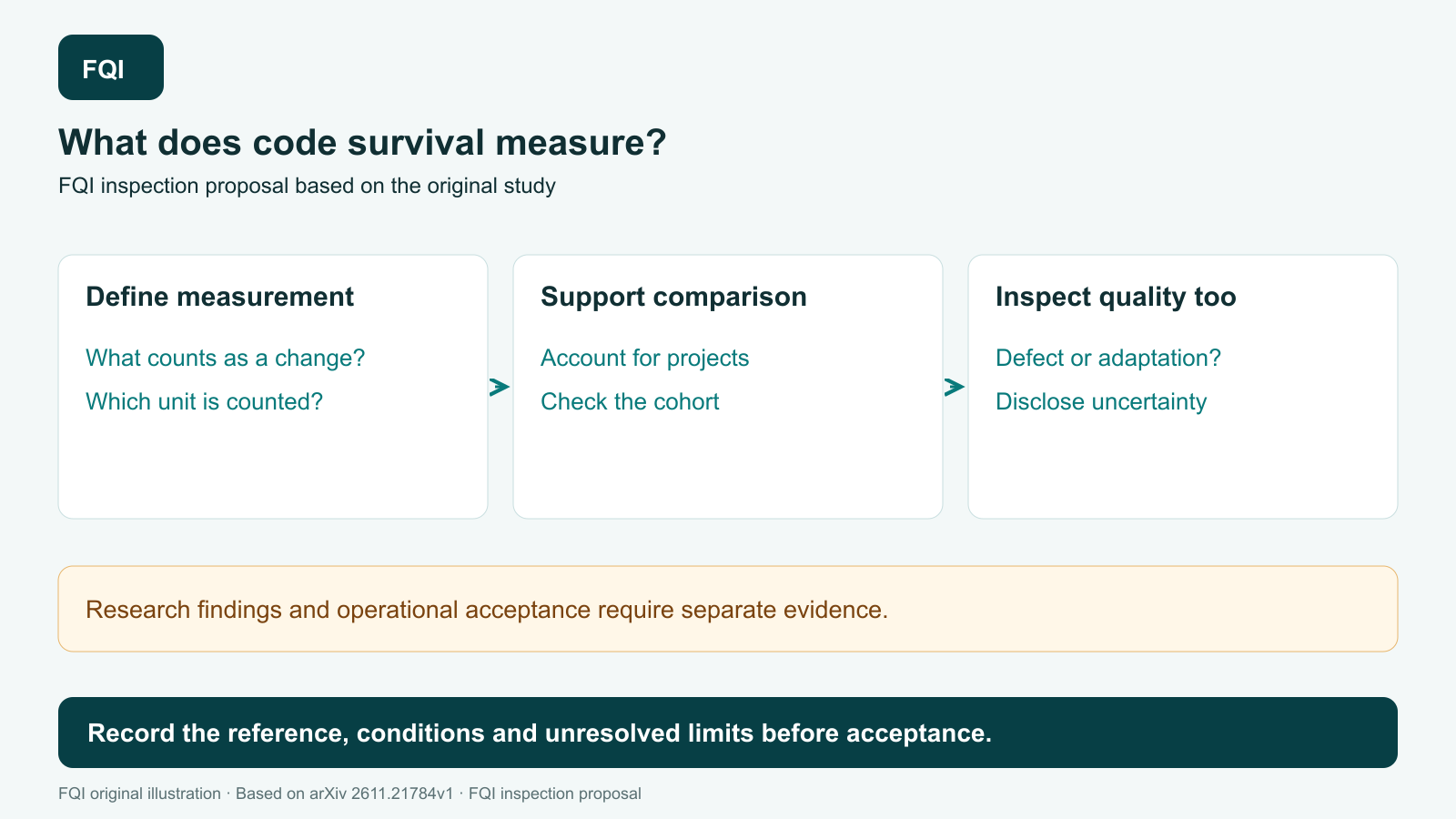
How long agent-generated code remains unchanged depends partly on how survival is measured. A study varies nine measurement decisions and compares 88 analyses of code attributed to artificial intelligence (AI) agents. For fully autonomous code, the analytical choices can change the verdict. For FQI, this is a practical warning about metrics: unchanged lines do not directly measure software quality. Comparisons need explicit observation periods, project boundaries, dependence assumptions and reasons for later changes.
FQI takeaway
- Define a modification and the unit of observation before analyzing results.
- Account for dependence between lines from the same project.
- Separate defect corrections from adaptation and other development.
The principle at a glance
After code enters a project, it may be edited, moved or deleted. Tracking these events produces a survival measure. That describes a version-history pattern. Whether a change repairs a defect or implements a new requirement is a separate question.
The study distinguishes human-supervised agents from a fully autonomous agent. Its artificial intelligence (AI) relevance concerns both assessment of generated software and language-model classification of modification intent.
Deep dive
The starting corpus contains 854,139 added lines from 2,802 merged change proposals in 215 repositories. Excluding vendored and generated files leaves 644,177 lines. This filtering already changes what the resulting metric describes.
The authors vary line tracking, file selection, observation unit, modification definition, within-project versus across-project comparisons and statistical uncertainty, among other choices. For human-supervised agents, the direction of the reported difference remains comparatively stable. For Devin, the fully autonomous agent, the verdict depends more strongly on measurement decisions.
Across repositories, 15 of 22 specifications report earlier modification when lines are treated as independent. Only three do so when uncertainty accounts for project-level dependence. Within repositories, no specification detects a difference. This is not evidence of equivalence: limited power can leave meaningful differences undetected.
A longer observation window can also remove recently merged contributions and change the comparison group. The study distinguishes this cohort effect from simply following the same code longer. That matters for organizations whose tooling or review practices changed during the observation period.
Modification reasons are compared using language models, keyword rules and human references. Language models agree better with human labels in this study, but their mistakes still alter estimated proportions. An automated intent classifier is therefore itself a measurement instrument needing validation.
FQI proposes declaring the measurement rule before presenting results about agent-generated code. Report defects, functional adaptation and other modifications separately. For each central claim, document at least one plausible alternative analysis. This makes it harder for a preferred conclusion to arise unnoticed from the unit chosen. The paper does not establish a general purchasing recommendation or the superiority of a particular coding agent.
Limitations and risks
The data come from public software projects. Agent attribution, project differences and limited follow-up constrain transfer. Some comparisons involve few independent repositories. Survival analysis does not capture every security problem, maintainability concern or requirement failure.
Language models used for intent labels may also change over time. FQI has not independently reproduced the analysis. When evidence is insufficient, the appropriate statement is that no difference was detected, rather than that the groups are equally good.
FQI conclusion
An apparently objective software metric rests on technical definitions. Teams evaluating AI-generated code should scrutinize those definitions as carefully as the implementation. Longer retention can be informative, but it does not replace defect or requirement checks. Transparent units, suitable uncertainty estimates and traceable modification reasons make a comparison useful. Only then can it support a bounded decision about tools, review effort or further investigation.
Sources & transparency
- Revisiting the Survival of Agent-Attributed Code: How Measurement Choices Decide the Verdict · Full text
- arXiv · Version history
Codex drafted this article and checked the cited original sources. FQI applications are editorial interpretation; the experiments were not independently reproduced.
Codex assisted with drafting and checked the claims against the cited original sources. Johann Fischer authorized publication on 2026-11-18.