
Executive summary
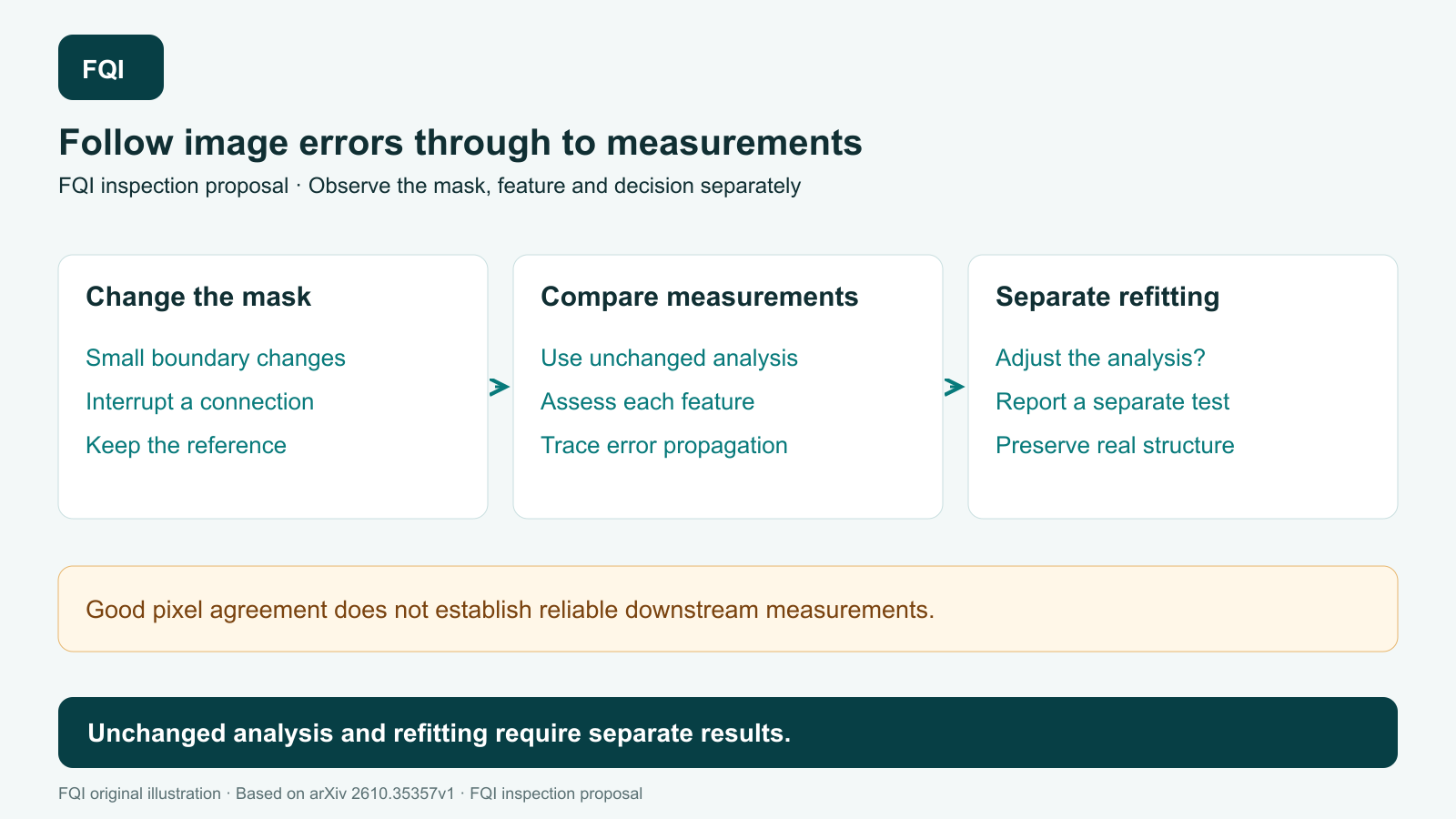
Good agreement between image pixels does not establish the reliability of a measurement calculated from them. An original study of artificial intelligence (AI)-assisted vessel segmentation compares five executable pipelines and investigates how small mask changes affect downstream features. The quality-management transfer concerns this propagation of errors: acceptance of an image model should reach the intended measurement outcome. The medical data provide a bounded methodological example, without establishing industrial or clinical readiness.
FQI takeaway
- Assess pixel agreement, structural fidelity and downstream measurements separately.
- Test small mask changes with both fixed analysis and separately reported refitting.
- Accept stabilization only when relevant real structures remain intact.
The principle at a glance
Segmentation assigns image pixels to a structure. Its output is a mask from which quantities such as width, length and connections can be calculated. A small error at a branch may matter more than a larger discrepancy in an unimportant area.
The study therefore evaluates several levels. It examines pixel agreement, retention of thin vessels and connected structures. It then asks what features calculated from the masks actually deliver. A single best pipeline across all these levels is not assumed.
Deep dive
The main comparison covers 244 images from six public datasets, with equal weighting across datasets. It compares complete executable pipelines. Training, resolution and post-processing are not identical throughout, so the results do not isolate the superiority of an architecture.
An additional experiment uses 45 images. The authors calculate eleven types of vessel features within nine concentric regions. They then change reference masks in controlled ways: expanding or shrinking vessel areas and removing terminal branches. This exposes how a known intervention changes the derived features.
Two experiments must remain distinct. In one, an already fitted classifier is tested on perturbed features without adjustment. In the other, the classifier is refitted to the changed representation. These answer different questions: does the existing analysis withstand a change, or can a suitable analysis be developed again after that change?
FQI proposes a corresponding protocol for industrial image inspection. First specify the decision-relevant quantity, such as a length or the number of continuous connections. Then introduce technically plausible mask changes in a separate evaluation set. Record the original measurement, changed measurement and resulting inspection decision together. Any analysis using refitted parameters receives its own results block.
Targeted stabilization may help. The study investigates smoothed centerlines and simplified connection graphs, among other approaches. A less variable metric alone is not success, however: processing must not remove genuine small structures together with numerical noise. A practical review should therefore retain examples of the structures that must survive and compare them before and after stabilization.
The comparison also needs to preserve the operational question. If a measurement threshold is fixed, its performance after a mask change is the relevant initial test. If the threshold is subsequently adjusted, that is a new configuration requiring separate evidence. Reporting both stages prevents adaptation from being mistaken for robustness of the original chain.
Limitations and risks
The downstream analysis of 45 images is exploratory. It replaces neither independent validation of the ranking nor clinical assessment. Reference masks are themselves uncertain, particularly at faint boundaries. Errors shared by several models do not automatically prove that the models or the reference are wrong.
Stabilization parameters were manually selected. Greater similarity to the reference also does not guarantee better downstream classification. Different measurement objects require their own justification of perturbations, tolerances and relevant structures.
FQI conclusion
The distinct quality question is which image discrepancy changes which measurement actually used. That connection should be traceable before acceptance. General image quality remains useful but does not cover the entire measurement chain. FQI therefore proposes a bounded experiment with known perturbations, unchanged analysis and separately documented refitting. It reveals whether the system remains robust or merely becomes usable again after adjustment. The study supplies a research example for that distinction, not an operational release decision.
Sources & transparency
Primary source: Evidence-Guided Selection of Retinal Vessel Segmentation Pipelines: A Cross-Dataset Benchmark of Performance, Structure, Failure Modes, and Reproducibility; versioned full text reviewed. Preliminary research; methods, relevant results and limitations were assessed. No independent reproduction.
AI-assisted article. Operational examples and inspection proposals are FQI interpretations, not additional study results. Approved for publication by Johann Fischer on 2026-11-01.