
Executive summary
A coding agent can find a difficult proof once and still struggle on related tasks with more clues. SeVerus investigates this distinction using formally verified Rust projects. The authors progressively remove proven intermediate statements while keeping the target fixed. For software quality teams this suggests a practical acceptance question. Given a fixed budget, how much supporting material does the agent need to prove the same requirement reliably?
FQI takeaway
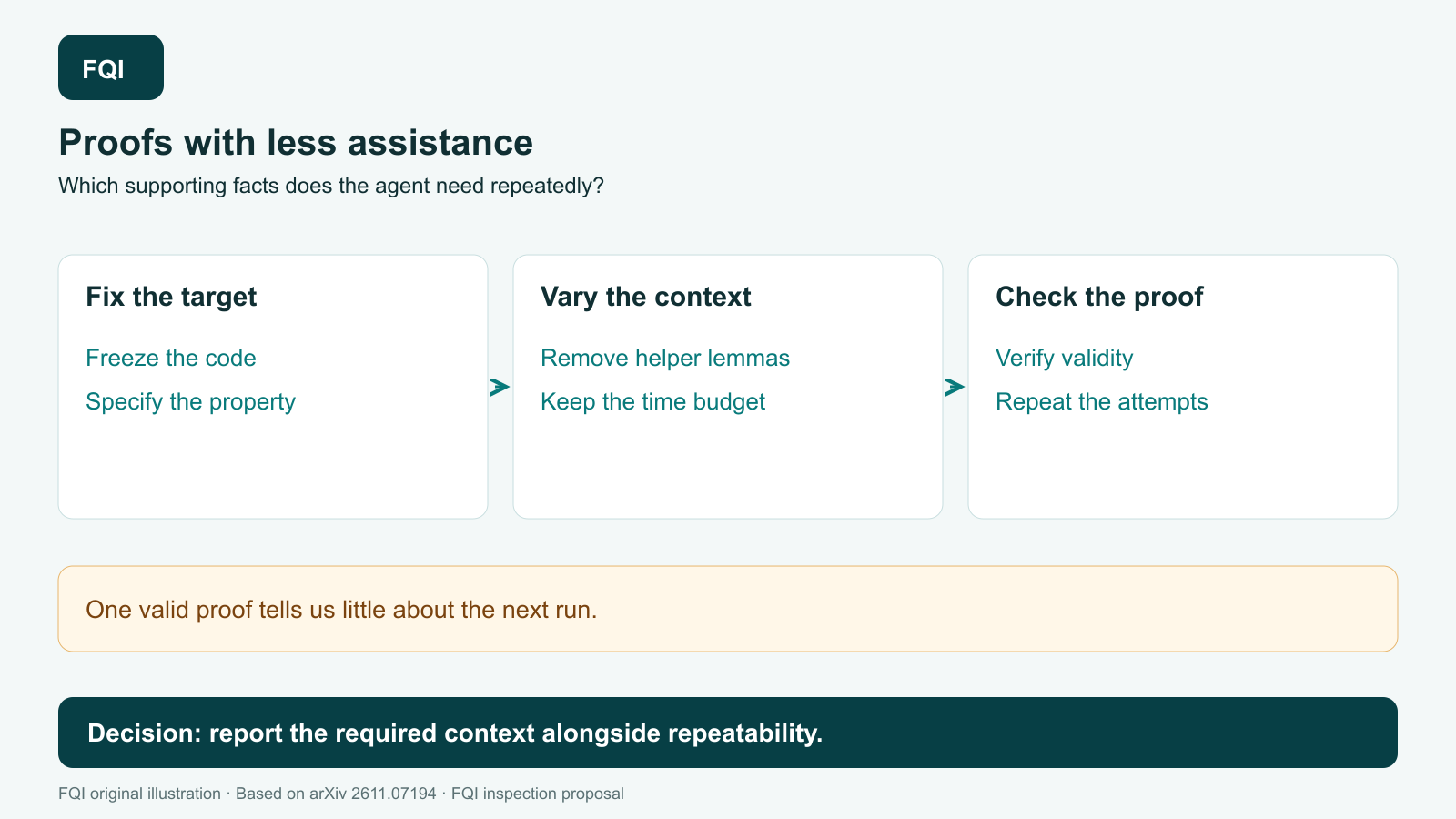
- Freeze the executable program and the property to be proved.
- Remove helper lemmas according to their dependencies and retain each task configuration.
- Report single successes, repeatability and effort separately.
The principle at a glance
A software proof establishes that a specified property holds under stated assumptions. In Verus, a verification tool for Rust, developers can first prove smaller statements called lemmas. The agent can then use those statements as verified steps. Two tasks involving identical code and requirements can differ considerably in difficulty. With every intermediate result supplied, the remaining work may consist mainly of discovering how to connect them.
Deep dive
SeVerus derives 819 series of tasks with 10,095 levels from six open projects. The researchers start with the dependencies of an existing proof. The hardest level withholds all supporting lemmas. An independent checker rejects changes to executable code, weakened requirements and unsound proof constructs. Alternative valid proofs remain possible. Successful solutions from the GPT-6 Sol agent rarely recreated the withheld lemmas in their original form.
The strongest agent solved the final level in 52 of 60 sampled series. Across levels, the authors estimated the reliably solvable share at 35 percent. The first figure counts series. The second concerns individual levels and an estimated threshold for reliable success. The search uses up to three trials at a tested level and decides by majority. Combining the two figures into a failure rate for arbitrary Rust tasks would mix different units of analysis.
For an internal assessment, FQI suggests starting with a small set of functions whose specifications have already been reviewed. Record which helper lemmas the team actually maintains. Give one run exactly that context and another a reduced selection. Compare effort and repeatability against the same checker. Keep its verdict alongside time spent, number of attempts and any manual intervention.
A failed attempt deserves a short diagnosis. Did the agent find evidence against the property, use a prohibited shortcut or run out of time? The first two outcomes call for technical examination. The last initially measures effort under this budget. Counting them together obscures whether the next investment should go into better supporting proofs, another agent or a corrected requirement.
Limitations and risks
The sample covers parts of six projects. Estimating the reliability threshold assumes that later levels generally become harder. An agent may occasionally discover a simpler route precisely because a particular intermediate step was withheld. Even a valid proof covers only the stated specification. A missing safety requirement can remain invisible in a successful verification result.
FQI conclusion
Record the assistance needed as part of the deliverable. If results depend on a specific library of lemmas, include its version in the acceptance record. After a change to the function or the agent, the team can then repeat the same level. Cases that eventually pass but consume many attempts deserve attention. Their practical risk lies in the time and effort needed to verify the next modification.
Sources & transparency
The methods and results are reported in the authors’ paper. The proposed workplace test and illustrative examples are FQI interpretations.
Artificial intelligence assisted preparation. Johann Fischer approved this article package for publication on 2026-11-07.