
Executive summary
A language model is a form of artificial intelligence (AI). It can shorten a mathematical proof while making it more expensive to check. Its revised proof may also work with only some of the required software versions. Bobber Cheng reports a competition entry that addressed all three objectives. Before replacing an existing proof, the team ran the old and proposed versions back to back. It required the measured gain to exceed the variation observed in the measurement itself.
FQI takeaway
- Keep a record of the exact statement the revised proof is required to establish.
- Compare the proposed and existing versions on length and checking effort under equivalent conditions.
- Identify which improvements were designed before the final cases were known and which arose from those cases.
The principle at a glance
Lean is a system for checking mathematical proofs written in a formal language. Each of the competition’s 60 final problems already had a working proof. Entrants could change the route used to prove a statement while retaining the statement itself. The score reflected the size of the resulting proof, the work Lean needed to check it and whether it still compiled with the specified versions of the software.
These criteria can pull in different directions. A very short instruction can leave the checker with a costly search to perform. A few extra instructions can guide it to the result more directly. The competition weighted savings in proof length and checking effort relative to the original proof for each problem. A shorter text on its own therefore gives little information about the eventual score or the cost of the next check.
Deep dive
Cheng combined suggestions from several language models with fixed rewrite rules and a local implementation of the competition’s scoring procedure. 59 of the 60 problems required several versions of the software, in some cases as many as four. The local comparison ran a candidate beside the version it might replace. A margin based on the spread of the measurements reduced the chance of accepting a small apparent gain caused by ordinary variation.
On the final board the entry scored 86.31 points, compared with 33.33 for the reference proofs. The entry included model selection for different steps, spending limits, mechanical rules and compiler checks. The score describes that combination. Some rules were fixed before the final tasks were released. Other rules were built or switched on afterwards. Their gains on the same final problems leave open how well they would work on fresh cases.
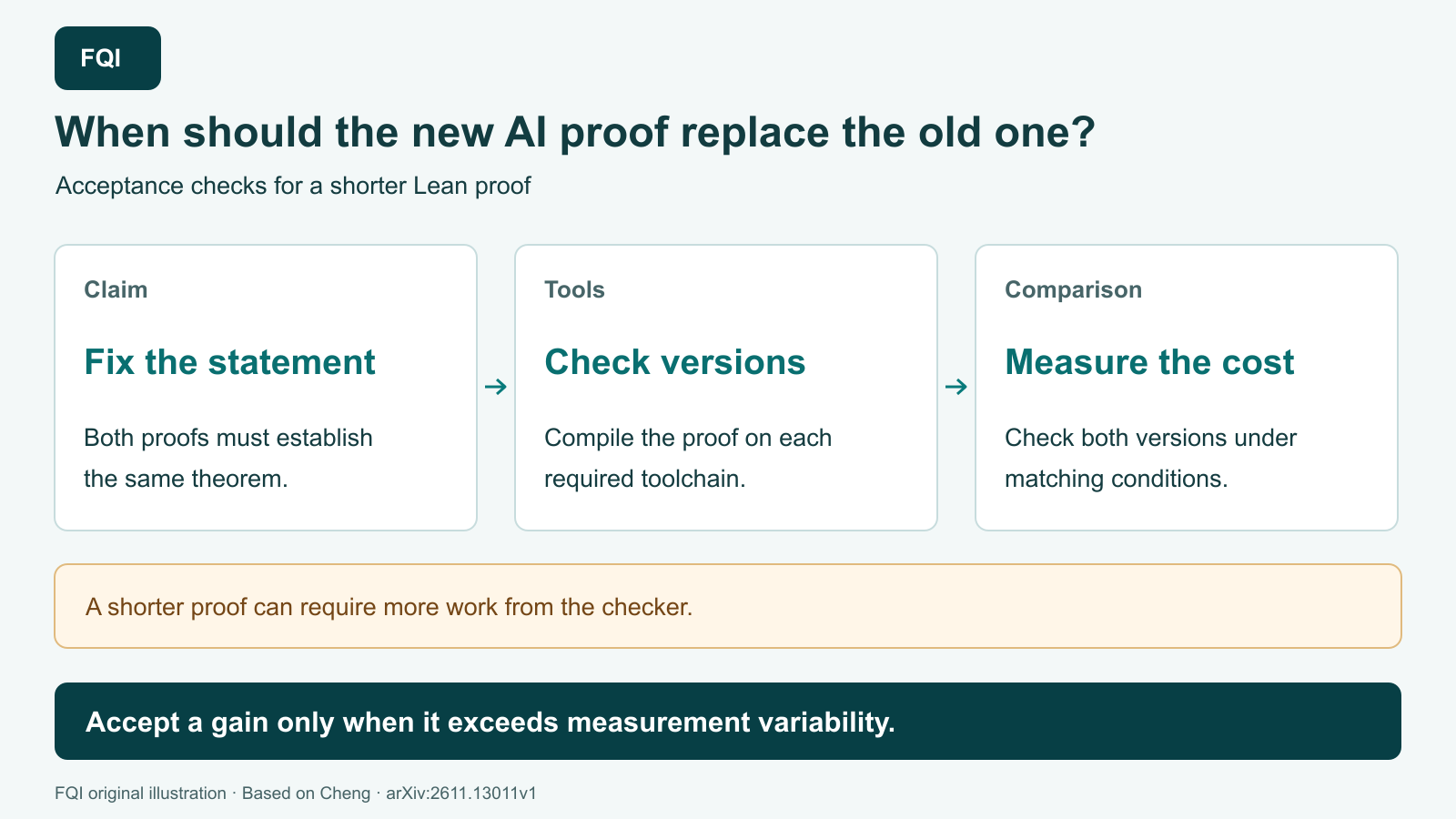
For an internal review, the experiment can be reduced to one proposed change. An engineer records the original theorem and the software versions the team supports. A model proposes a revision. The engineer checks both versions under equivalent conditions and records which software versions accept each proof. Among acceptable proofs, the team can then compare size and checking effort. A gain seen on just one run or one version gives a reason to repeat the measurement before replacing the proof that already works.
Limitations and risks
The competition had a specific scoring system and provided a valid reference proof for every task. Cheng notes that many development comparisons came from a single run on 15 problems. Rules developed after the final cases became available were evaluated on those same cases. Formal acceptance of a proof also depends on what was specified. A person responsible for the application still has to check that the unchanged theorem expresses the intended requirement.
FQI conclusion
The decision concerns one proposed replacement. Preserve the theorem, verify compatibility with every required version and establish a gain large enough to distinguish it from measurement variation. A successful competition entry supplies a procedure worth examining. Each later revision still needs its own comparison.
Sources & transparency
Bobber Cheng reports the entry, scoring method and development decisions in Sections 2, 3 and 8. FQI proposes the single-change acceptance exercise. The figures come from the entrant’s own competition report.
Codex assisted with drafting and checked the claims against the cited original work. Johann Fischer authorized publication on 2026-11-11.