
Executive summary
An inventory can show that an organisation uses artificial intelligence. Someone affected by a particular decision may still have no way to discover that involvement. A study in the United States follows the steps between registering a system and obtaining a correction. It suggests a practical quality audit: trace one case from the first notice to the person authorised to change the outcome.
FQI takeaway
- Establish how the affected person learns of artificial intelligence (AI) involvement in their own case.
- Record the owner, authority and evidence for each stage of a challenge.
- Distinguish a planned improvement with a due date from a procedure already in effect.
The principle at a glance
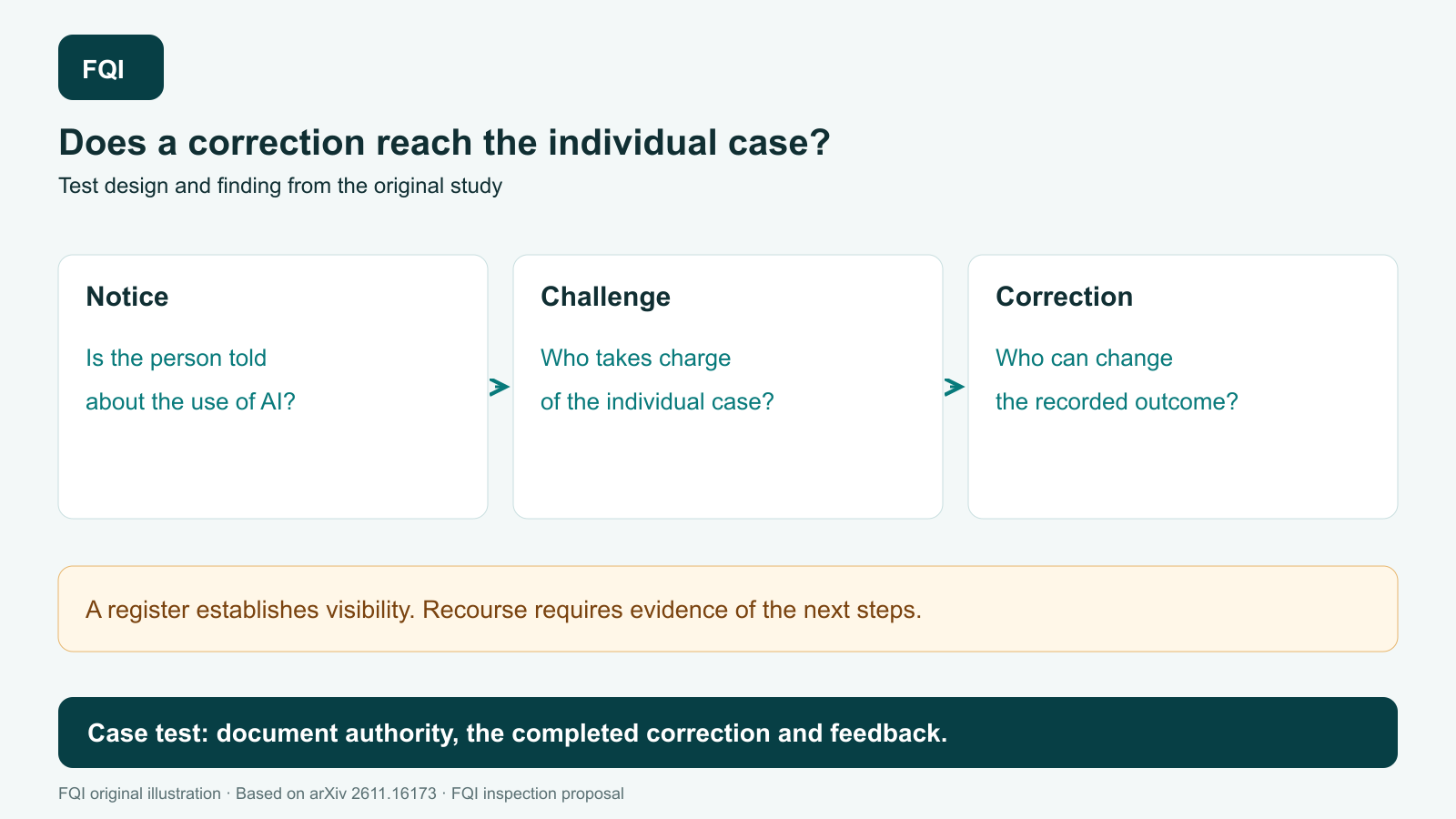
The researchers read policy instruments from the perspective of a person whose case involved an AI-supported decision. An administration may have a duty to record its systems. The resulting inventory gives the administration information about its operations. A person seeking help faces further questions. Will they receive a notice? Can they have the individual decision examined? Who can act on a confirmed error?
The study tracks instruments by date, binding status and responsibility. This preserves the distinction between a roadmap announcing a measure and a subsequent decision needed to put it into effect. For an auditor, a named team and deadline are evidence of a commitment that can be followed up. Evidence that a complaint can be resolved today requires a functioning route through the case.
Deep dive
The authors examined 49 documents from 19 US states and interviewed nine members of North Carolina’s AI Leadership Council. Language models assisted with coding individual provisions, and people reviewed the coding. Interviews before and after the state roadmap added context to the documents. For the state’s own systems, the team found duties that make AI use visible. Notice appeared as an agency duty. Under the AI instruments studied, a person could not invoke a corresponding right to notice. AI-specific challenge and correction remained advisory.
For an internal audit, select a completed case and inspect the notice that was actually sent. Follow the route a question about AI involvement would have taken. Determine whether the staff member responsible at that time could inspect the basis for the decision and correct an erroneous entry. Where a correction was recorded, check that it reached the underlying case and that the affected person received feedback. This case test is an FQI application of the study’s framework.
A useful record identifies the first unsupported handover. A help desk may accept a complaint and forward it successfully. If the receiving office has no authority to change the decision, the documentation establishes receipt and routing while leaving the remedy open. That gives the process owner a specific gap to investigate.
Limitations and risks
The study analyses documents and council members’ accounts. It does not estimate the proportion of successful complaints or represent all affected people’s experiences. General appeal routes can exist under other provisions. The regional finding applies to the AI instruments and period analysed. It is not a legal assessment of another jurisdiction.
FQI conclusion
Ask for a case in which the responsible person had authority, the corrected result reached the operational record and feedback reached the claimant. If the evidence stops earlier, document where and why. That gives management a way to check whether the next change closes the gap experienced by a person seeking recourse.
Sources & transparency
The study is an author preprint. The proposed operational checks are FQI interpretations. Between Niti and Nyaya: A Society-Centered Framework for AI Governance · Version record
- Approval status: First-use explanations and the glossary were added systematically on 15 November 2026. This version awaits renewed human review and is not approved for publication.
Codex assisted with drafting and checked the claims against the cited original sources. Johann Fischer authorized publication on 2026-11-15.