
Executive summary
A high classification score does not automatically establish the capability a benchmark is intended to measure. A study of drone intent recognition divides that inference into observation, representation, decoding, use and behavior. It identifies unreliable references, weak linear readouts and evidence consistent with alternative visual cues. For FQI, the contribution is a framework for testing what a metric supports. Failure to detect an effect is different from proving that the information is absent.
FQI takeaway
- Check the technical reference before comparing model scores.
- State which effect sizes the study could detect.
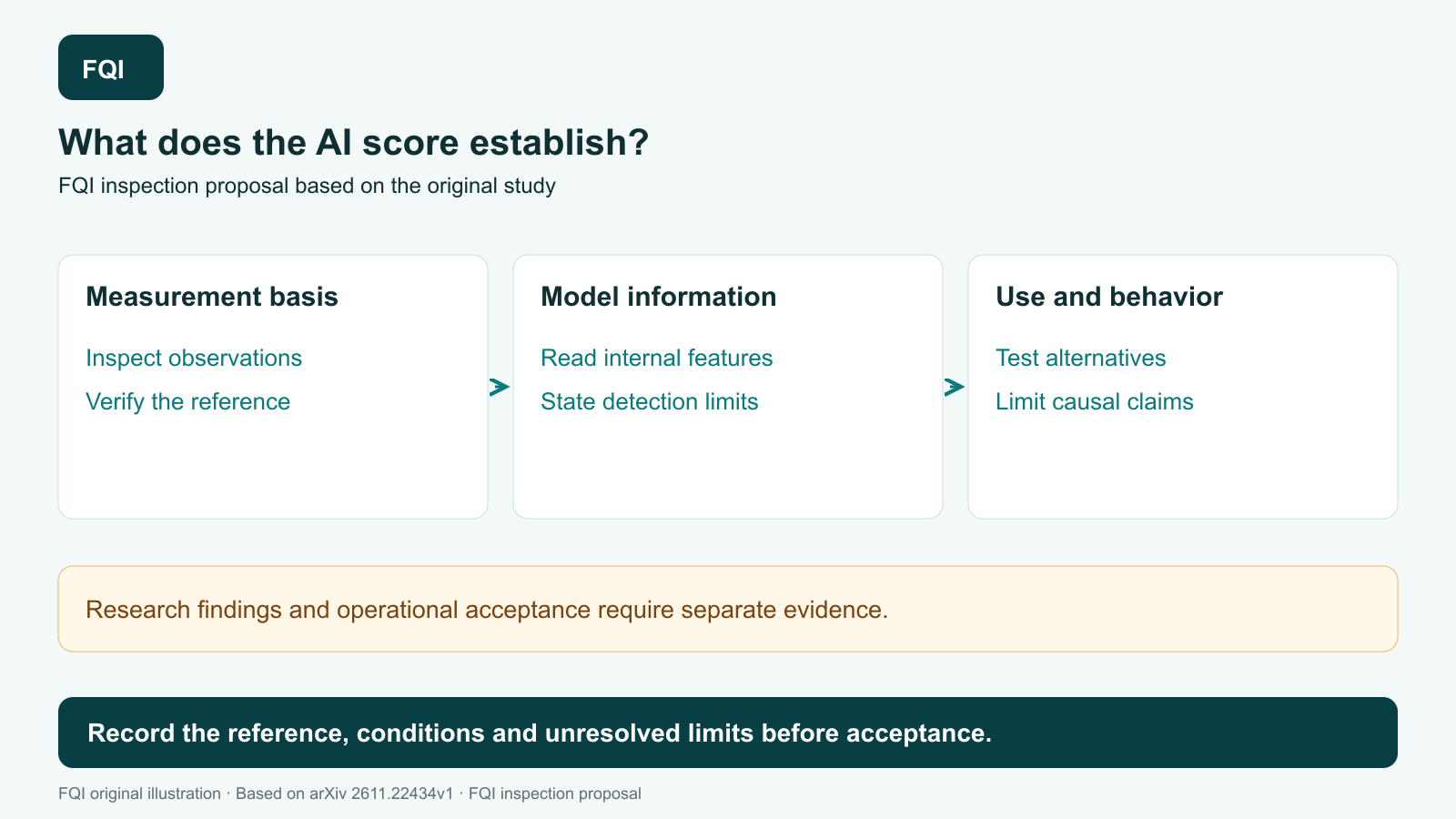
- Separate internal decodability, actual use and observed behavior.
The principle at a glance
A benchmark connects data to labels and produces a performance measure. To support a claim about a capability, several steps must work. The input must expose the feature; the model must represent it; an analysis must be able to detect it; and the final decision must depend on it.
The five-layer framework makes these assumptions explicit. The case study examines radial velocity, movement toward or away from a camera, and its relationship to classification. The artificial intelligence (AI) question concerns what a learned visual model demonstrably obtains from a test set.
Deep dive
The authors audit AeroIntent. They first compare reconstructed motion references with analytically derived values. For seven of twenty drone programs, the signs disagree. A comparison against an unreliable reference can therefore be misleading before architecture or training is discussed.
The study then investigates visual features and linear readouts. The strongest positive global correlation in the considered multi-feature analysis is 0.080. Under the specified design, the minimum correlation detectable with the selected statistical power is much larger, 0.599. That detection limit belongs to this analysis; it is not a universal limit of visual inference.
Signal-injection controls expose another condition. Artificially introduced information is detected differently depending on its alignment in the feature space. The exclusion of large effects is consequently conditional on the alignment tested. A negative linear readout cannot rule out every possible nonlinear representation.
Further comparisons find performance consistent with program identity and static appearance cues. An appearance representation outperforms the examined trajectory representation in one comparison. These findings support alternative explanations, but observational associations do not fully establish which information causally controls the final decision.
FQI proposes a measurement-chain record for model acceptance. Begin with a checked technical reference and state the capability claimed. Then test at least one simple competing explanation and document the detection limit. In a factory, a comparable question would be whether a model detects a defect or recognizes different acquisition conditions for accepted and rejected parts. This is an illustrative transfer, not a result of the drone study.
When a score is used for release, the owner should identify which observation supports the technical claim and which competing explanations remain unresolved. Such a record sets a defensible operating boundary without treating a research score as either conclusive or worthless.
Limitations and risks
The audit covers one benchmark. Readout tests are mainly linear, and other controls are associational. Interventions establishing causal use across the relevant model states are unavailable. The results and detection limits cannot be generalized to arbitrary visual models.
The five-layer structure organizes questions rather than answering them automatically. Each layer still needs suitable evidence. FQI has not reproduced the calculations and treats the work as a preliminary research contribution.
FQI conclusion
A classification score, recoverable internal information and proof that a model uses that information are different findings. Distinguishing them allows acceptance claims to match the evidence. The explicit detection limit is especially useful: it prevents an insensitive or unsuitable experiment from becoming a claim that a capability does not exist. The measurement chain itself therefore belongs within the scope of model quality assurance.
Sources & transparency
- Encoding, Decodability, and Use: A Five-Layer Framework for Benchmark Measurement Audits with Evidence from UAV Intent Recognition · Full text
- arXiv · Version history
Codex drafted this article and checked the cited original sources. FQI applications are editorial interpretation; the experiments were not independently reproduced.
Codex assisted with drafting and checked the claims against the cited original sources. Johann Fischer authorized publication on 2026-11-18.