
Executive summary
In a benchmark for learned defence systems, a change to the evaluation setup produced a large difference in score. For one agent the sequence of actions actually carried out stayed the same. The simulator could discard a request to a busy agent yet still deduct a point for it. Before selecting an artificial intelligence (AI) system from a ranking, a buyer needs to know exactly which events the score counts. Requesting work, performing it and achieving a result can produce three different totals.
FQI takeaway
- Establish whether each measure counts requests, executed actions or outcomes.
- Document the software that submits requests to the simulator as part of the system under evaluation.
- Before using a ranking, check whether a difference in points corresponds to a difference in the outcome of interest.
The principle at a glance
A simulator implements the rules of a test environment. A learned agent makes decisions within that environment. Additional software turns those decisions into requests and may wait for an earlier request to finish. This changes which events the simulator observes. A score that includes request charges will therefore reflect the behaviour of that software. Someone interpreting such a score as the number or value of successful interventions needs a record linking each request to its execution and result.
Deep dive
James Rice, Ji Hwan Park and Andres Kwasinski studied two reference systems in the CAGE 4 challenge. Both used information about whether an agent was still occupied. Removing the check reduced the average score per episode by about 100 points for one system and 146 for the other in the published setting. For the second system, executed actions matched step for step across the paired runs. In this comparison the point difference reflected the cost of discarded requests. It cannot establish that the system made fewer successful interventions.
Repetition introduces another complication. The environment can use the same initial random choices while the learned agent makes a different choice in an otherwise identical situation. Its action changes what it can observe next, and the subsequent episode can develop differently. The authors investigated these sources of variation separately. A person comparing reported averages therefore needs to know which choices were held fixed and which were sampled again.
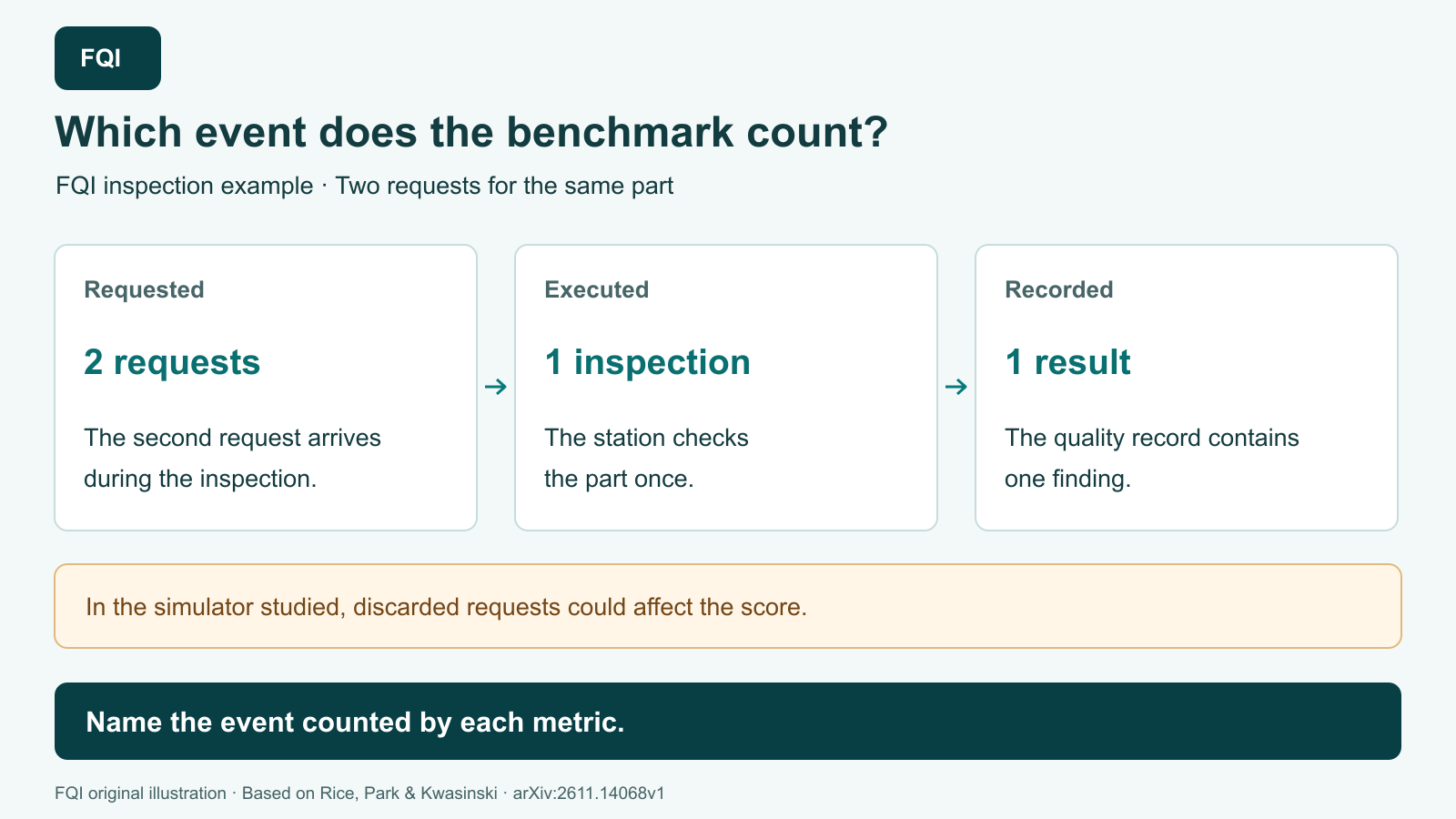
Consider a simplified FQI example outside the challenge. An AI system requests that a part be inspected twice. The second request arrives while the first inspection is still running. A request counter records two messages, the station records one inspection and the quality file contains one result. All three figures can be correct. The importance of the second request depends on whether it occupies a worker, incurs a fee or simply appears as a discarded message in a log.
An acceptance team could start with a few complete histories and match requests to actual starts and results. It could then divide the aggregate score into the contribution from completed work and the charge for submitting requests. For a purchasing decision, the team can compare those components with the real process. A fee for every submission and a fee for each completed inspection favour different interpretations of exactly the same record.
Limitations and risks
The audit covers one simulator and two learned reference systems. Its measurements of sampling variation also depended on the specific experimental setup. The reported loss of points cannot predict the size of the effect on another platform. A discarded request can still consume time or money in a real process. Local observations are needed to determine its consequences even when the actions completed by a machine remain unchanged.
FQI conclusion
Before asking which agent scored higher, follow a request from submission through execution to its outcome. A short event record can reveal which part of a score is relevant to the decision the ranking is supposed to support.
Sources & transparency
Rice, Park and Kwasinski, preprint version 1. The reference-system comparison and section 10 on limitations support the reported findings. The double inspection is an FQI example.
Codex assisted with drafting and checked the claims against the cited original work. Johann Fischer authorized publication on 2026-11-11.