
Executive summary
A complaint classifier must choose from a list of causes, but the verified cause is absent. A plausible choice can enter the quality record and misdirect the subsequent investigation. SO-Arena evaluates fast decision models using both ordinary tasks and controlled changes to the options. Its results show why recognising a missing answer deserves a separate place in acceptance tests.
FQI takeaway
- Retain a documented reference for every case.
- Reorder options only when order has no intended meaning.
- Remove the correct option in a separate test and specify how the system may abstain.
The principle at a glance
System One models are designed to make fast decisions with little generated text. A short response time can be useful in a routing workflow. A decision that triggers another process also needs to survive irrelevant changes in presentation. When options change order, compare the meaning of the selected option across runs. Comparing only position numbers could make a stable decision appear to have changed.
Deep dive
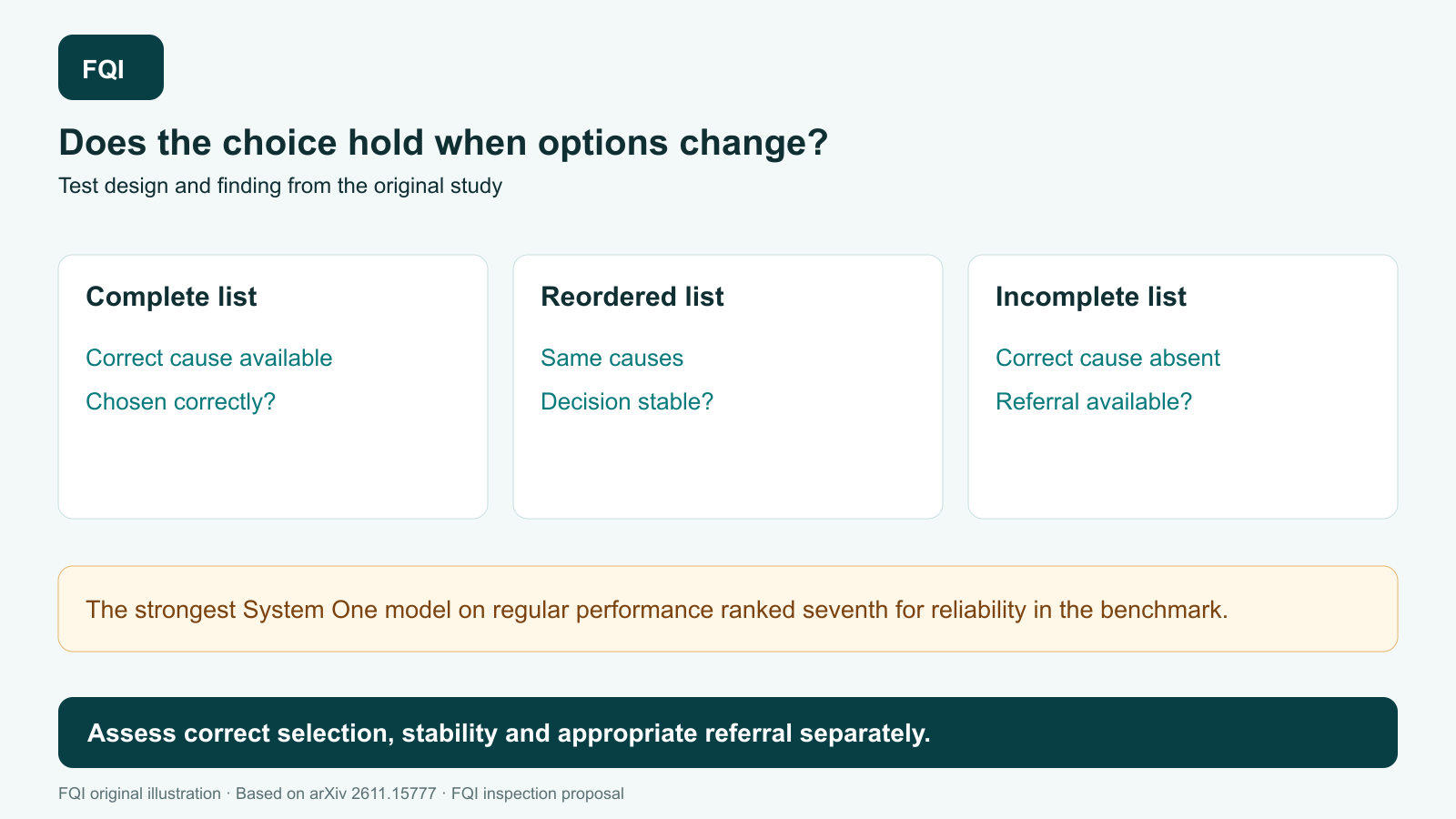
The study evaluates 21 models across eleven domains. Its designers check reference labels against information visible to the model. In addition to measuring performance on conventional tasks, they assess decision stability under option changes and recognition of missing correct answers. The top System One performer on the regular comparison ranks seventh for reliability. Which model appears strongest depends on the property being tested. These ranks describe the study’s tasks and settings. They do not provide a complaint-handling error rate. The transferable idea is the construction of related cases in which a specialist can observe the same decision under controlled variations.
Limitations and risks
In a simplified example, the established cause is the wrong material batch. One list includes this cause among plausible alternatives. A second version moves it to another position. A third offers only unsuitable causes and a route to a human reviewer. Specify the permissible follow-up before each run. Referral is appropriate when the answer is missing and may cause unnecessary work when the correct category is plainly available. Real categories sometimes overlap. Before removing an answer, check whether a different remaining option still describes the case correctly. Some lists are ordered by severity. Rearrangement makes sense only if it preserves the task.
FQI conclusion
Report correct selection, stability after reordering and appropriate referral separately. Cases that pass an ordinary test and fail a related variant are especially informative. They help determine whether the process needs a better category list, an explicit request for clarification or a narrower automatic follow-up. The same variants and rules can be reused to compare model versions.
Sources & transparency
The figures and comparisons come from the authors’ arXiv preprint. The workplace example and proposed acceptance decisions are FQI interpretations. SO-Arena: Benchmarking the Capability Spectrum and Reliability of System One Models · Version history
Codex assisted with drafting and checked the claims against the cited original sources. Johann Fischer authorized publication on 2026-11-14.