
Executive summary
Can a language model supply one rating in a panel whose human members vary from item to item? AltRA-Test compares the agreement of a mixed panel with that of an all-human panel. It tests whether any loss is within a specified allowance. This supports a limited decision about replacing one rating. Its interpretation depends on whether the human ratings contain a meaningful shared signal in the first place.
FQI takeaway
- State the acceptable loss of agreement before evaluating the replacement.
- Compare mixed and all-human panels on the same items.
- Investigate weak human agreement before using it as the basis for substitution.
The principle at a glance
An annotation assigns a judgment such as a defect category to an item. Agreement among annotators measures how consistently they apply their judgments. They may agree and still share a mistake. AltRA-Test addresses a narrower question than objective correctness. It asks whether replacing one annotation per item preserves enough of the signal shared by the people in the original pool. It is designed for cases in which different staff members review different items.
Deep dive
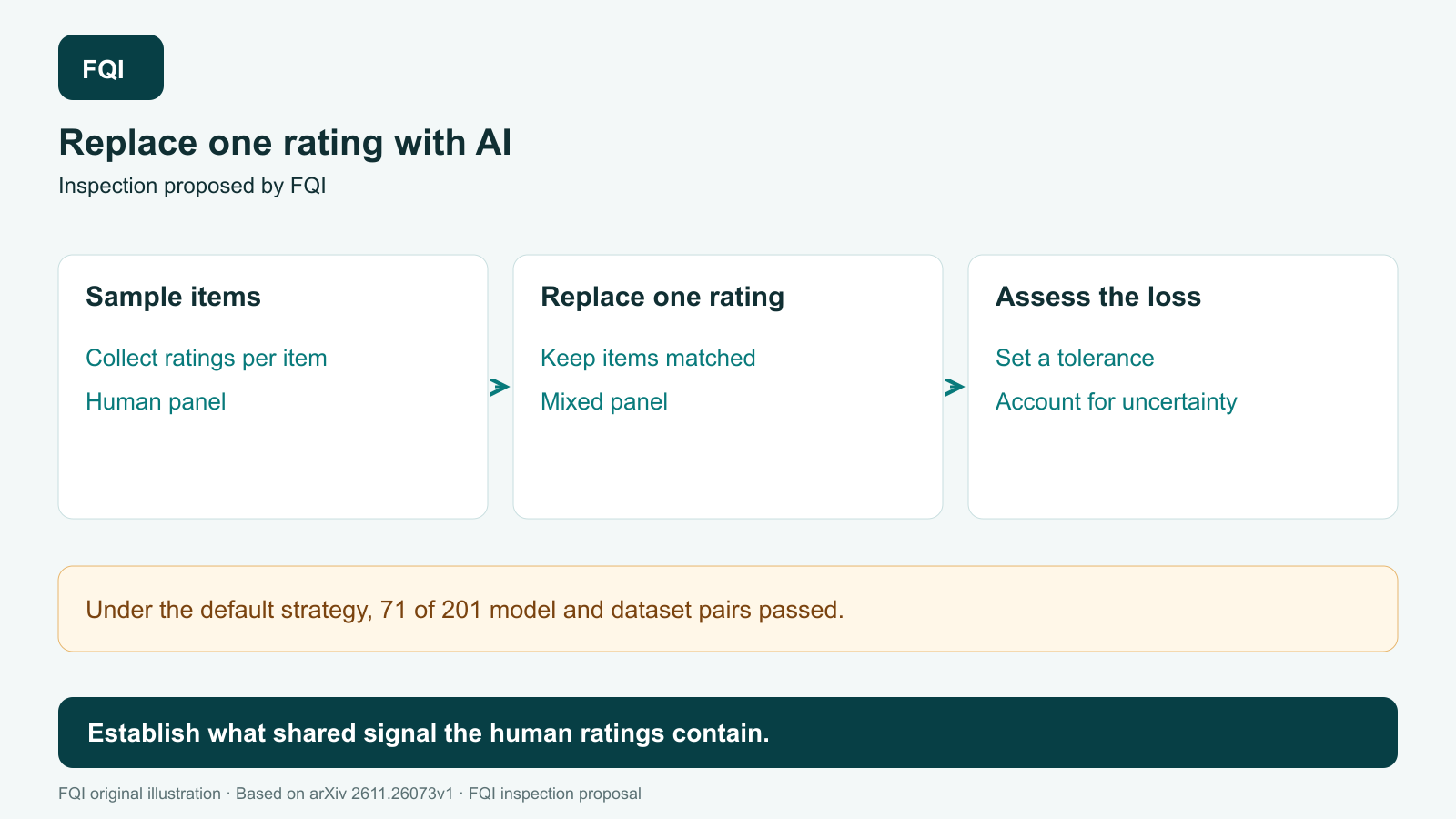
The procedure repeatedly samples items with replacement. For each sampled item it draws several human ratings and constructs a paired mixed panel by replacing one of those ratings with the model response. Both panels now concern the same case and share the other ratings. Resampling measures uncertainty in the difference in agreement without requiring the same people to have rated all items.
The acceptable loss scales with observed disagreement among human ratings. The researchers used simulations to calibrate a default setting. A workplace would still need to justify its allowance in terms of the intended decision. A small loss averaged across all categories could be significant in a rare category that triggers a costly or irreversible action.
Across twenty datasets in text, image, audio and video, the authors compared eighteen models in the combinations applicable to each input type. Under the reported default instruction strategy, 71 of 201 model–dataset pairs passed. Using each model’s best tested instruction strategy increased the number to 95 of 201. Evaluating a fixed deployed instruction on fresh items would help a team avoid mistaking selection on its test data for a transferable benefit.
A positive point estimate does not always settle the decision. In some comparisons the mixed group had as much or more observed agreement but the uncertainty was too wide to demonstrate an acceptable replacement. Conversely, a slightly lower point estimate can pass if the loss stays within the allowance with sufficient statistical support.
FQI proposes defining the categories, intended rater pool, model version, instruction and allowed loss before an internal trial. Keep a separate sample of items from the actual process. Also review high-consequence categories and perspectives that a majority rating could obscure. Those checks address operational requirements that a single agreement statistic cannot decide.
Limitations and risks
The test is relative to the observed pool of people. Shared errors may survive the substitution. When human agreement is close to zero, a pass can mean that very little common signal existed to preserve. The authors recommend applying the test when human agreement on the measure used is at least 0.2. This suggested minimum is specific to their analysis and is not a universal quality threshold.
FQI conclusion
Changing one member of a review panel is a specific intervention with a measurable consequence. The method allows reviewers to quantify that consequence even when staff rotate across items. Before accepting a replacement, FQI would verify both what the human ratings capture and how precisely the trial estimates the change. That evidence defines which assignment the model can take on and which decisions still require other safeguards.
Sources & transparency
AltRA-Test: An Alternative Annotator Test for LLM Judges Without Shared Annotators · arXiv v1
Author preprint v1. FQI checked the cited sections of the original study. Workplace examples and inspection proposals are FQI interpretations. The experiments were not independently replicated.
Codex drafted the texts and checked them against the original study. Johann Fischer authorized publication on that basis on 27 November 2026.