
Executive summary
Term note: reasoning – Machine processing steps used to reach an answer or decision.
Multiple artificial intelligence agents can attempt the same task and exchange their reasoning. Does a higher score reflect cooperation, or simply the chance to try again? A new analysis of nine empirical studies compares agent teams with stronger single-model baselines. Across comparisons matched on sample count or resource budget, team accuracy averaged 4.2 percentage points below baseline. The relevant alternative for a deployment decision must have a realistic opportunity to solve the task.
FQI takeaway
- Give the single-model baseline repeated attempts on the same tasks.
- Specify which resource is matched in each comparison.
- Measure whole-task resource use and response time alongside accuracy.
The principle at a glance
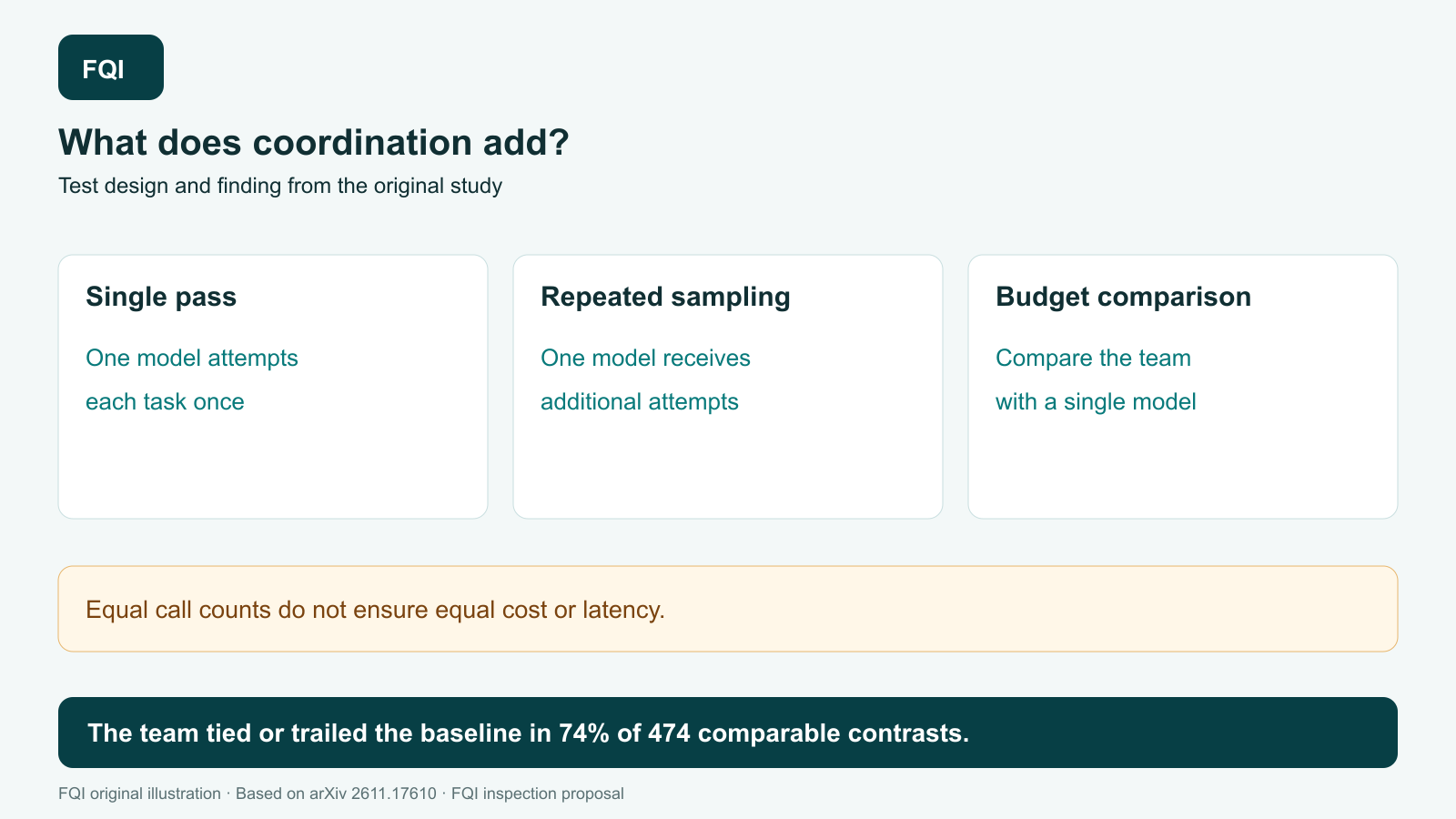
Two workers can contribute different evidence. They can also read the same document and independently propose answers. Repeated attempts alone can improve the final choice when a selection rule combines them. An agent team additionally communicates. Comparing the entire team with one response from its underlying model changes several conditions at once. That may answer a procurement question, but it does not isolate the benefit of paying for coordination.
Deep dive
The authors classify 516 distinct configurations from nine empirical studies by their comparison condition. These include a single pass, repeated samples and matched budgets. In 74% of 474 contrasts matched on sample count or resource budget, team accuracy was equal to or lower than baseline accuracy. This is a proportion of comparisons, not a proportion of tasks answered incorrectly. The mean accuracy difference within the group was minus 4.2 percentage points.
Suppose a team drafts three responses to an order and asks its members to review each other. Another condition could give a single model three independent attempts and apply a predefined selection rule. A further comparison could cap total computation for both systems. Equal call counts are not enough if one architecture produces much longer responses. Parallel calls can consume more computation and still finish sooner. Resource consumption and elapsed time therefore belong in separate columns.
Present every task to each variant. Record which answer passed the domain check, how much work was required and when the answer arrived. Examine cases only the team solved. If one agent had an additional information source, consider giving the baseline equivalent access in a follow-up, provided that access is realistic for the intended process.
Where a baseline uses repeated samples, specify how its final answer was selected. That rule is part of the alternative being evaluated and should be fixed before scoring the test tasks.
Limitations and risks
The nine studies cover different tasks and models. One contributes 180 of the 516 configurations. The first five studies were selected without a systematic search protocol. The 474 contrasts are therefore not independent field deployments. An average deficit in this corpus neither sets a price threshold nor rules out an advantage on specialized subtasks.
FQI conclusion
A release decision should connect the extra resource use to a measurable benefit. Comparing the same tasks under the operational constraint that actually matters makes it possible to judge whether communication between agents justifies the additional work.
Sources & transparency
The study is an author preprint. The proposed operational checks are FQI interpretations. More Agents, More Samples, or More Thinking? Untangling Coordination, Ensembling, and Test-Time Compute in Multi-Agent LLMs · Version history
- Approval status: First-use explanations and the glossary were added systematically on 16 November 2026. This version awaits renewed human review and is not approved for publication.
Codex assisted with drafting and checked the claims against the cited original sources. Johann Fischer authorized publication on 2026-11-16.