
Executive summary
A protection mechanism can block attacks on an artificial intelligence (AI) agent while also preventing legitimate work. Evolution Under Fire studies the joint development of executable protection environments and adaptive stress tests, keeping the task model fixed. FQI draws a requirement for separate evidence: attack success, useful task completion and valid execution must remain visible. The different outcomes in two test environments also show why one safety score cannot support a general release decision.
FQI takeaway
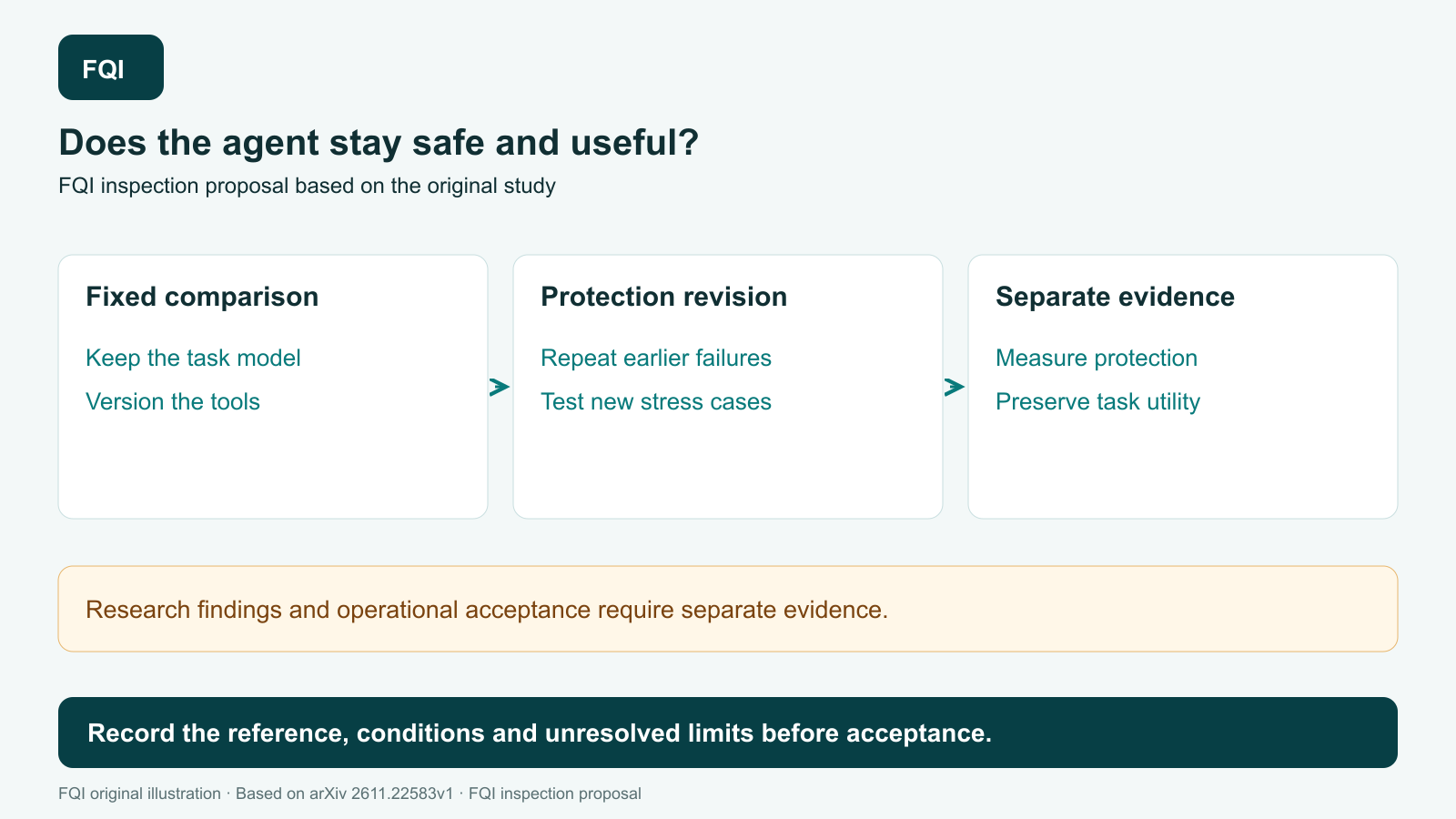
- Measure protection and legitimate task utility separately.
- Keep the task model and evaluation environment fixed during comparisons.
- Retest each protection version against older and changed stress cases.
The principle at a glance
Agents read messages, webpages or documents before using tools. Instructions embedded in these materials can be confused with the user’s actual task. The execution environment controls information flow and permitted actions. The paper calls this environment a harness (technical control environment around the task model).
The proposed search changes this executable protection environment while evolving stress cases. The model doing the task remains distinct from models supporting protection development. Keeping those roles separate makes the comparison interpretable.
Deep dive
The authors evaluate AgentDyn with GPT-4o-mini and Agent-SafetyBench with Qwen2.5-7B-Instruct. In AgentDyn, reported attack success falls from 50.4 to 3.0 percent. Clean-task utility rises from 45.0 to 46.7 percent, and attacked-task utility rises from 36.1 to 39.1 percent. In this setting, protection improves without achieving the result simply by refusing everything.
The second environment gives a less favorable picture. Attack success falls from 82.6 to 62.0 percent. The evolved configuration reaches 48.3 percent helpfulness and 99.9 percent runtime validity. A technically valid execution can consequently remain unhelpful or unsafe. The safety measures also have different definitions across the two environments.
The search develops complete protection configurations and compares possible branches of improvement. Stressors that remain effective after a change supply further development evidence. The researchers additionally transfer a frozen protection configuration to another task model. Such evidence is useful but cannot replace testing the actual operational configuration.
FQI proposes a versioned change record. Give every protection version the same set of legitimate tasks and a controlled set of attempts at unauthorized influence. Confirm successful task completion separately. A safe abort can count as an appropriate security response without counting as completed work.
Repeat earlier failure cases before acceptance. Otherwise, an improvement against new stress can reopen an old weakness. Set minimum utility requirements and non-tolerable failure categories in advance. The research contributes a search and comparison logic; application-specific limits still need independent justification.
Tool versions and judgment rules also need to remain identifiable. If they change during a comparison, an observed gain may come from the environment rather than the protection intervention. Keeping the evaluation conditions stable is part of the causal interpretation, not merely record keeping.
Limitations and risks
The findings apply to specified models, reproduced comparison methods and research environments. Different meanings of safety and utility must not be collapsed into an apparently uniform aggregate. Automatically developed protection code may fail in ways absent from its test set.
FQI has not run the programs or independently reproduced the experiments. This article describes defensive evaluation without operational attack instructions. Production use would also require technical permission limits, code review and independent testing.
FQI conclusion
Protection and ability to complete work must be demonstrated together. An agent that blocks everything is not useful, and a useful agent can still violate boundaries. The study offers a way to keep both aspects visible during development. Its uneven results support carefully bounded claims. Acceptance belongs to a particular protection version, task model and documented test set, including the failures that remain unresolved.
Sources & transparency
- Evolution Under Fire: Evolving Agent Safety Harnesses with Adaptive Injection Stressors · Full text
- arXiv · Version history
Codex drafted this article and checked the cited original sources. FQI applications are editorial interpretation; the experiments were not independently reproduced.
Codex assisted with drafting and checked the claims against the cited original sources. Johann Fischer authorized publication on 2026-11-18.