
Executive summary
A failed agent workflow can contain many repetitions of one original mistake. RecordRoute learns to rank execution records, selects a likely decisive step and uses that record to classify the error. The study reports stronger performance than several comparison methods, with much lower absolute localisation accuracy on naturally occurring failures than on controlled ones. For quality teams, the method can help choose where to start an investigation and which evidence to examine next.
FQI takeaway
- Link the actor, step and proposed error type to the same execution record.
- Compare diagnosis from that record with diagnosis from the full sequence.
- Report performance on controlled and naturally occurring failures separately.
The principle at a glance
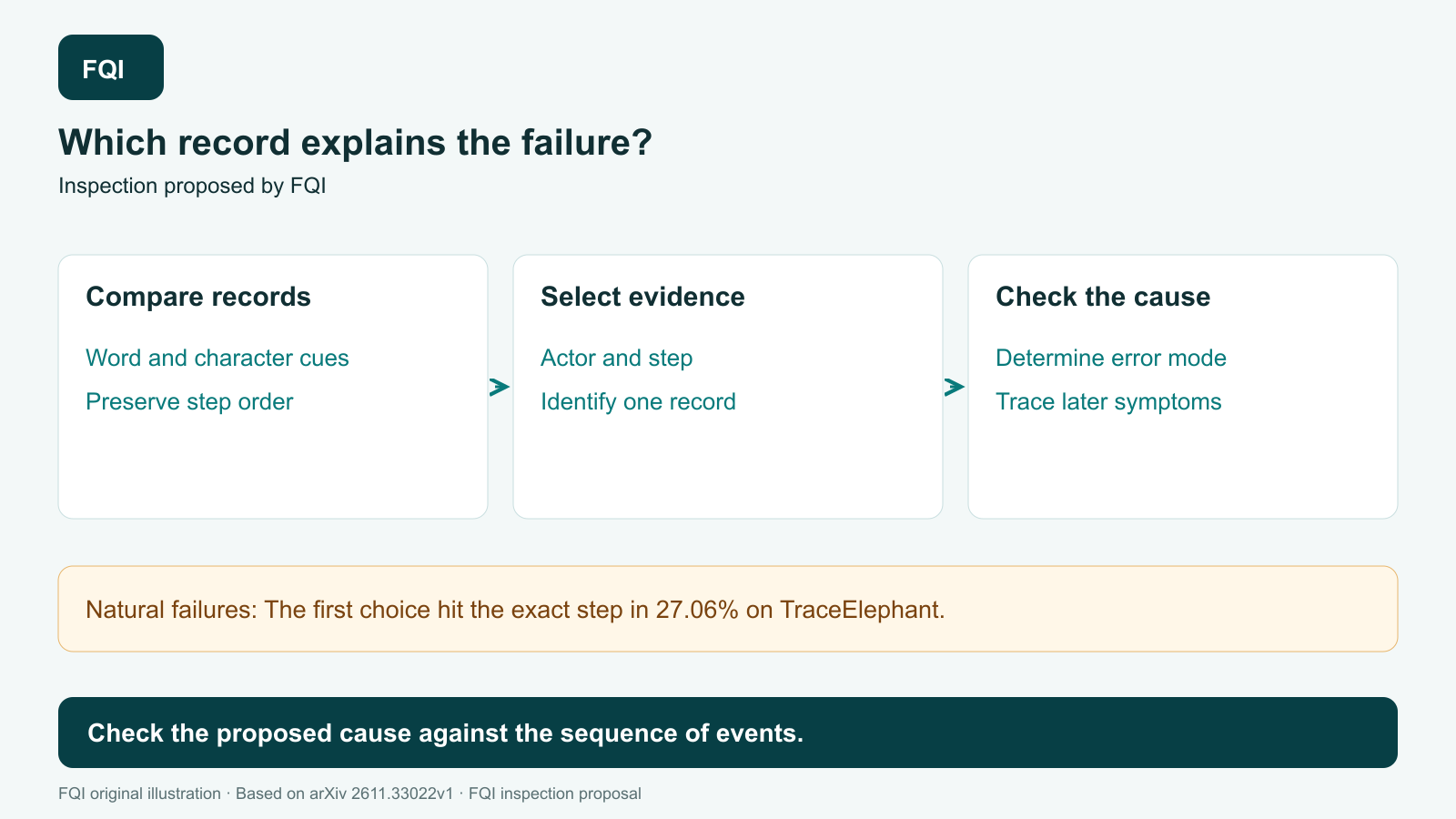
An agent can repeat incorrect information supplied by an earlier agent. Both records then contain much the same error wording. A method that recognises those words can still highlight the wrong point in time. RecordRoute learns from comparisons between records within a trajectory. Word and character patterns preserve details such as tool names and exception fragments. The selected record supplies the actor and step, and its text and metadata guide classification of the error mode.
Deep dive
The authors tested the approach on Who&When Pro, which contains controlled injections, and on TraceElephant and CatchBench POST, which contain natural failures. Trained methods were compared on common splits within each evaluation. For one comparison on the controlled dataset, the predicted actor and step were held fixed. Using the selected record for diagnosis yielded 77.47% pooled joint accuracy versus 69.28% using the concatenated full trace. The 8.18 percentage-point difference concerns jointly identifying actor, step and mode under that comparison.
On TraceElephant, the selected record identified the exact step in 27.06% of cases. On CatchBench POST, the first choice matched the annotated fault in 37.46%, while the top three included it in 77.78%. These results support inspecting a short list. They also show why a proposed starting point should carry a link back to the event rather than becoming an unverified root-cause entry.
Tests on unseen agent frameworks further qualified the result. Averages across frameworks and averages pooled over individual traces assign different weights to the cases. Under the pooled measure a simple rule that chose the last step remained competitive. A quality team therefore needs to evaluate the method on logs that resemble its own workflows.
FQI would store the selected record, actor and step alongside the proposed diagnosis. A reviewer could inspect the preceding inputs and later actions to identify whether the record introduced a mistake or repeated an existing one. Where feasible, a controlled replay after correcting the proposed cause can test whether the final outcome changes. A system returning several candidates should record which one was eventually confirmed.
Limitations and risks
The training labels specify what the benchmark treats as decisive. Real incidents may permit more than one interpretation. Comparisons with language models that have received no benchmark labels involve different training conditions. Reported latency figures also use different hardware. The results support a localisation method within its evaluated settings and leave causal confirmation to a separate investigation.
FQI conclusion
Tying a diagnosis to one identifiable event makes an assertion about the origin of a failure easier to test. The comparisons show that restricting the evidence for error classification can help in a controlled setting. The natural-failure results define a realistic use for that output. Give the reviewer a small set of concrete records, then document the additional evidence that supports a corrective action.
Sources & transparency
RecordRoute: Auditing Agent Failures with Localization-Guided Diagnosis · arXiv v1
Author preprint v1. FQI checked the cited sections of the original study. Workplace examples and inspection proposals are FQI interpretations. The experiments were not independently replicated.
Codex drafted the texts and checked them against the original study. Johann Fischer authorized publication on that basis on 26 November 2026.