
Executive summary
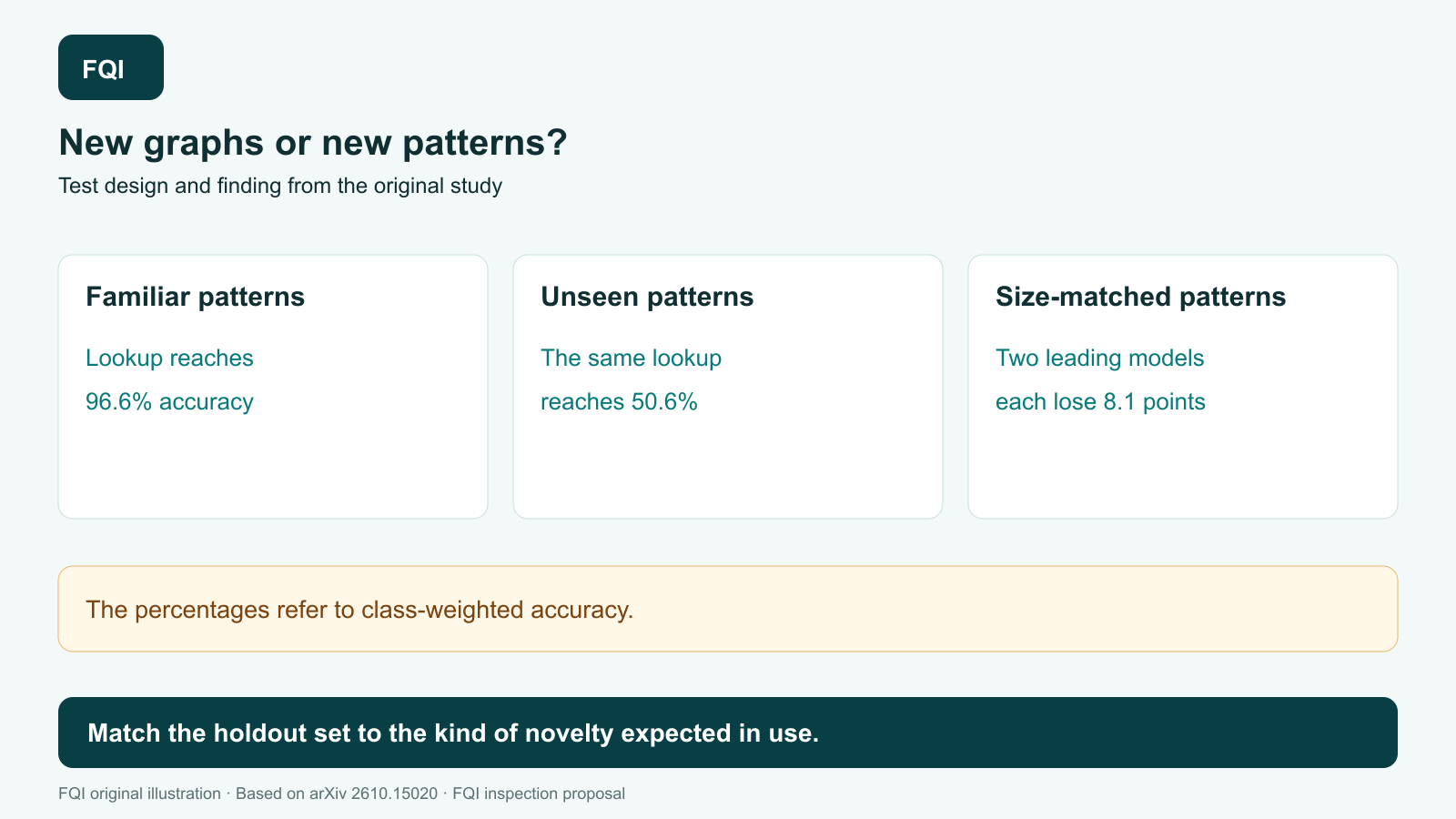
A new test file can contain a familiar solution. PATTERN asks a graph neural network to identify a small pattern inside a larger network. The surrounding networks change, but the planted structures come from a shared library. A lookup procedure reaches 96.6% class-weighted accuracy on the official split and 50.6% on unseen patterns. A second test set shows which kind of novelty a reported score actually covers.
FQI takeaway
- Identify reusable templates that contribute to training and test cases.
- Evaluate the same trained model on familiar and withheld pattern families.
- Include a simple lookup procedure as a baseline for recognizing familiar structures.
The principle at a glance
A graph consists of nodes and connections. Here the task is to mark the nodes belonging to a planted pattern. Official test graphs have new hosts but draw from the same 100 patterns used in training. That is a reasonable task when a system needs to find a known circuit in a new diagram. It leaves a separate qualification question if the system will also encounter new kinds of circuits.
Deep dive
The authors extract the familiar patterns from labeled training examples. Their lookup procedure needs neither a fitted neural network nor access to the generator to achieve its official score. Class-weighted accuracy accounts for the unequal frequency of the two node classes. It is neither the proportion of whole graphs solved perfectly nor the proportion of patterns localized exactly.
A second test introduces previously unseen patterns. The researchers also match familiar and unfamiliar patterns by size. Among five retrained networks, GRASS and PPGT move from the top two on the official split to the bottom two on fresh patterns. Both lose 8.1 percentage points in the size-matched comparison. Pattern size alone therefore cannot explain the change. A simple predictor using properties of nearby nodes provides another useful baseline on the fresh graphs.
In a company, drawings with different order numbers may still derive from the same template. One group of acceptance cases could use known templates in new settings. Another could reserve whole template families. Freeze the model, scoring rule and comparison methods before evaluating either group. If a withheld family is later admitted to training, keep its cases for regression testing and select genuinely unseen material for the next generalization claim.
Traceability needs to extend beyond file identifiers. When a drawing is copied and revised, record its parent template. Two separately numbered files can still encode the same geometry. A family-level test can be audited later only if that relationship survives the preparation of the test data.
Limitations and risks
PATTERN is synthetic. The successful lookup shows that the official task permits this solution. It does not identify the internal mechanism used by every trained network. Nor do the reported percentages transfer to real circuit diagrams. If the intended process uses only known patterns, the familiar-pattern condition remains directly relevant.
FQI conclusion
Name the unit of novelty in the report. A new record, a new host part and a new pattern family make different demands. Two scores obtained with the same model weights can support release for known families while leaving expansion to further families subject to its own qualification.
Sources & transparency
The study is an author preprint. The proposed operational checks are FQI interpretations. PATTERN Can Be Solved from Memory: Testing Graph Neural Networks on Unseen Patterns · Version history
Codex assisted with drafting and checked the claims against the cited original sources. Johann Fischer authorized publication on 2026-11-16.