
Executive summary
A fault scenario generated by artificial intelligence (AI) becomes a useful test only when it runs and actually activates the intended fault. FaultGene investigates this evidence chain for autonomous driving systems with real computing hardware inside a simulated environment. A language model generates executable scenario programs, whose quality is checked through execution and reference behaviour.
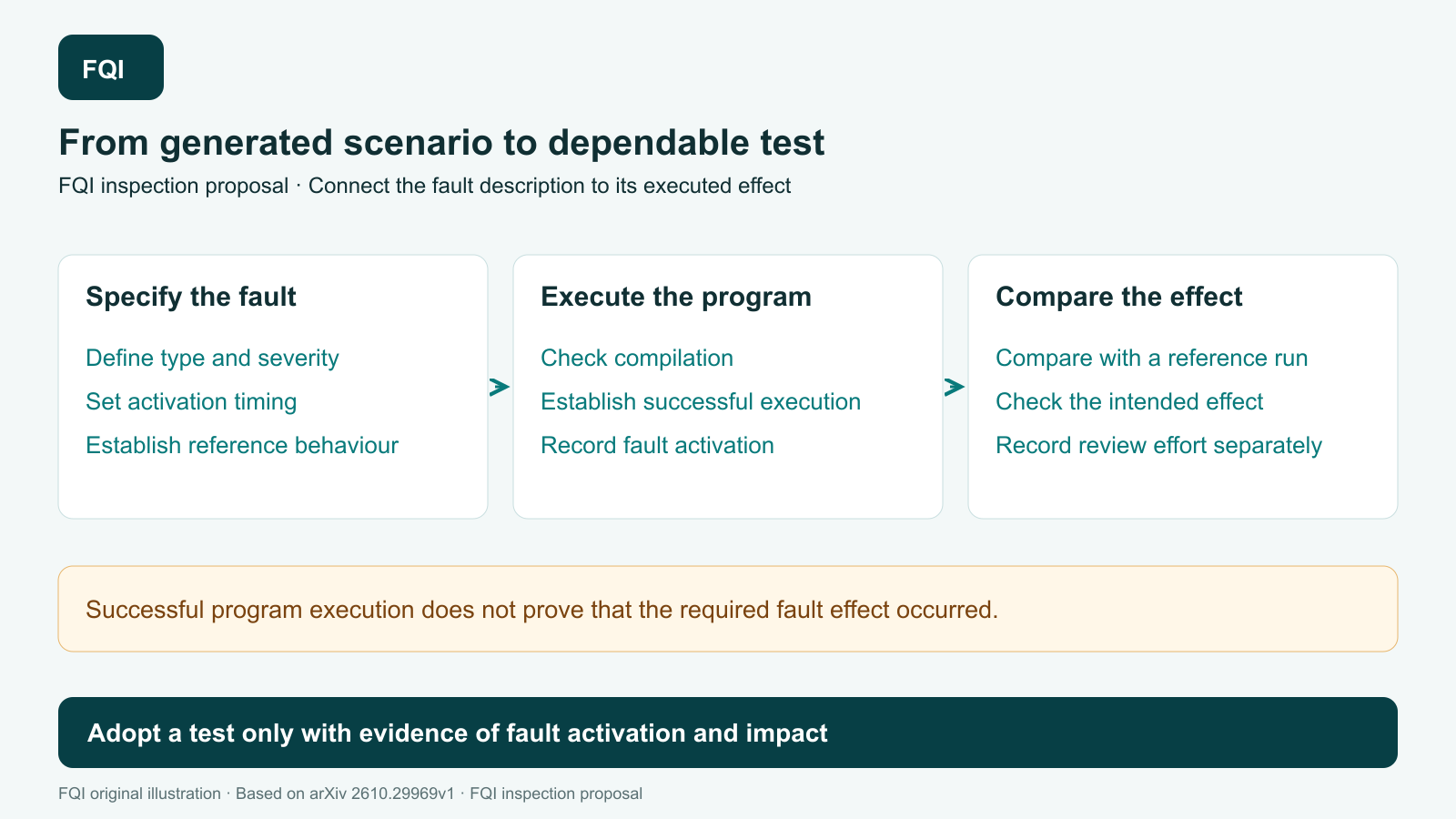
The transferable quality principle is to establish compilation, execution, fault activation and observed impact separately. A plausible written test description is insufficient evidence for these properties.
FQI takeaway
- Specify fault type, activation timing and severity as testable inputs to the generator.
- Check separately whether the scenario compiles, executes and activates the required fault.
- Establish the relevant effect against reference runs and label estimated effort savings as estimates.
The principle at a glance
A simplified FQI example: a test should examine an AI controller’s reaction to a delayed sensor message. A generated program can mention that fault without making it effective during the relevant operating interval. The simulation may then finish without testing the intended property.
Dependable evidence links the requirement to execution: which message was delayed, when did it happen, and which reaction was observed? That connection makes the scenario useful for a specific testing decision.
Deep dive
FaultGene uses a language model to generate a program in Scenic from a baseline scenario and structured fault description. Scenic is a language for describing simulation conditions. The study couples the CARLA driving simulator to real NVIDIA computing modules. This arrangement is called hardware-in-the-loop: a real component operates within a simulated environment.
The fault set includes delayed or missing sensor signals, spatial misalignment and targeted changes to individual stored bits. The latter concern computation. Evaluation covers both a modular driving system and a simpler system that maps sensor data directly to control outputs.
Training data are produced through a preliminary scenario-refinement process. Hardware reference runs provide comparison information. A model processing images and text helps assess scene behaviour.
Fault relevance is checked separately. Programs that cannot compile and problematic executions are excluded, including cases in which the intended fault never activates.
The authors report 600 training pairs and 200 separate test cases. After adaptation, the generator produces new scenarios in a single pass without the reference feedback used during refinement. The more expensive preparation of training examples and the later generation stage must therefore be distinguished.
For the modular system, 96 percent of generated programs compile successfully. Of those compiled programs, 93 percent execute successfully. The second percentage does not use all generated candidates as its denominator. Even successful execution still needs evidence that the intended fault had the relevant effect.
For operational transfer, FQI proposes a short evidence record for each generated test: fault requirement, generator version, program, compilation result, execution status, activation evidence and impact comparison. The team uses this record to decide whether the case enters the test collection. A small expert-authored reference set can expose typical generation defects, such as a correctly named sensor fault activated too late.
Effort assessment should separately record generation time, reference preparation, training and manual review. The paper calculates campaign savings under stated assumptions. These calculations do not establish measured total savings for an operational test process.
Limitations and risks
The investigation concerns specific driving systems, simulators and hardware. An image-and-text model used as an evaluation aid can itself misinterpret a scene. Executability and similarity to reference behaviour establish neither complete fault coverage nor road safety.
Fault timing is also not a fully assured optimisation objective of the generator. Other controllers require their own activation conditions, tolerances and reference behaviour. The described process supports this work but does not replace it.
FQI conclusion
For FQI, an AI-generated test case should be treated like a new inspection instrument: its intended effect must be established before its result influences a quality decision. FaultGene provides a traceable connection between fault description, program and actual execution on computing hardware. A practical next step is a bounded collection with a few clearly defined fault types. The important measures are how many generated scenarios pass the complete evidence chain and which expert checks remain necessary to support that conclusion.
Sources & transparency
Primary source: FaultGene, original full text v1, particularly Sections III–VII. Research manuscript from the University of California, Irvine; no independent reproduction by FQI. The sensor example and proposed evidence record are FQI interpretations. AI-assisted article, approved for publication by Johann Fischer on 2026-10-23.