
Executive summary
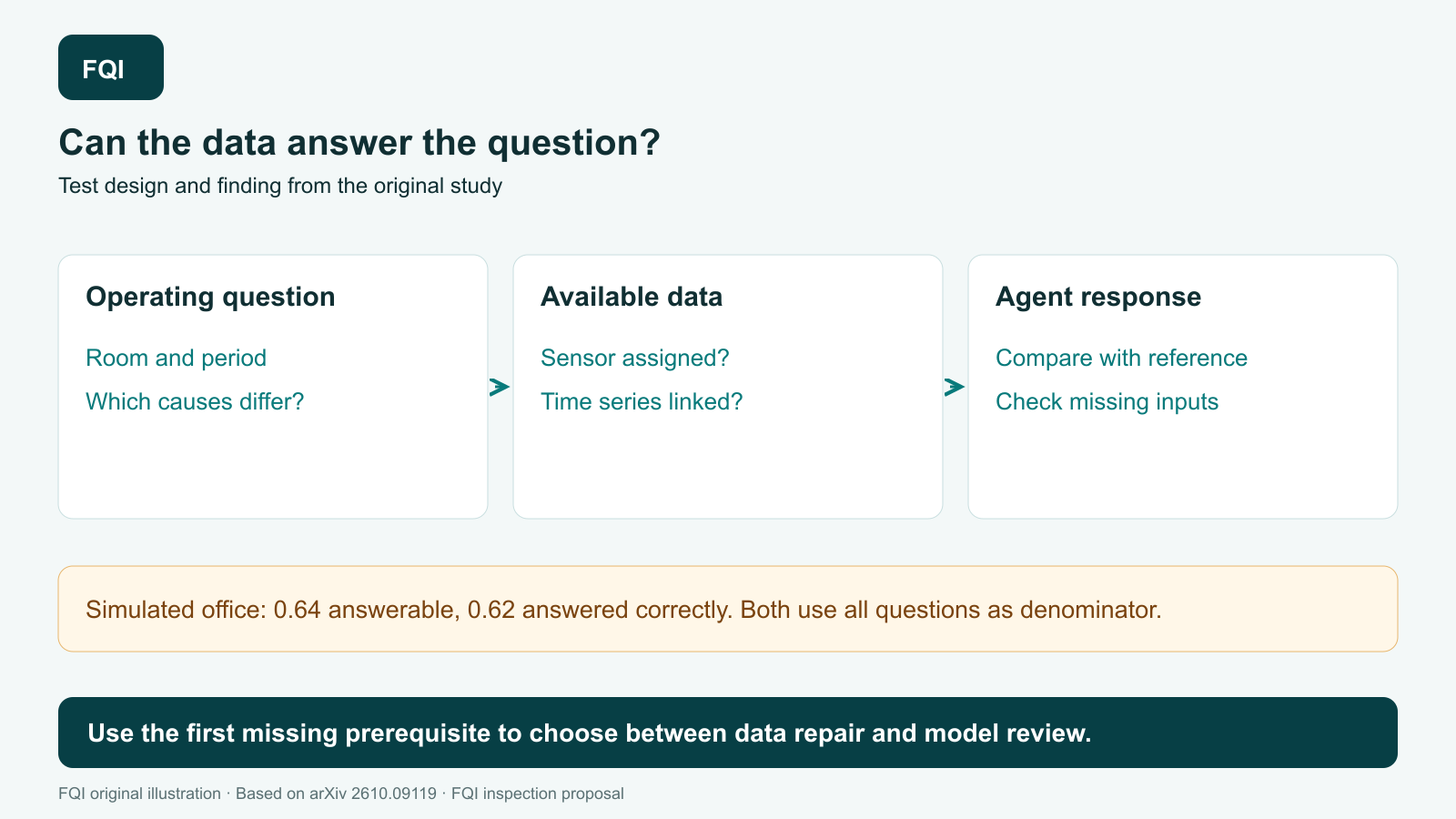
A warm office can have several plausible explanations. Before comparing language models, the building team can ask which available measurements would distinguish those causes. A study compares operating questions with the information accessible to a building assistant. In the simulated office, a reference agent answered about 0.62 of the full question set correctly against an estimated answerability ceiling of about 0.64.
FQI takeaway
- List the data prerequisites for each priority question.
- Check that each point is associated with the right room or piece of equipment.
- Assess the availability of a control point separately from permission to operate it.
The principle at a glance
The researchers use a knowledge graph, a structured record of equipment, sensors and relationships that can link to time series. Listing a sensor establishes its presence in the record. Answering a question about one shift also requires the correct series for that room and period. The available information sets a ceiling on the fraction of questions that can be answered. A separate ceiling concerns the actions exposed by the control interfaces.
Deep dive
In the controlled experiment, the researchers use simulated operating data and fixed questions with reference answers. They first check the information required by each question and then let a specified agent attempt it. A wrong answer despite sufficient data calls for a different investigation from a question that lacks a necessary signal. Naming a fault’s cause can remain difficult even when the measurements distinguish it. Across 37 real building graphs with linked data, the median answerable ceiling was 0.16. In a wider group of 45 graphs, unlinked sensors reduced usable coverage in 15. These counts describe different groups. Neither establishes how accurately the simulated agent would answer questions at a particular real site.
Limitations and risks
In a simplified acceptance case, compare a scheduled temperature setpoint with the setpoint actually in effect. If both move together, a scheduled change fits the observation. If only the effective value shifts, a local override is one possibility. A persuasive account of the cause can hide the fact that one of these records was missing. The study uses defined questions and prepared data. Ambiguous room names, faulty sensors and uncertain time references can introduce further limits in service. A control point visible in the graph establishes a technical possibility. Operating it still requires the site’s own authorisation.
FQI conclusion
Prioritise work using the questions the operating team actually needs answered. Repairing one missing link may make several important questions answerable. A question that the data already resolve, but that the agent repeatedly answers incorrectly, calls for investigation of the agent. Retesting the same question against a recorded data state makes either improvement observable.
Sources & transparency
The figures and comparisons come from the authors’ arXiv preprint. The workplace example and proposed acceptance decisions are FQI interpretations. Which Buildings Are Artificial Intelligence-Ready? A Measurement-Based Assessment Framework for AI Question Answering and Actuation · Version history
Codex assisted with drafting and checked the claims against the cited original sources. Johann Fischer authorized publication on 2026-11-14.