
Executive summary
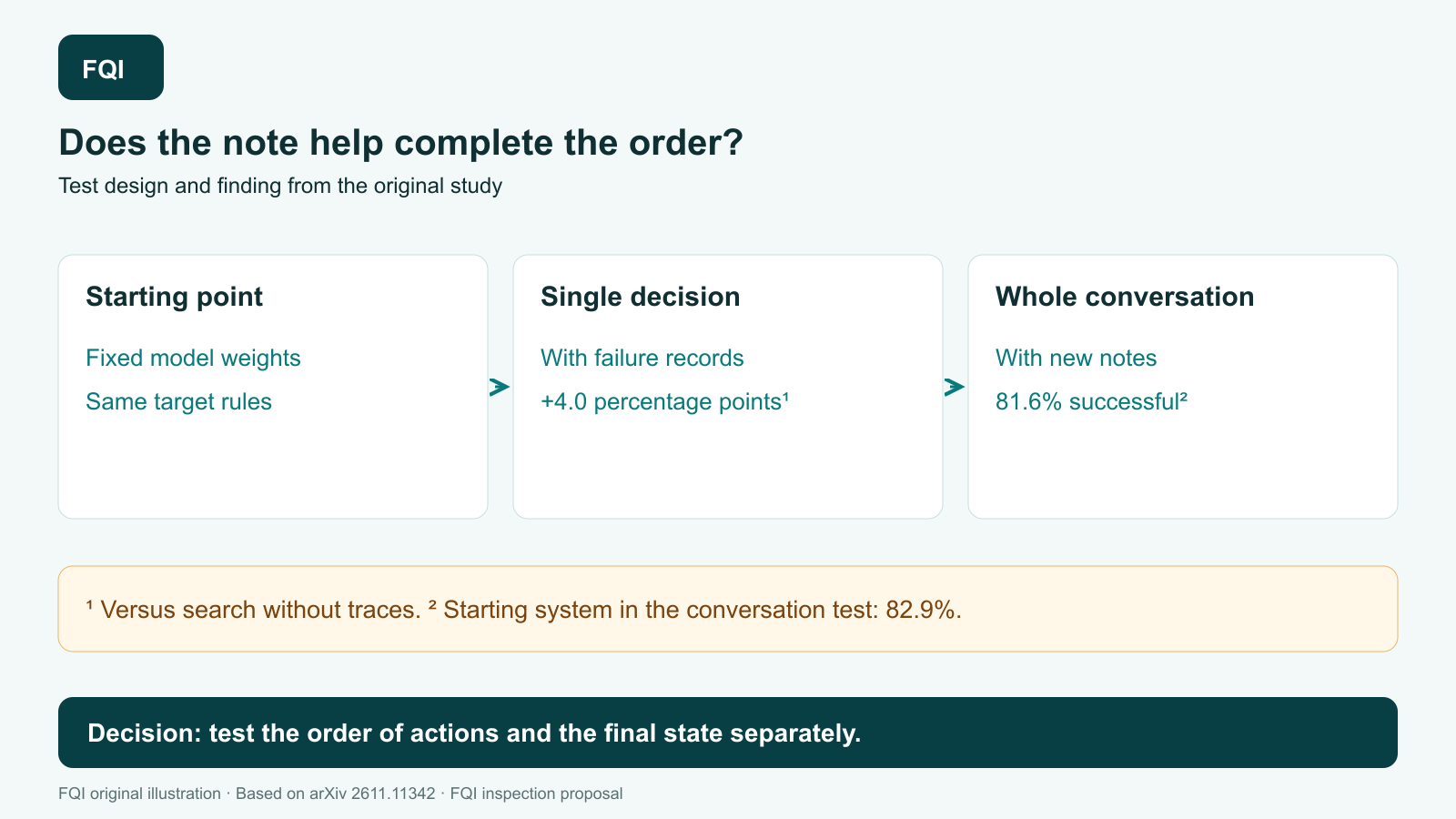
A service assistant needs to change a delivery address before editing the items in an order. A note can help it choose the right next action. Whether the customer ultimately receives the right order is a second question. An experiment with a fixed language model distinguishes these outcomes. Access to records of earlier failures improved performance on individual decisions. The researchers could not demonstrate a gain for complete customer conversations.
FQI takeaway
- Compare notes based on failure records with a search for better notes that never sees those records.
- Decide before testing what improvement in individual decisions would matter to the operation.
- Test the selected notes in held-out conversations through to the agreed final state.
The principle at a glance
The model executing the tasks had nine billion parameters. Its learned weights stayed fixed throughout the experiment. A larger language model wrote notes that the smaller one could read when deciding what to do. In one condition the writer saw records of unsuccessful interactions. In the control condition it knew the target rules and received feedback on candidate notes but could not inspect those records.
A writer that proposes alternatives and keeps the best on development cases may improve the instructions even without seeing a failure. Comparing its winning note only with the initial instructions would credit the records for gains that the search itself could achieve. The control approximates the additional value of access to the records under the tested procedure.
Deep dive
Across 2,997 held-out decisions the starting configuration scored 70.3% correct. Search without the failure records reached 76.8%, and notes written with them reached 80.9%. The preregistered contrast between the two search conditions was 4.0 percentage points, with a reported interval from 2.3 to 5.7. Its point estimate was below the five-point gain the researchers had specified as worthwhile.
For the end-to-end test, both the task and the comparison changed. Across 114 simulated retail tasks with four trials each, the team compared the notes derived from failures with the starting configuration. The conversation success rates were 81.6% with the notes and 82.9% at baseline. The interval for the difference ran from a disadvantage of 5.9 points to a benefit of 3.3 points. One ordering error disappeared in the observed conversations, even though overall benefit remained uncertain.
An acceptance record can capture both levels. One field records whether the assistant changed the address before editing the order. Another records whether the system contained the correct items and address once the interaction ended. If the sequence improves but the final state does not, the later steps are worth inspecting. This is an FQI proposal for an operational test.
Limitations and risks
The researchers used one frozen model and simulated customer tasks. The figures do not estimate the performance of a particular service centre. The control retained development feedback. Its gain cannot be divided cleanly between repeated selection, improved wording and restatement of rules. The conversation result remains compatible with a small benefit or disadvantage.
FQI conclusion
Name the intended benefit before adopting a lesson from past failures. For a narrowly defined sequencing correction, a targeted test can document the change. A claim about better order fulfilment also requires complete held-out cases and a technically valid definition of the final state. Those two records allow a reviewer to approve a limited improvement without promising a broader one.
Sources & transparency
The study is an author preprint. The proposed operational checks are FQI interpretations. Agent Self-Improvement with Frozen Weights: The Added Value and Limits of Failure Traces · Version record
Codex assisted with drafting and checked the claims against the cited original sources. Johann Fischer authorized publication on 2026-11-15.