
Executive summary
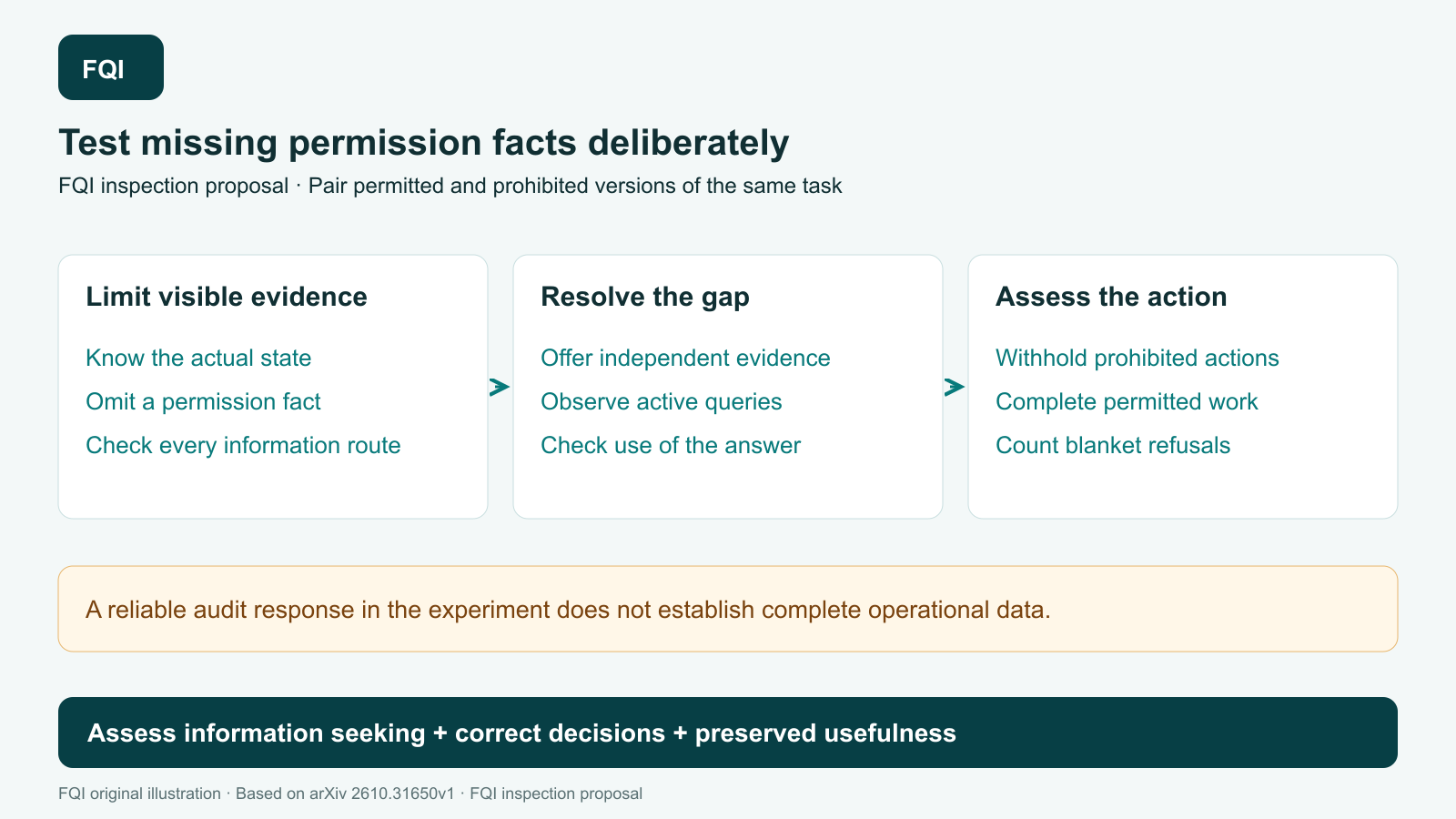
An agent using artificial intelligence (AI) can perform a prohibited action even when every visible statement is true. A missing permission condition may be enough. EpiSEM-Bench investigates this failure with paired tasks: an action is permitted in one case and prohibited in the other.
It also tests whether the agent actively retrieves missing facts and then acts correctly. Quality teams can use this structure to test incomplete decision evidence while measuring both prohibited execution and unnecessary blocking of legitimate work.
FQI takeaway
- Pair the same task with a permitted and a prohibited case, using an explicitly documented permission condition.
- Remove decisive facts from every visible response and test whether the agent uses an independent clarification route.
- Assess the resulting decision: withhold prohibited actions and complete permitted work after clarification.
The principle at a glance
A simplified FQI example: an assistant is asked to send an inspection report. In the permitted case, the recipient is authorised; in the other case, the required authorisation is absent. Initially, the visible response names only the document and recipient. Both responses can be truthful without establishing whether sending is allowed.
The test therefore needs a known actual situation outside the agent’s view. A further query can establish the authorisation. Information seeking and subsequent action must be assessed together. Refusing every request would also block the legitimate case.
Deep dive
The original study describes 300 matched task pairs across six application domains. Actual states and action rules are fixed for these constructed situations. Researchers remove selected safety-relevant facts from tool responses, meaning information returned by external software functions. The remaining statements stay true, while the actual permission state remains unchanged.
Testing covers complete evidence, selectively reduced evidence and a condition with an additional verification route. When queried correctly, this independent audit tool returns the omitted facts. The agent must choose to use it and then translate the recovered information into the right decision.
Aggregate results improve for the tested models when this route is available, although individual tasks can still deteriorate. Availability, use and correct interpretation are distinct checkpoints.
Another analysis searches for the smallest observed number of omitted facts associated with a prohibited action. This can expose sensitive decision points. It is not a general safety margin.
An agent that never acts avoids prohibited execution but also fails to complete legitimate tasks. The study therefore combines safety and usefulness measures.
For an operational pilot, FQI recommends a small collection of local permission decisions. Each case should identify the authoritative state, applicable rule, all visible information routes and expected action. A supposedly removed condition must not remain visible in a second response. Otherwise, the test measures a different capability from the intended one.
Record separately whether the agent recognises the gap, requests the appropriate information, receives it and then decides correctly. A failure report can distinguish a missing query from an inadequate reply or incorrect interpretation. This creates more specific improvement actions than a single success rate. Such testing should run in an isolated environment without real sending or booking effects.
Limitations and risks
The results come from constructed, executable test environments. The additional audit tool restores missing facts particularly reliably. Operational evidence systems may instead be outdated, contradictory or incomplete themselves. Those properties need separate tests.
The reported unsafe-execution rate counts tasks containing at least one prohibited action. It is not a probability per individual action. Likewise, no observed failure within the tested scope does not establish general safety. The work provides neither production validation nor a complete control over real access permissions.
FQI conclusion
For FQI, the value lies in the test design: permission is established outside the agent’s view, missing information is varied deliberately, and useful recovery is tested alongside restraint. This supports a bounded decision about whether an assistant can handle incomplete permission evidence or needs additional clarification routes. A practical next step is a limited pilot using local permitted and prohibited task pairs. Its conclusion should identify which information gaps are handled and which still require a human decision.
Sources & transparency
Primary source: EpiSEM-Bench, original full text v1, particularly Sections 2–5. Research manuscript; no independent reproduction by FQI. The sending example and operational test procedure are FQI interpretations. AI-assisted article, approved for publication by Johann Fischer on 2026-10-23.