
Executive summary
Artificial intelligence (AI) learns partly from the image proposals that training labels as suitable examples. This study supplements the usual overlap measure with shape information. Average detection scores improve on two metal-surface datasets, but some defect classes deteriorate. Quality teams should therefore treat training assignment as a separate inspection object. A better average does not justify poorer detection of a critical defect. The claim of unchanged computation also needs checking because one table contains conflicting figures.
FQI takeaway
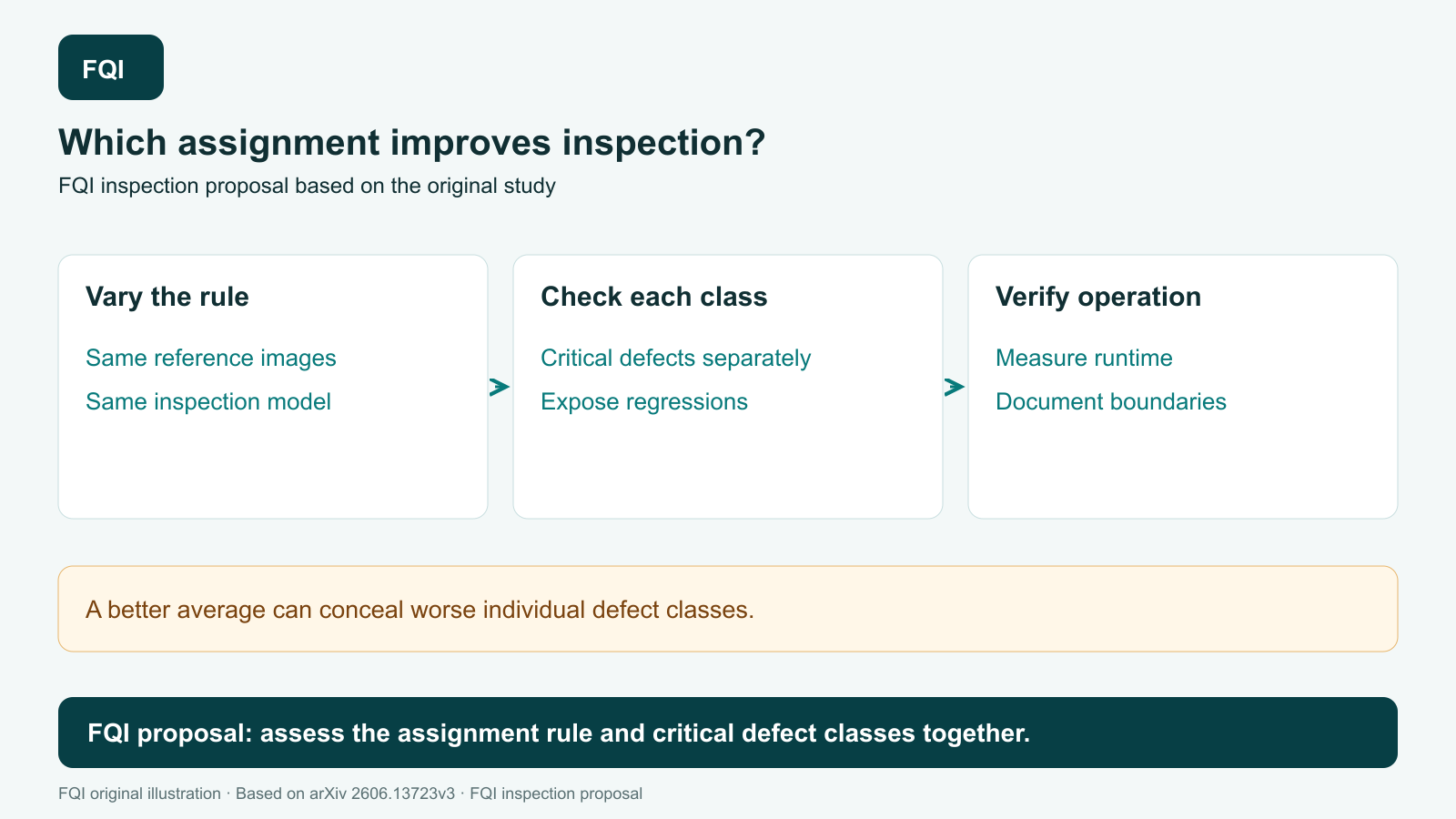
- Compare assignment rules with the model and data split held constant.
- Assess gains and regressions separately for every critical defect class.
- Measure performance on target hardware rather than assuming zero additional cost.
The principle at a glance
An object detector proposes boxes around possible defects. During training, a rule decides which proposals belong to a labelled reference. Intersection-over-Union, or IoU, divides the shared area of two boxes by their combined area. Different geometric matches can nevertheless receive similar overlap scores.
The authors add similarities in area, shape and aspect ratio to the positive-example assignment. The intervention changes how a neural visual detector learns. It does not introduce another physical sensor or a separate human inspection stage.
Deep dive
The third author version changes the assignment function within the YOLOv9 family. The model backbone and detection head are intended to remain unchanged. Evaluation uses GC10-DET, containing 2,294 images and ten defect types, and NEU-DET, containing 1,800 images and six types. Their training-to-evaluation splits are nine to one and eight to two respectively.
The reported measure is mean average precision at an overlap threshold of 0.5. It aggregates detection performance across classes; it is not a factory scrap rate. For the small YOLOv9-t variant, the GC10-DET score rises from 70.2% to 72.9%. On NEU-DET, the corresponding score increases from 76.4% to 77.6%. Each comparison concerns the same model variant with a different assignment rule.
Class-level results distinguish a research improvement from a release decision. An increased average does not mean that every defect type improves. FQI would set criticality-based limits before comparison: which defects must not be missed more often, and what false-alarm burden is acceptable? Those limits should govern acceptance rather than follow the result.
A controlled pilot would use identical real images, annotations and data splits for the baseline and the modified assignment. Repeated training runs should expose variability. FQI additionally recommends reporting thin cracks, broad stains and small inclusions separately, because the shapes may benefit differently. Final evaluation belongs on held-out images from the intended process, not a collection of favourable examples selected afterwards.
A model change also needs a clear acceptance record. The record should identify the assignment implementation, trained weights, evaluation set and operating threshold. This is an FQI recommendation for traceability, not an industrial outcome demonstrated by the paper. If a critical class regresses, the team should investigate that regression before accepting a higher aggregate score.
Limitations and risks
The paper claims no additional inference computation. Table 2 nevertheless gives different operation counts for the largest variant while keeping parameter counts identical. The discrepancy remains unresolved, so the table cannot establish unchanged computation without qualification. The stated number of models is also inconsistent in places. Two public image collections do not establish robustness under different lighting, cameras or surface conditions. An unchanged parameter count alone is not a measured latency result.
FQI conclusion
The useful contribution is to make training assignment visible as a quality decision. A controlled comparison can test whether a different rule improves the intended detector without sacrificing critical defect classes. The reported gains justify investigation, not blanket production approval. Acceptance still requires class-level evidence and measurements on target hardware. Higher averages and identical parameter counts must not conceal regressions or unresolved inconsistencies in computational cost.
Sources & transparency
- Morphology-Aware Sample Assignment: Overcoming IoU Insensitivity for Surface Defect Detection
- Morphology-Aware Sample Assignment: Overcoming IoU Insensitivity for Surface Defect Detection
Codex assisted with drafting and checked the claims against the cited original study. Results were not independently reproduced. Operational recommendations and simplified examples are FQI interpretations.
Codex assisted with drafting and checked the claims against the cited original sources. Johann Fischer authorized publication on 2026-11-23 following review by Codex. Individual human reading is not claimed.