
Executive summary
An image watermark can support a claim that an image passed through a marked generation pipeline. However, its detector must also match the image generator. SpiderMark combines an embedded frequency pattern with a trained recognition model. When the generator changes, the same embedding construction remains usable while the unchanged detector performs substantially worse. Quality management should therefore validate the combination of generator, detector, decision threshold and image processing. A favourable comparison does not establish performance for every operating configuration.
FQI takeaway
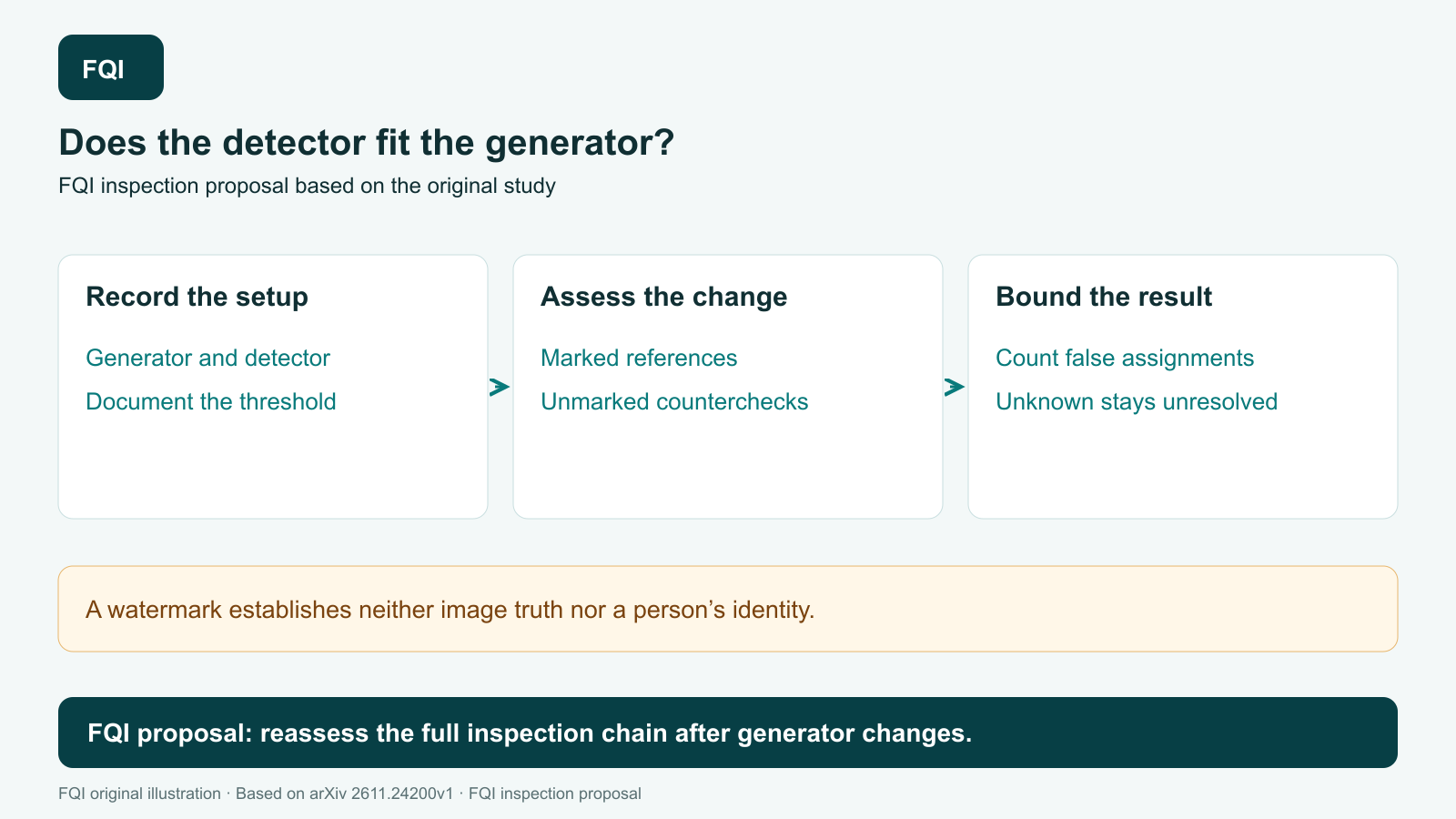
- Bind the configuration: Record the generator, detector version and decision threshold together.
- Reassess changes: Test new generators and processing chains against marked and unmarked reference images.
- Limit the claim: Detecting a watermark establishes neither image truth nor a particular creator’s identity.
The principle at a glance
SpiderMark inserts a fixed pattern into the initial noise used by a diffusion model. Such a model generates an image by progressively refining a noisy starting state. The pattern resembles a web with spokes and rings. Embedding does not require retraining the generator’s weights.
Recognition does use a learned neural network. It processes reconstructed frequency features and additional similarity measures, then compares its output with a fixed threshold. Artificial intelligence (AI) therefore performs inspection within an AI image-generation pipeline; this is more than attaching a file label.
Terms explained
- Detector: A trained model distinguishing images with and without the particular watermark.
- Decision threshold: A predetermined boundary above which the detector declares a positive result.
- Ranking discrimination: The ability to give marked images higher scores than unmarked images; this does not guarantee correct decisions at a fixed threshold.
Deep dive
The authors create marked and unmarked image pairs using matching text instructions and starting conditions. Their reference training dataset contains 500 images per class, split into 85 percent for training and 15 percent for validation. The detector threshold is 0.5. Inspection requires a compatible copy of the relevant diffusion model to approximately reconstruct the starting features.
Table XI provides the key generator-change comparison. With Stable Diffusion 2.1, the reference detector averages 84.95 percent accuracy across nine conditions. Applied directly to SDXL images, the same detector achieves 52.12 percent. Adapting the detector to SDXL raises accuracy to 76.13 percent. These figures average five evaluation runs with seeded conditions, rather than five independent training repetitions.
This supports transferable embedding with adaptation of the recognition stage. It does not establish a universal provenance detector. Image processing introduces another boundary: an intentionally extreme combination of transformations produces 50.93 percent accuracy. A favourable individual robustness test cannot establish resistance to arbitrary processing chains.
An FQI pilot could accompany a company’s library of synthetic training illustrations. The team would specify which generation pipeline receives the mark and which image transformations occur in normal use. It would retain an untouched test set containing known positive and negative examples, and choose the decision threshold before evaluating that set. Missed marks and false provenance assignments would then be reported separately.
Changing the generator or preprocessing would trigger a new validity assessment. Historical performance would remain attached to the old configuration. For unknown configurations, the process could return an unresolved status instead of turning uncertain evidence into a provenance confirmation. This process design is an FQI recommendation, not an operational result demonstrated by the authors.
Limitations and risks
The study examines a fixed watermark and its binary presence. It contains neither individual issuer identifiers nor image metadata. The authors claim neither cryptographic identity binding nor formally calibrated probabilities. A score of 0.9 must therefore not automatically be described as 90 percent certainty about provenance.
Some parameter studies use the same validation images for model selection and evaluation. Their variation does not represent uncertainty from independent retraining. A co-author works at software provider Canva; these are authors’ research findings, not an independent product acceptance test. The National Institute of Standards and Technology (NIST) framework supports documenting test conditions and demonstrating validity in the deployment context, but confirms none of SpiderMark’s performance figures.
FQI conclusion
Image watermarks require a traceable inspection chain. SpiderMark’s useful contribution for FQI is the visible distinction between transferable marking and transferable recognition. Quality teams should treat a generator change as an inspection-process change and assess the new configuration against independent reference cases. Documenting the combination of model, threshold and processing conditions makes the result interpretable. Detecting a pattern remains a limited provenance indication and cannot replace an assessment of the image’s content.
Sources & transparency
- SpiderMark: Hybrid Watermarking for Generative AI via Algorithmic Injection and Learning-Based Verification
- SpiderMark: Hybrid Watermarking for Generative AI via Algorithmic Injection and Learning-Based Verification
- NIST AI RMF Core
Codex assisted with drafting and checked the claims against the cited original study. Results were not independently reproduced. Operational recommendations and simplified examples are FQI interpretations.
Codex assisted with drafting and checked the claims against the cited original sources. Johann Fischer authorized publication on 2026-11-22 following review by Codex. Individual human reading is not claimed.