
Executive summary
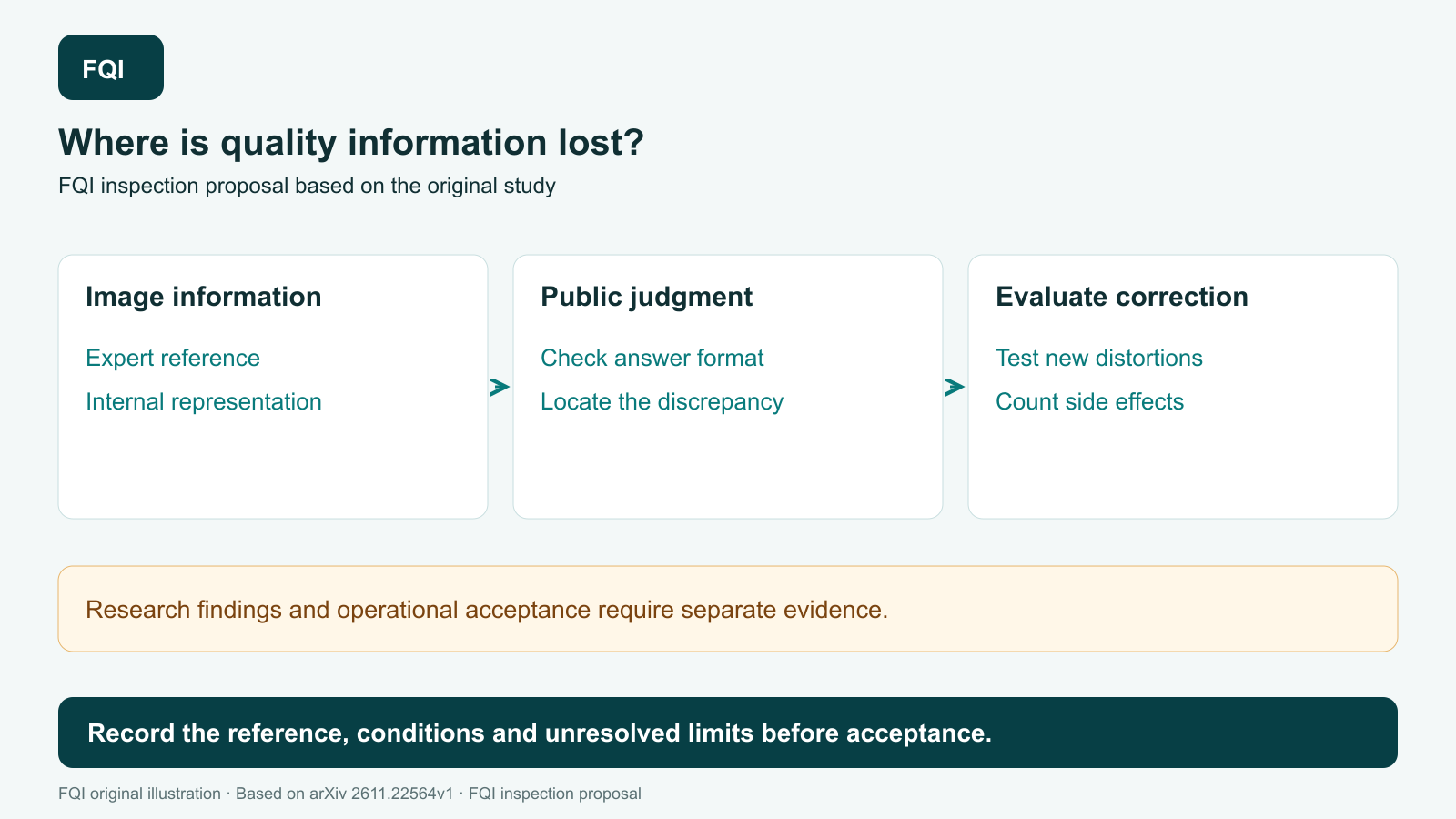
A vision-language model may represent image quality internally without expressing it reliably in its answer. Lost in Read-out compares internal readouts with public responses and tests a limited edit to the final processing layer. FQI draws a diagnostic question from the work: does weak quality assessment originate in perception or in the conversion to an answer? The experiments also show clear transfer limits. The edit is not a general repair for industrial visual inspection.
FQI takeaway
- Compare the stated quality judgment with independent expert references.
- Test unseen instructions, answer formats and image distortions.
- Check unrelated outputs for side effects after a model correction.
The principle at a glance
A vision-language model processes visual information and eventually turns it into words or scores. The authors study judgments contrasting good and poor image quality. Simple mathematical readouts of internal states are fitted to human quality ratings and compared with the model’s ordinary answer.
If more relevant information can be recovered internally than the answer expresses, perception is not the only possible bottleneck. The artificial intelligence (AI) role is directly diagnostic: the study examines where quality information is lost or weighted differently inside a neural model.
Deep dive
The work studies five models and several image-quality datasets. Fitting and evaluation use distinct images and instructions, including twelve held-out instructions. Improvement on familiar wording alone would not demonstrate robustness.
Quality information is recoverable from the visual component and late language states. Relative to human ratings, the public answer tends to reward colorfulness more and sharpness less. This does not explain every error, but it provides a specific hypothesis to investigate.
The authors then edit one computational unit in the last layer. On KonIQ, the intervention closes much of the gap to an external readout fitted under comparable conditions. The reference is that measured gap, not perfect human agreement. A fraction of a closed gap must not be reported as an overall accuracy rate.
Transfer is uneven. Some larger models improve too little to meet the predefined criterion. On synthetic distortions, results sometimes deteriorate. Yes/no questions and numerical ratings do not simply inherit the benefit of the good-versus-poor contrast. The intervention can also alter those words in unrelated text.
FQI proposes comparing the original and corrected systems on the same acceptance set. Separate natural acquisition problems, artificial distortions and answer formats. In a technical inspection, specify the relevant feature as well: a pleasing image need not make a small defect easier to see. Suitable expert references determine whether the intervention helps the actual task.
Record the adaptation data and configuration, and decide beforehand which side effects would make an improvement unacceptable. This is an editorial inspection proposal, not an industrial workflow demonstrated by the paper. Keeping unchanged comparison cases also helps distinguish an intended correction from a broader change in response behavior.
Limitations and risks
The human ratings measure image quality, not necessarily the visibility of a component defect. Internal decodability does not establish that the unmodified model actually uses the information in a decision. Effects depend on model, data and response contrast, and new distortions may require refitting.
The authors disclose extensive AI assistance and accept responsibility for the work. FQI has not independently reproduced the experiments; code availability was announced in the version read.
FQI conclusion
A poor quality score need not be explained only by missing visual information or insufficient model size. The mapping to an answer deserves separate examination. The limited correction also illustrates how narrowly success should be stated. Independent expert references, unseen test cases and side-effect checks remain essential. An internal improvement becomes operationally relevant only when it makes the judgment actually needed by the application more reliable.
Sources & transparency
- Lost in Read-out: Locating the Image Quality Gap in Vision-Language Models with a Closed-Form Edit · Full text
- arXiv · Version history
Codex drafted this article and checked the cited original sources. FQI applications are editorial interpretation; the experiments were not independently reproduced.
Codex assisted with drafting and checked the claims against the cited original sources. Johann Fischer authorized publication on 2026-11-18.