
Executive summary
An image search with a requested change needs three things to agree: the reference picture, the description of the change and the target picture. If they disagree, a model can learn the wrong association. CREDIT, a research method for training artificial intelligence (AI), gives uncertain matches less influence. It improved retrieval when the researchers disrupted training examples. On one dataset with the original assignments intact, a competing method scored higher on the combined measure. A quality team evaluating the approach therefore needs to track difficult correct matches as well as resilience to errors.
FQI takeaway
- Verify the relationship between the reference image, the requested change and the target as a unit.
- Compare results under training errors with results on difficult examples whose assignments have been confirmed.
- Use the model’s estimate of uncertainty to select examples for inspection. Establish whether the assignment is wrong by checking the underlying evidence.
The principle at a glance
A shopper might show a dress and request a similar one with longer sleeves. To learn the task, a model sees sets of three items that illustrate a change. A wrongly assigned target can teach it to look for another feature. Even a correct target can be difficult to distinguish from the other dresses in the collection.
CREDIT uses the text to identify relevant parts of the reference image. It assesses the evidence for the assigned target relative to other candidates. This produces a weight controlling how much the example influences learning. A further component perturbs internal image features and learns to recover information relevant to the text. The source photographs stay intact. All examples participate in retrieval training, while a threshold restricts part of the uncertainty training to well supported assignments.
Deep dive
The authors used FashionIQ, a clothing image collection, and CIRR, which contains more varied scenes. They selected training examples and corrupted one component of each selected group. They tested noise levels of zero, 20, 50 and 80 per cent. These are settings chosen for an experiment. They do not estimate the prevalence of errors in operational records.
On FashionIQ, with 20 per cent of training assignments disrupted, CREDIT retrieved the assigned target among the first ten results in 55.32 per cent of queries, averaged across clothing categories. The figure for the first fifty was 75.73 per cent. The paper reports a combined average of 65.52 per cent, 1.14 percentage points ahead of the strongest comparison on that measure. Whether a user reviews ten results or fifty therefore matters when interpreting the headline score.
On CIRR the combined measure includes both retrieval across the gallery and a choice within a smaller group. CREDIT led on this measure under the three noise settings. With the original assignments in place it scored 81.35 against 82.02 for TME. The authors suggest that ambiguous evidence may cause difficult correct assignments to receive too little training weight. Removing the uncertainty component also changed performance: on FashionIQ at 20 per cent noise, the top-ten figure fell from 55.32 to 53.31 per cent. This comparison tests a component of the training method. It does not tell an inspector which individual records are wrong.
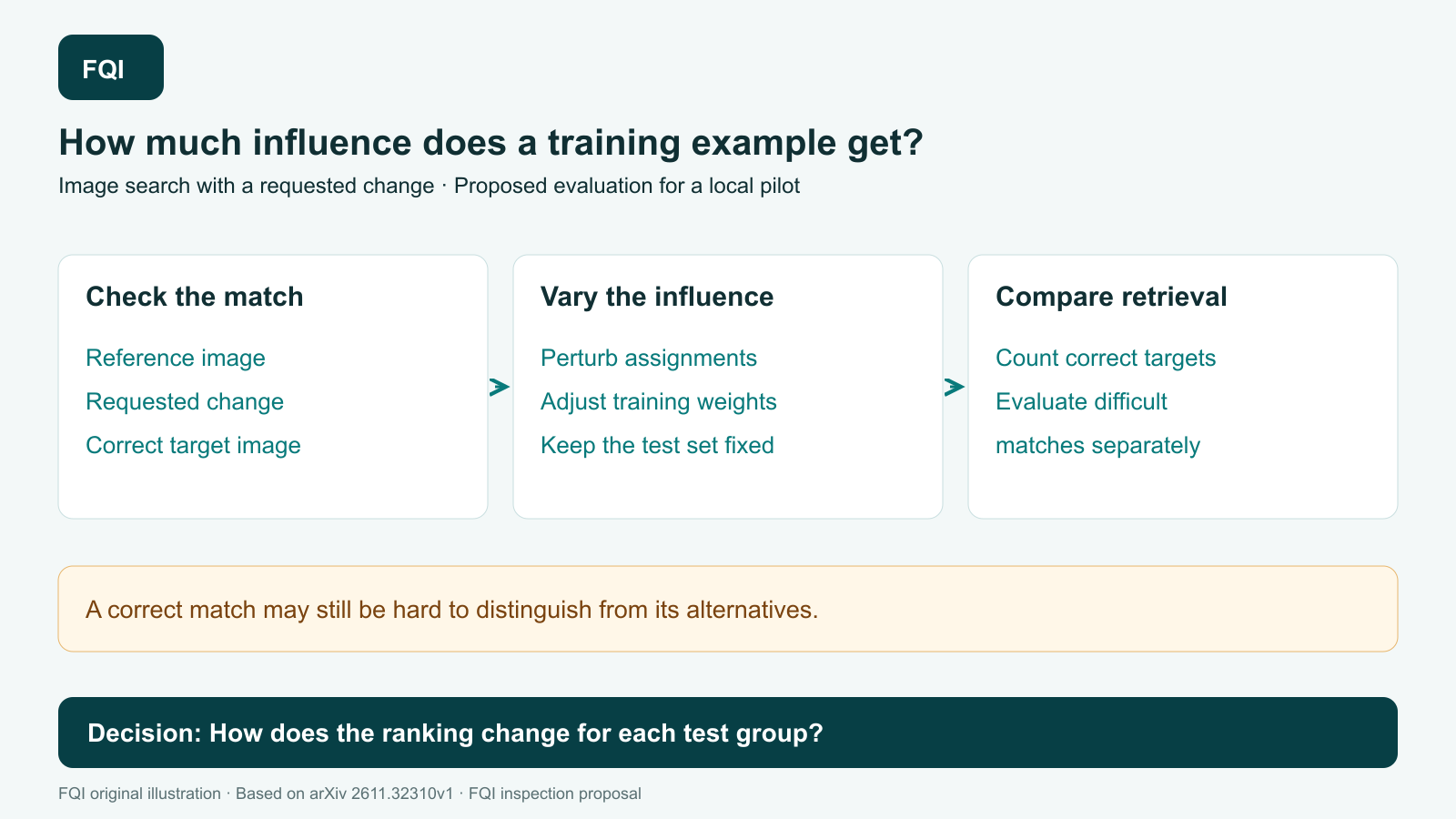
An FQI pilot could examine a search tool for documented damage cases. An inspector would supply a photograph and describe one distinguishing feature. Experts would first agree on valid reference, description and target combinations. The test set would be set aside, with subtle but operationally important differences flagged for separate assessment. The team could then disrupt assignments in training, keeping the test photographs and target decisions fixed across methods.
For each method, count how often the correct report appears within the number of results staff actually inspect. Repeat that calculation for the difficult confirmed cases. Inspect a sample of downweighted examples alongside their original case records. The review can show whether a rare but relevant feature was repeatedly discounted.
Limitations and risks
The experiments use two public datasets and artificial disruptions. Mistakes in workplace records may concentrate in particular groups. The main result tables do not show variation across repeated training runs, which limits interpretation of small differences. Neither benchmark measures industrial defect detection or the cost of missing a case. The proposed damage search pilot is an FQI application of the evaluation logic.
FQI conclusion
For a quality team, the decision is how much influence to give uncertain training assignments. CREDIT offers an experiment for that decision and a result that could otherwise be overlooked: reducing the influence of bad matches can also weaken the distinctions needed for difficult good ones. Before using a weighted training procedure, set a retrieval target that reflects actual work, verify the reference cases and inspect the groups where a missed match carries the greatest consequence.
Sources & transparency
Zhou et al., CREDIT · Full text of version 1. Sections 3–4 and Tables 1–3. Results come from the author preprint dated 24 November 2026. The workplace evaluation plan is an FQI proposal.
Codex assisted with drafting and checked the claims against the cited original sources. Johann Fischer authorized publication on 2026-11-25 following review by Codex. Individual human reading is not claimed.