
Executive summary
Additional preparation can make knowledge documents easier to read without improving the answers produced by artificial intelligence (AI). A recent preprint examines this distinction in a processing chain for recorded technical presentations. Human experts rate the fully revised question–answer pairs more highly, while measured answer utility does not improve accordingly. The practical decision for quality management is to require evidence for the intended purpose of each added processing stage. A better text score alone does not justify expanding the entire knowledge pipeline.
FQI takeaway
- Measure two outcomes: assess readability and technical text quality separately from the quality of subsequent answers.
- Test stages individually: switch transcript correction and subsequent revision on and off independently.
- Protect the comparison questions: derive test questions and reference answers independently of the optimised knowledge material.
The principle at a glance
A knowledge assistant finds relevant passages and supplies them to a language model as the basis for an answer. This is called Retrieval-Augmented Generation, or RAG. Several preparation stages may precede retrieval: speech recognition, correction, generation of question–answer pairs and their revision.
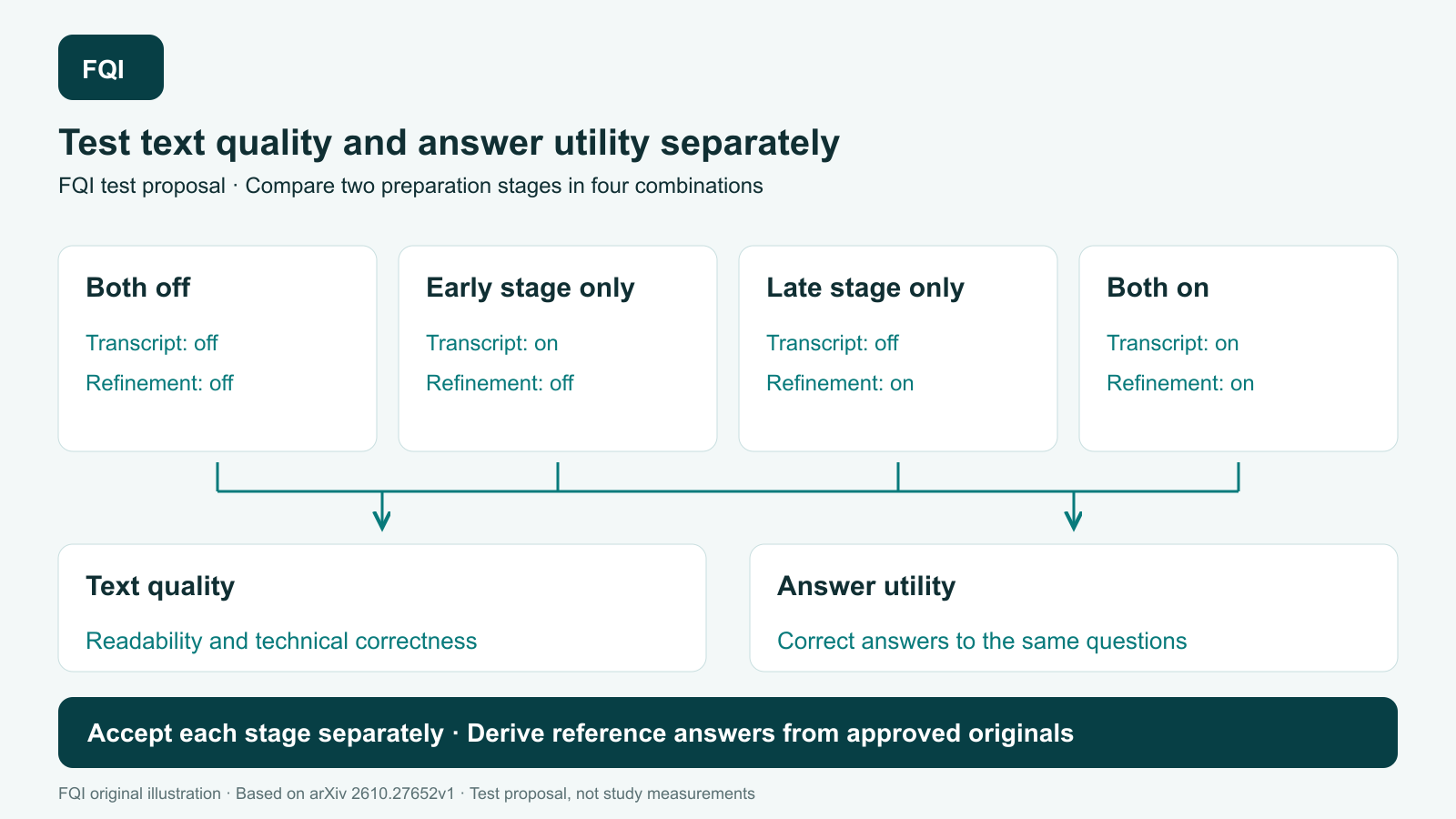
An ablation is a controlled comparison with selected components disabled. It reveals whether a particular stage helps. Four variants allow an initial assessment of two stages: neither enabled, only the first, only the second and both enabled. Other conditions should remain as similar as possible.
Terms explained
- AI: Artificial intelligence; systems that derive patterns from data or support tasks automatically.
- RAG: Retrieval-Augmented Generation; language-model output grounded in deliberately retrieved sources.
- NIST: The US National Institute of Standards and Technology.
Deep dive
The study uses 40 Korean conference sessions from medicine and finance. It varies transcript rewriting and later filtering or refinement of question–answer pairs. Four automated judges and six human experts assess a sample. Six smaller language models undertake the answer comparison with the same tasks. An additional filter limits wording overlap between reference answers and the knowledge corpus.
Combining both preparation stages improves mean text ratings by 0.18 points for automated judges and 0.22 for human experts on a one-to-five scale. Answer evaluation shows no corresponding utility gain. Transcript rewriting alone lowers answer performance in this setup. The small benefit from late filtering alone does not survive correction for multiple comparisons. These are findings from this experiment, not a general recommendation to remove transcript correction.
The following workplace test is an FQI proposal. A suitable pilot might be an assistant for internal work instructions. The process owner first specifies the questions it must answer and consequential errors: incorrect steps, overlooked applicability limits or unsupported numbers. Experts write reference answers directly from approved originals.
The team then prepares the four data variants. It records the model, search method, number of retrieved passages and answer instruction. Each variant answers the same held-out questions. Evaluation distinguishes technically correct answers, missing mandatory information and invented additions. A separate assessment of document quality remains useful but receives its own results report.
Individual cases in which revision changes a number, exception or condition deserve particular attention. Reviewers trace each case from the original through the processed passage to the answer. This helps locate the failure in rewriting, retrieval or answer generation and directs the corrective action.
Acceptance of a stage connects its benefit with execution time, cost and maintenance. A stage may help a handbook read by people while adding errors or overhead when the same content feeds an automated assistant. Decisions therefore need to be documented for each use. The voluntary National Institute of Standards and Technology (NIST) framework supports evaluations under representative conditions and regular assessment of the measurement methods themselves.
Limitations and risks
This unreviewed preprint is authored by staff of Flitto and examines clean recordings, one language and two domains. Correction could be more useful with noisy recordings. A rewriting model also changed during data production. The authors cannot attribute the early-stage penalty conclusively to a single cause. Their equivalence margin is a research choice, not an organisational acceptance threshold. FQI has not independently reproduced the results.
FQI conclusion
When introducing a knowledge assistant, the central question is which additional stage improves the actual work outcome. A bounded comparison can expose unnecessary processing as well as useful corrections. Reporting text quality, answer quality and effort separately supports targeted simplification or improvement. Value comes from an explicit, testable decision about each stage and its intended use, with responsibility for the comparison retained by the process owner.
Sources & transparency
- Corpus Quality Improves, Retrieval Utility Does Not, version 1; original full text. Read: sections 3–6 and 8–10, including limitations.
- NIST AI RMF 1.0, Core, MEASURE 2.3 and 2.13. Voluntary guidance, not evidence that the proposed pilot works.
Study findings and the FQI pilot are distinguished. AI-assisted translation; approved for publication by Johann Fischer on 2026-10-21.