
Executive summary
Experts can often correct a faulty text produced by artificial intelligence (AI) more easily than immediately specify the complete general rule behind their correction. ValiAssist studies how a system can translate such edits into visible, adjustable criteria. Its setting is feedback on programming exercises. The transferable FQI idea is a controlled learning step: one correction supplies a proposed rule whose applicability must then be tested on other cases. That testing turns the example into a useful reusable instruction.
FQI takeaway
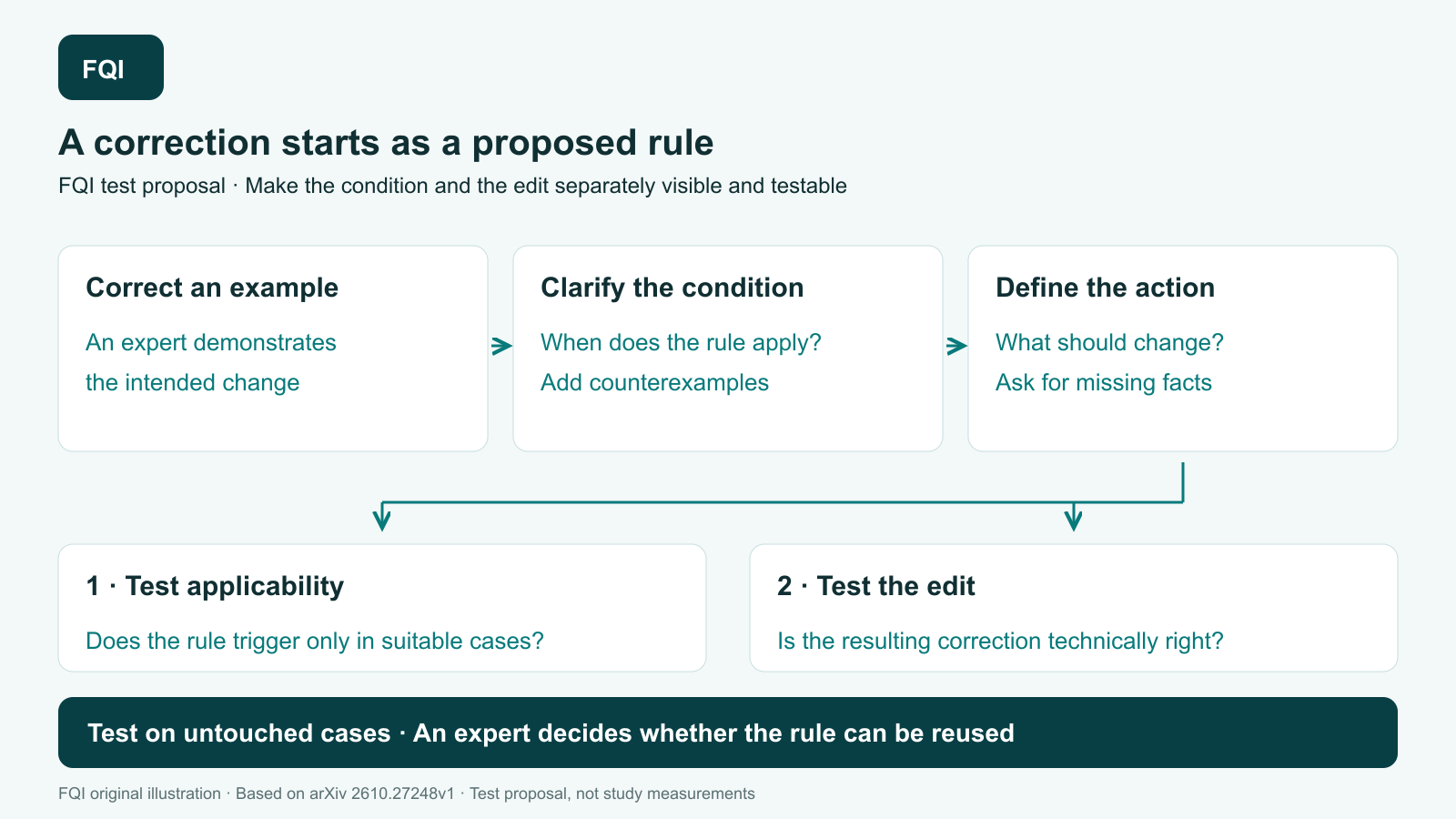
- Treat corrections as proposals: one observed edit does not establish a universally valid rule.
- Separate condition and action: show when a rule applies and what change it should trigger.
- Test counterexamples: specifically examine which correct texts a new rule might change unnecessarily.
The principle at a glance
The system lets instructors revise automatically generated feedback. It derives structured criteria describing conditions and desired changes. Instructors can then inspect which other texts a criterion affects and adjust it.
The core is an iterative sequence: edit an example, inspect the proposed rule, apply it to further cases and refine its scope. A language model supports inference and application. The expert’s intention, however, remains something the system must first understand correctly.
Deep dive
In a laboratory study, 16 participants with programming and teaching experience perform the same kind of review task using two system variants. Order is counterbalanced and randomly assigned. The comparison system uses criteria expressed only in natural language. Participants review previously generated feedback and revise criteria during the task.
In a sample, the studied variant improves agreement with the instructors’ own criteria: mean alignment is 0.91 versus 0.57. This measures satisfaction of those criteria, not objective pedagogical quality. A separate technical evaluation reveals an important limit: deciding whether an inferred criterion applies to a new case reaches accuracy of only 0.68. A good correction when a rule applies does not solve the applicability decision.
An FQI pilot could begin with preliminary checking of internal deviation reports. An expert team selects one narrow document type and records common corrections. For example, a statement about action effectiveness is revised because the reference period and inspection basis are missing. The system should infer a proposal that identifies missing information and prepares a focused clarification request.
The team first checks whether the proposal captures the intended meaning. Perhaps the requirement applies only to completed actions, whereas an interim report intentionally lacks an effectiveness conclusion. Applying the same change to every report would then be technically wrong. The condition must explicitly match document status and process stage.
The proposed rule then receives positive and negative reference cases. Positive cases require the change; negative cases must remain unchanged. Boundary cases are identified separately. The team evaluates both whether the rule activates and whether the proposed edit is correct. These results remain separate in the report.
Only afterwards is the proposal applied to a larger but still bounded collection. Experts inspect small groups of suggested changes with their rationale and rule version. They can reject individual edits and adjust scope. Automated revision must not invent new facts or evidence; missing information prompts, task instructions to a language-processing system a question.
A held-out test set finally checks whether the rule generalises beyond its starting examples. The results record includes overbroad application, missed corrections, false additions and actual review effort. Time savings are measured separately and cannot be inferred from better alignment with criteria.
Limitations and risks
ValiAssist is an unreviewed preprint with a small, short laboratory study. Tasks come from programming education rather than industrial document inspection. The central quality measure uses participants’ own criteria as its reference, so their technical suitability is not automatically established. Long-term maintenance, large collections and new error patterns have not been demonstrated in routine operation. A single edited example may also contain an exception that the model incorrectly generalises. FQI has not independently reproduced the reported results.
FQI conclusion
Corrections can yield useful inspection rules when the transition is explicitly controlled. Acceptance concerns two questions: does the rule activate for the right cases, and does applying it improve the text technically? A bounded pilot with visible conditions, counterexamples and held-out tests can address both. Automatic inference remains a proposal within an accountable change process. Any claim of reduced effort needs its own measurement alongside the evidence for better decisions.
Sources & transparency
- ValiAssist: Scaling LLM-generated Programming Feedback Validation by Demonstration, version 1; original full text. Read: sections 6–10, especially technical criterion testing, laboratory design, results and limitations.
The document-review pilot is an FQI adaptation. Study values were not independently reproduced. AI-assisted translation; approved for publication by Johann Fischer on 2026-10-21.