
Executive summary
A team of language-model agents can lose a request even when the task is simple and the communication channel delivers every message. CypherMAS isolates forwarding and return delivery by giving each request a known destination and a shortest route. The comparison reveals lost requests, duplicate traffic and unnecessary model calls. For a team assessing an automated workflow, it offers a way to test handovers before adding difficult domain decisions.
FQI takeaway
- Test delivery and return on a known route before introducing complex content.
- Count dropped requests, misrouting and duplicate work separately.
- Vary the arrangement of participants as well as the number of handovers.
The principle at a glance
Each participant has a coded message. A different participant holds the corresponding decoder. The owner needs to route the request through permitted neighbours and recover the decoded reply. The benchmark knows where every decoder is located. It can therefore establish what a successful exchange should achieve and how much communication would be sufficient under the specified protocol. A routing mistake can be investigated without first resolving a dispute about subject-matter expertise.
Deep dive
Eleven open-weight models were tested in four network arrangements. A chain and a ring become longer to traverse as the number of participants grows. A star and a network with two connected groups can keep the distance between participants short. Experiments extended to 25 participants and included both messages with specified fields and free-form text.
Structured communication did not improve success in every configuration. A fixed field can simplify interpretation while still leaving a model responsible for responding to every pending request. The authors found configurations in which only one of several incoming requests was processed. Other systems repeatedly circulated messages until the run reached its call budget.
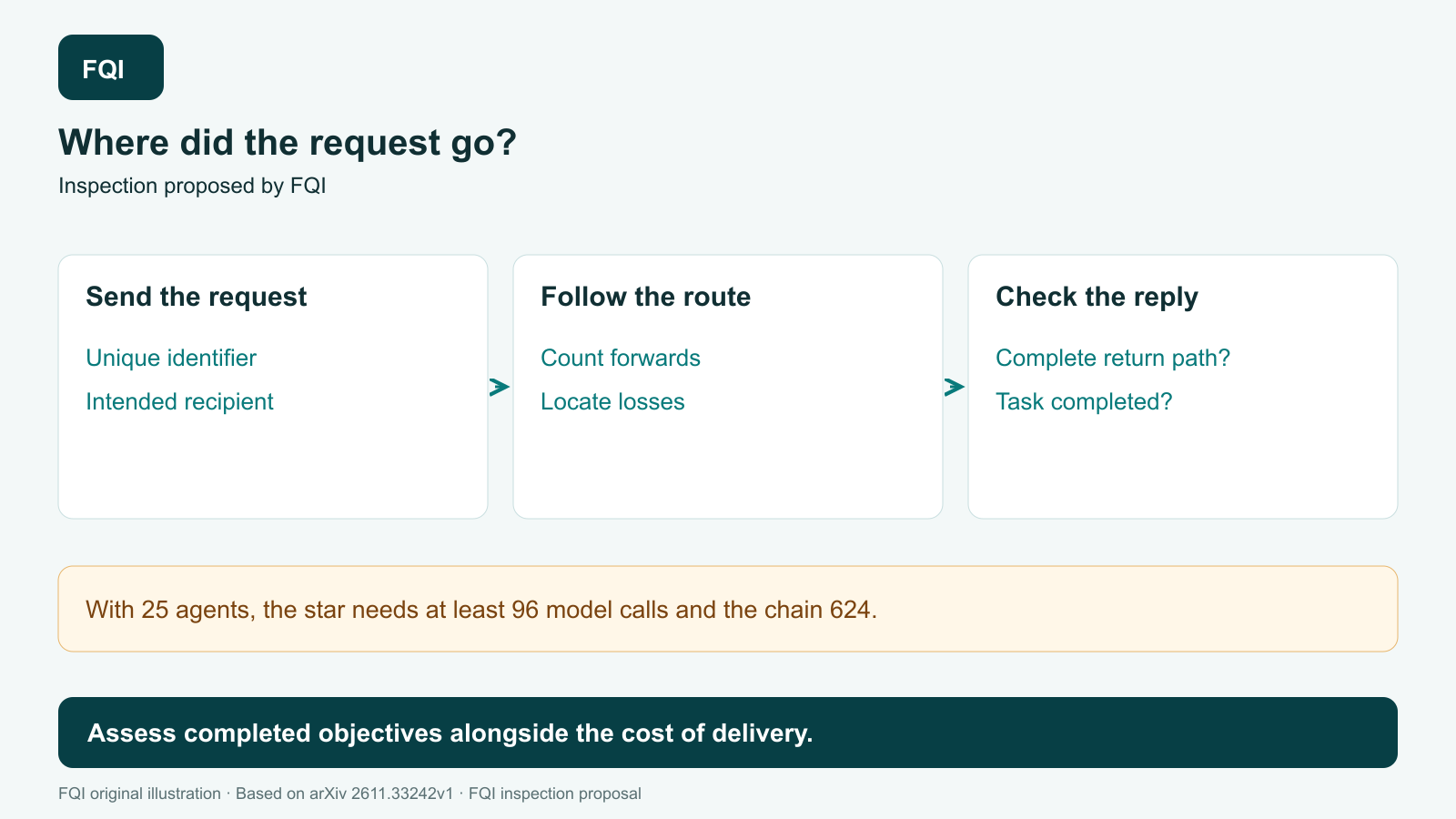
Success rate counts the fraction of agents that recover their own plaintext. It measures completion at participant level. A high rate leaves room for an individual request to remain unresolved. The cost comparison also needs the completion figure. At 25 agents the theoretical minimum is 96 model calls for the star and 624 for the chain. A system that makes fewer calls because it stops early has not achieved a saving on the full task.
For an internal trial, FQI would give a review agent a request with a unique identifier and an expected reply known to the tester. Two roles might forward it to a specialist. The observer records the original request, each forward, the specialist response and the return to the owner. A missing acknowledgement can then be located without relying on the participants’ own descriptions of success.
A second set of trials could add concurrent requests and delays characteristic of the intended service. Testing these changes separately would make it easier to distinguish problems in the routing protocol from congestion or ambiguous instructions. Report the number of completed, open and duplicated requests alongside the model calls required. Reassess the result when changing the arrangement of participants.
Limitations and risks
The benchmark used synthetic messages, noiseless delivery and synchronous rounds. It did not cover asynchronous external services, corrupted packets or hostile participants. There were three runs per configuration. Small differences between models therefore warrant caution. The reported trends do not establish a universal minimum model size for reliable routing or a general ranking of teams on real collaborative work.
FQI conclusion
A message can be accurate and still fail to reach the person or service that needs it. A known route makes that failure observable. FQI would use this test to qualify the handover mechanism and then evaluate the complete workflow with realistic content. Keeping the routing result available during the later review helps identify whether an incident requires better subject-matter decisions or a change to message handling.
Sources & transparency
CypherMAS: Benchmarking Routing Reliability in LLM-Based Multi-Agent Systems · arXiv v1
Author preprint v1. FQI checked the cited sections of the original study. Workplace examples and inspection proposals are FQI interpretations. The experiments were not independently replicated.
Codex drafted the texts and checked them against the original study. Johann Fischer authorized publication on that basis on 27 November 2026.